The Colony’s Dark Night
The Passage (Justin Cronin Edition)The Colony’s Dark Night is the catastrophe that marked the Colony’s beginnings and remained a defining wound in its history. The event is recalled through the losses it caused, the community’s lasting isolation, and the competing ways survivors remember what happened: as private grief, as a reason to fear newcomers, and as a past that must be recorded before it disappears.
The remembered catastrophe
In Peter’s recollection of the Colony’s history, Dark Night is the event in which Liza Chou and her family were lost, either killed or taken up. Peter remembers Liza from their childhood in the Sanctuary, where she had been one of the older children. Years later, when Alicia says she thinks she has seen Liza, that uncertain sighting brings the catastrophe’s unresolved losses into the present: Peter remembers the name, but not even whether Liza was killed or taken up.
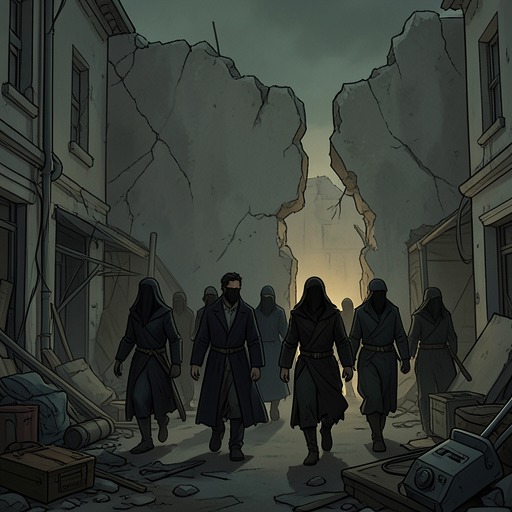
Auntie’s account of the First Night gives the catastrophe a broader communal frame. She remembers the children being taken to the Sanctuary and told that its lights and walls would protect them until the war was over. The promised return of the Army, with more children and soldiers, never came. After the buses and trucks left, the gates were sealed; the lights came on so brightly that they blotted out the stars. Auntie and Terrence stood outside together, understanding that this was where they would live from then on. In her memory, the beginning of life inside the Colony is inseparable from the loss of the world beyond it.
Losses carried across generations
The catastrophe’s consequences persist in individual lives as well as in the Colony’s origin story. Auntie remembers people who died, including Terrence, who was taken up at twenty-seven, and Lucy, who died in childbirth. She also remembers those who ended their own lives, whose absence remains especially difficult for her to think about. The people of the First Night have mostly been dead or taken up for so long that their names have faded from common memory; Auntie’s recollection resists that erasure by holding particular people and losses together.
The dead and missing are not only a matter of the past. When Sam Chou blames the Walker girl for the deaths of eleven people and calls for her and Caleb to be put out, fear turns the Colony’s history of loss into an argument for expulsion. The crowd takes up his demand in a growing chorus. Peter sees that the community’s restraint has given way and that the scene is on the verge of violence. Dark Night’s remembered danger thus becomes part of the logic by which frightened survivors judge a new crisis, even when the girl’s responsibility has not been established.
Memory as a record
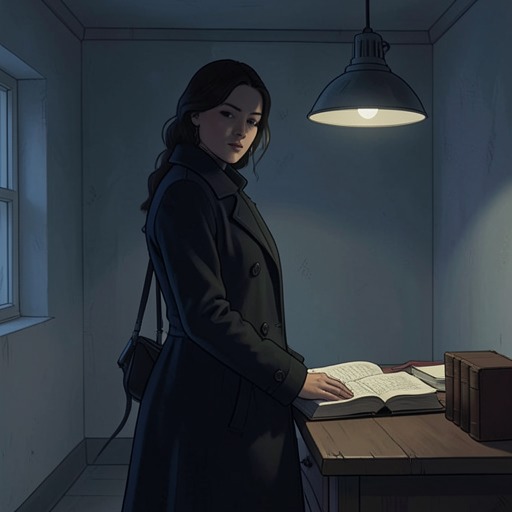
Auntie treats remembrance as work that would otherwise go undone. She writes not only how the community came to live in the Colony, but also about the Time Before and the people who have since died or been taken up. Her memory book is a handmade volume wrapped in lambskin, filled with small handwriting made with a crow feather and homemade ink; she makes its paper from boiled sawdust, forming sheets on old window screens. The material care of the book answers the fragility of the history it holds: individual names and experiences can vanish unless someone records them.
Auntie says she writes about the world before, the train that brought them to the Colony in the fire, and the people she remembers, so that someone may someday want to know what happened there. Her account also establishes the emotional limits of remembering: she describes missing people, but says the hardest memories are of those who chose to end their lives. The archive preserves grief without making every loss equally speakable.
A history told in layers
The event reaches the reader through recollection rather than a single complete account of the catastrophe itself. Peter’s uncertainty about Liza and Auntie’s personal memories preserve different scales of the past: one childhood acquaintance whose fate remains unclear, and a community formed by isolation and repeated loss. Later, Sara Fisher’s journal is presented as a document at a conference devoted to the North American Quarantine Period, placing a survivor’s account within a future effort to study and transmit the period’s history.
This layered telling makes Dark Night more than a past disaster. The Colony’s present fears, its endangered sense of order, and Auntie’s painstaking record all bear its imprint. The catastrophe has not been reduced to a settled public explanation: its people survive in stories, some named and some nearly forgotten, and the act of preserving those stories becomes part of how the community understands what it has endured.