The Colony’s breakdown
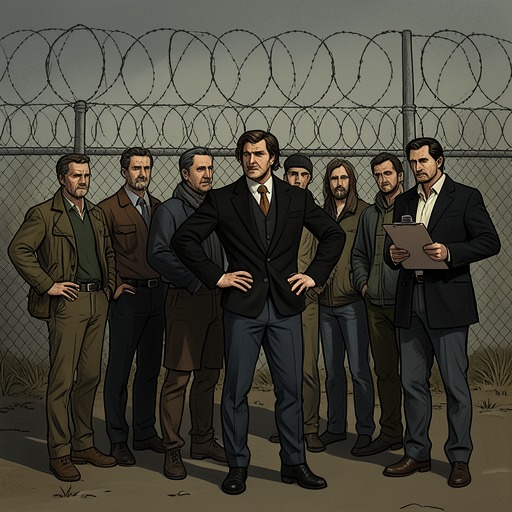
The Passage (Justin Cronin Edition)The Colony’s breakdown is the disintegration of a community’s fragile order under fear and pressure. The crowd’s killings of Mar Curtis and Elton make the collapse public and irreversible; the Watch’s effort to recover control and Peter’s group’s wary retreat show how little authority remains. In the episodes surrounding it, private grief and moral injury echo the same broader pattern: people inherit disastrous choices, and the consequences fall on those with the least power to resist.
From accusation to mob violence
The immediate eruption follows a crisis that the crowd associates with the girl, Alicia, Caleb, Peter, Michael, and Jacob Curtis. At the gate, Gloria Patal demands that her daughter be brought back and that the others be killed. Her rage overturns Galen’s assumptions about her, while the gathering’s shouting and gestures make clear that blame has already displaced deliberation. Sanjay, whom Galen imagines might have calmed the crowd, is absent in the Infirmary, where he is described as babbling and weeping. With no moderating voice present, accusation hardens into a demand for punishment.
The crowd then seizes Mar Curtis, although she is not the person it truly wants. A mass of people carries her up the ladder and throws her over the Wall, cheering as she is killed. The violence does not satisfy the gathering: Hodd Greenberg names Elton, who had been with the others in the Lighthouse, and the crowd rushes there. Elton, an old and blind man, is also taken to the Wall and thrown over. The sequence turns an initial act of collective violence into a pattern; each victim makes the next seem easier, and Galen senses that the crowd has only just begun.
The Watch loses its authority
Galen keeps quiet as the crowd acts, aware that his wife Mausami may also be implicated and that he could become a target himself. Ian eventually gives an order, not because Galen believes pursuing the fugitives makes sense, but because the Watch needs to maintain at least the appearance of control. Galen is the only Second Captain left; the others are dead. The public killings thus expose both a political and a practical vacuum: the institution that should restrain violence is reduced to preserving its image while the crowd dictates events.
Ian sends Galen after the group and tells him about twelve crates of guns concealed behind a wall in a storage room. His instruction separates the operation’s immediate objective from the crisis’s emotional center: he says he does not care about the Walker and leaves Galen’s wife to Galen, but insists that the guns be brought back. The five-person party—Galen, Emily Darrell, Dale Levine, Hodd Greenberg, and Cort Ramirez—is poorly matched to the assignment. It is Galen’s first command outside the Wall, yet his party includes a sixteen-year-old runner, a man he distrusts, and two people who are not even Watch members. His appointment signals how thoroughly the old command structure has been depleted.
Fear beyond the Wall
As the party rides through Banning, Galen sees a town of collapsed buildings and abandoned, desiccated bodies. The landscape outside the Wall reinforces the Colony’s dependence on rules meant to keep danger at a distance. From childhood, Watch members have been drilled in the maxim that an attacker comes from above, but Galen recognizes that this instruction offers little protection if he himself is exposed. The trained formula persists even as confidence in its usefulness gives way to dread. The colony’s breakdown therefore extends beyond the gate: its inherited habits still organize thought, but no longer guarantee safety or shared purpose.
Withdrawal under watchful eyes
Later, Peter and Alicia leave Olson’s gathering and move through the settlement toward their quarters. The huts are quiet, the party shed is deserted, and the buildings are dark. Peter senses that residents are watching from their windows. Alicia tells him not to look and to keep walking; her warning confirms that their unease is shared rather than imagined. When they return, Sara is anxiously waiting, and Peter reports their conversation with Olson. The scene makes the breakdown intimate: public disorder has given way, for a moment, to silence and surveillance, but the community no longer feels like a place where people can move without scrutiny.
The danger becomes immediate when Caleb asks whether they are leaving and what will happen to the Circuit. Peter insists they will not go without him and tells him to go. Caleb runs out, returns, and reports that the others are gone. Peter and Alicia exchange a look, recognizing that something is happening and that they must move quickly. Their response is not to restore the Colony’s institutions but to act within a shrinking window, relying on one another as the surrounding order becomes less dependable.
A wider pattern of moral injury
The Colony’s public violence resonates with Wolgast’s earlier reckoning about how people arrive at ruin. In his reflection, a life can become a chain of mistakes, many borrowed from other people and adopted as one’s own. He connects that recognition to his work with Anthony Carter and to the loss of his daughter Eva, who died three weeks before her first birthday. Since then, he has felt like a living dead man, carrying the empty space left by her absence. His account does not explain the Colony’s uprising, but it gives the novel’s repeated failures a moral dimension: harmful decisions accumulate through imitation, loss, and compromised judgment rather than appearing as isolated exceptions.
Other moments sharpen that pattern without making the circumstances identical. Hollis recognizes his infected brother Arlo only as he fires the crossbow; the key at Arlo’s neck and the look in his eyes make the shot an act of mercy and an irreversible killing at once. Peter, meanwhile, understands that giving Amy up is a choice made in gratitude rather than surprise or regret. These scenes place responsibility under extreme pressure: love does not prevent harm, and recognition may arrive too late to undo an action. Against that background, the Colony’s breakdown is more than a riot or a failed command. It is the point at which fear converts the language of protection into punishment, while individuals struggle to retain responsibility and care amid a community that can no longer reliably uphold either.