The Wall
The Passage (Justin Cronin Edition)The Wall is the Colony’s defensive perimeter: a fortified boundary that keeps the virals outside and organizes the community’s movement, watchfulness, and sense of safety. Its importance becomes clearest when the lights fail. In darkness, a breach turns the barrier from protection into a point of entry, and the rules meant to defend the Colony collide with the urgent need to save a person outside it.
Definition and Place in Colony Life
The Wall is more than a physical enclosure. It separates the Colony from the dangerous ground beyond, while its catwalks, ladders, firing platforms, gate, and watch posts give the community a system for observing and responding to threats. People are stationed above the perimeter, runners report what they see, and movement through the gate is governed by strict rules. The Colony’s security therefore depends not only on the barrier itself, but on the people who monitor it and the systems that allow them to see and act.
That dependence is made explicit in a discussion of the future. Peter asks what might happen when the lights go out or no one remembers how to repair them. Theo answers that staying alive means keeping the lights on for as long as possible. His concern links the Wall’s defensive function to the Colony’s electrical infrastructure: the barrier can remain standing and still fail as protection if darkness prevents the Watch from responding effectively.
The Watch’s routine also reaches beyond defense. The community’s daily life is described as existing under the Watch’s protection and the Household’s authority, without the Army. The Wall is thus part of a local political order as well as a fortification: it helps define who guards the Colony, who governs it, and how the inhabitants try to preserve their lives in isolation.
A Breach During the Power Failure
During a later attack, a power surge flips the main breaker while Michael Fisher is briefly away from the Lighthouse, manually resetting a vent on the battery stack. The outage lasts less than three minutes. Michael races back through the darkness and restores the system, but that short interruption is enough for the Wall to be breached. Ian explains to the gathered Colony that Michael had no reason to foresee the surge, and that leaving the Lighthouse to vent the stack was proper; the failure is presented as a sudden vulnerability in the system, not a deliberate lapse by the engineer.
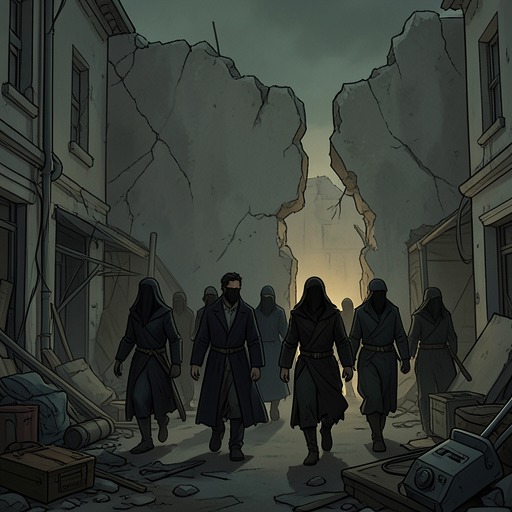
The attack unfolds in separate groups. A large pod gathers at the fireline, and three people, including Jimmy Molyneau, Soo Ramirez, and Dana Jaxon, are later found to have been taken. A second pod approaches the Wall near Platform Six, drawing the Watch toward the attempted ascent. While attention is concentrated there, a third pod, or a part of the second, makes it over the Wall near the unmanned Platform Nine and comes down the catwalk. The layered defenses do not prevent the incursion: the Watch is pulled toward one point, and another is left exposed.
The aftermath makes the breach’s human cost concrete. Gar Phillips, Aidan Strauss, and Kip Darrell are killed in the fighting; Sunny Greenberg and Old Chou are missing and presumed lost. No virals are reported killed. At first light, the Household declares a civil emergency: activities beyond the Wall are suspended, the herd and the crews remain inside, and the gate is to stay closed. Caleb is sent to the lockup, but the Household postpones a sentence amid the fear and uncertainty following the deaths.
The Colonel’s Death and the Girl at the Gate
The Wall is also the setting for a later night of violence. The Colonel, who had been absent for days, is seen on the catwalk near Firing Platform Three shortly after half-night. He stands unarmed, fingering his necklace of teeth and looking out over the empty field. After a few minutes he disappears; a runner later claims to have seen him descending toward the pens. When he is next seen, he is running across the field toward three virals. They overwhelm him, and people above the Wall release arrows, but the distance is too great to reliably stop them. The witnesses watch him die.
A girl then emerges from the shadows and runs toward Main Gate. At first, people on the Wall mistake her for another viral; in the confusion, arrows and bolts are fired, and one strikes her shoulder. Alicia recognizes that the figure is human and orders the Watch to hold fire and get ropes. With the person authorized to order an excursion beyond the Wall absent, Alicia does not wait for permission: she climbs onto the rampart, descends by rope, and runs across the ground below. The gate is the only available way back inside with the wounded girl.
The episode brings the Colony’s rules into direct conflict with rescue. Opening the gate at night is prohibited, even for Alicia, and the people inside hesitate. Peter arrives as Caleb reaches the wheelhouse first. Caleb releases the brake; the gate’s weights begin to descend, making the opening difficult to reverse. Peter and others seize the wheel and try to close it, but one viral enters before the doors shut. Caleb’s action later becomes the basis for implicating him, while Peter is cleared of blame. The attempt to save the girl therefore brings a new threat across the same boundary designed to keep threats out.
Protection, Vulnerability, and Meaning
The Wall’s defenses depend on more than stone and gates. They require functioning lights, coordinated watch posts, working machinery, and decisions made under pressure. The brief outage shows how an electrical failure can undo the advantages of a perimeter; the attack near Platform Nine shows how attention drawn to one breach can leave another route exposed. The gate rescue, meanwhile, reveals the human cost of treating the boundary as absolute: Alicia must cross it to help the wounded girl, and opening it allows a viral through.
The Wall therefore holds together the Colony’s opposing needs for protection and compassion. It gives the inhabitants a defensible limit, but it cannot make them invulnerable or decide when its rules should yield to an emergency. After the breach, the community’s response is to suspend outside activity and keep the gate shut; after Alicia’s rescue, the gate itself becomes the instrument through which danger enters. Its repeated role in defense, loss, and rescue makes the Wall a measure of the Colony’s precarious security: the barrier can preserve life only when its people, machinery, and judgment hold together.