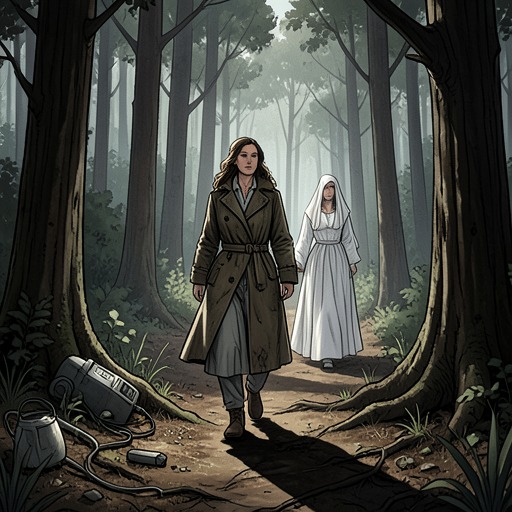
Whether Virals Still Have Souls
The Passage (Justin Cronin Edition)Whether Virals Still Have Souls names a contradiction at the center of the Colony’s understanding of infection: its official teaching declares that the virus takes a person’s soul, while the infected repeatedly return to the place they once called home. Peter’s question does not resolve what survives after infection, but it exposes the limits of a doctrine that treats the infected as wholly emptied of personhood even when their actions appear to carry traces of human attachment or memory.
The Colony’s Account of Infection
The Colony teaches its children that the infected are not vampires from old stories but people changed by illness. Ida Jaxon recalls being frightened when her mother explained that the attackers called jumps had once been people like her and her family. Her father, Monroe Jaxon III, rejected the comparison to fictional vampires: whatever name people used, he insisted, the danger was real. The terminology varies, but the basic recognition remains that the infected were human before the virus transformed them.
That recognition coexists with a sharper doctrine about what the transformation means. When Peter Jaxon leaves the Sanctuary at eight, Teacher explains the accepted account: a tiny virus enters through a bite, usually at the neck, steals the soul, and leaves the body to walk the earth indefinitely. The former person, according to this teaching, is gone. The explanation is presented not as an open question but as the foundational truth from which the Colony’s other beliefs follow.
The Sanctuary’s secrecy rules help preserve this system of belief. Children are kept within its walls until their eighth birthdays and are forbidden to learn about the Virals, the Watch, or the Great Viral Cataclysm while they are minors. Their first formal knowledge of the infected therefore arrives within an institution that controls what they may know about the world outside the Colony. Peter’s later uncertainty emerges against that background of carefully managed instruction.
The Return and the Mercy
The Colony’s practice of the Mercy gives Peter’s question its immediate force. When someone is taken by the Virals but has not been confirmed dead, relatives wait for the person to return. The customary vigil lasts seven nights; if the missing person does not come back, the family’s hope ends, the name is placed on the Stone, and belongings are sent to the Storehouse for repair and redistribution. Peter stands watch for Theo Jaxon on the final night, as Theo had once stood for their father, Demo Jaxon.
The returns follow a pattern that unsettles any simple account of the infected as beings with no remaining connection to human life. They may come back after three days, five days, or a week. Many are Watchers, riders, or workers taken outside the walls while scavenging, tending the herd, repairing equipment, or hauling refuse. Some return fully transformed; others arrive while still in the Quickening, sick and disoriented. The danger varies, but the act of returning is sufficiently familiar that the Colony has made a ritual around receiving the missing and, when necessary, ending their lives.
Many of those who reach the gate do not resist. They stand beneath the lights, blinking and waiting for the shot. Peter considers whether some remnant of their humanity might remain enough to make them want to die. That possibility is not established as fact; it is his attempt to interpret conduct the Colony’s doctrine cannot fully explain. The Mercy thus holds two judgments together: the returnees are dangerous, but their arrival is also treated as a final encounter with someone who once belonged to the community.
Peter’s Doubt and Its Stakes
On the seventh and final night of Theo’s Mercy, Peter watches the herd pass through the gate and sees Sara Fisher turn back for a lamb that has wandered near the fireline. After securing it and lifting it onto her horse, she meets Peter’s eyes before riding away. The ordinary care of the scene—an animal briefly separated from the herd, a person retrieving it—frames the much more terrible separation at the center of Peter’s vigil. His brother may return, or may already be dead; the Colony’s ritual can prepare for either outcome but cannot answer what infection leaves behind.
Peter’s reflection begins from the inherited claim that a Viral has no soul, yet it presses beyond that claim. If the transformed always come home, he wonders, is their return a last memory of the person they were, a farewell, or evidence that something persists? He knows the accepted explanation as well as anyone. The question matters precisely because he is not ignorant of it: he has been taught that the soul is gone, and still the observed pattern of return keeps the question alive.
The issue remains unresolved in these scenes. The returns do not prove that the infected retain a soul, and the Colony’s teaching does not explain why they come back. Instead, the repeated homecoming puts doctrine and experience into direct tension. Peter’s attention to that gap makes the infected more than a category defined by danger: without denying the threat they pose, he asks whether the person declared absent may not be entirely absent after all.