the Watch
The Passage (Justin Cronin Edition)The Watch is the First Colony’s organized defense force and one of its Seven Trades. It guards the Wall, holds the Colony’s firearms and other weapons in a protected armory, and stands between the settlement and the infected outside. Its formal structure gives the community a means of collective defense; its members’ experiences reveal the cost of maintaining that defense, and the danger of letting fear turn protection into exclusion.
Identity and Organization
The Colony’s founding rules recognize the Watch as a Trade equal to the other branches of work. Its minimum establishment consists of one First Captain, three Second Captains, fifteen full Watch, and an undetermined number of runners. The arrangement defines a hierarchy and an operational workforce rather than a loose group of armed residents: captains lead, full Watch serve at their posts, and runners move through the defensive system.
The Watch also controls the Colony’s weapons. Firearms and piercing weapons—including longbows, crossbows, and blades longer than ten centimeters—must be kept in the armory under its protection. This rule makes the Watch responsible not only for using force against threats, but also for regulating who can access the means of force inside the walls. The same institution that defends the community is therefore entrusted with a central piece of its internal security.
The Wall and the Work of Defense
A Watch member’s service is visible in the Colony’s daily rhythms. Peter Jaxon, twenty-one and serving as full Watch, takes his place on the Wall as his brother and father had before him. His assigned post is a firing platform on the catwalk, one of fifteen along the rampart. The setting makes defense a repeated, collective task: armed members take shifts, occupy distributed positions, and answer the calls that bring them to the Wall as evening falls.
The night shift includes fifteen people carrying crossbows and longbows, while Alicia Donadio gives orders from below and runners move between the firing posts. The Watch’s defensive capacity depends on this coordination. Its members are not simply positioned to meet an attack; they are part of a system in which weapons, posts, leadership, and communication have to work together.
Peter’s particular watch has an additional personal purpose. He has spent six nights holding a post alone, waiting for his brother Theo to return. A crane and ropes at the platform could lower him to the base of the Wall if Theo appeared. Alicia has remained nearby through the vigil, ready to ride down with Peter if the moment comes to do what needs to be done. The Watch’s duty to defend the Colony thus intersects with family loyalty and the practice of the Mercy: guarding the boundary can also mean preparing for the return of someone who may not be safe.
Training, Rank, and Exemplary Service
Alicia’s career shows how the Watch trains and advances its members. After losing her parents, John and Angel Donadio, she is taken into the Colonel’s care. He teaches her what he learned in the Darklands, including how to fight and how to face the possibility of death. At eight, Alicia apprentices to the Watch; by fourteen she is a runner, moving between firing platforms. Her skill soon exceeds the limits of that role.
When six virals enter over the south Wall, Alicia is supposed to sound the alarm and run rather than engage. Instead, she defeats three of them single-handedly, using a throwing blade, a crossbow, and a knife, and drives the rest back over the Wall. Her action establishes her reputation and changes her standing: she remains in the Watch, and by twenty she has become a Second Captain. Members expect her to succeed Soo Ramirez as First Captain when Soo steps down. Alicia’s three blades, which she has worn since that decisive encounter, mark a personal practice shaped by the moment her service moved beyond the duties expected of a runner.
This record gives the Watch a model of competence, but also exposes the tension between rules and judgment. Alicia’s extraordinary defense begins with disobedience to her assigned task. The episode does not erase the chain of command; it shows that the survival of the Colony may depend on someone recognizing when the ordinary instruction to retreat is insufficient.
Authority Under Pressure
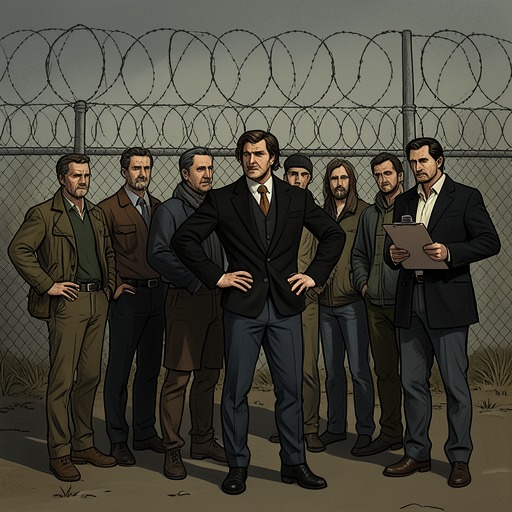
The Watch’s authority is tested when the Colony faces deaths blamed on the arrival of a Walker girl. In a public gathering, Sam Chou argues that the girl and Caleb Jones should be put outside the walls. Peter answers that the people do not know whether the girl is responsible, but fear and anger begin to overwhelm that uncertainty. Voices rise into a repeated demand to put them out, while Ian Patal tries to quiet the crowd. Peter sees the scene approaching violence and the appearance of order falling away.
The Watch’s position in this crisis is significant even where the excerpt does not establish a final institutional response. Sam explicitly invokes the Watch’s inaction as the reason residents should organize themselves, turning a defensive force’s perceived silence into an argument for mob action. The dispute pits the community’s fear against the need to establish responsibility before punishing the vulnerable. In this way, the Watch’s mandate to protect the Colony is tested not only at the Wall but within it: defense can fail if public danger is answered by scapegoating.
Narrative Significance
The Watch links inherited service to the Colony’s political order. Peter’s place on the Wall connects him to generations of Jaxons, while Alicia’s rise from apprentice to Second Captain shows how skill and courage can earn authority within the same institution. Its rules also clarify the Colony’s bargain: weapons are centralized, defense is organized as communal labor, and service is structured by rank and duty.
At the same time, the Watch’s scenes resist a simple ideal of disciplined protection. A vigil for a returning brother, a runner’s decision to fight, and a crowd demanding the expulsion of a suspected outsider each test what keeping people safe means. The Watch stands for the Colony’s defenses, but the narrative measures those defenses by more than their strength: it asks whether order can protect people without surrendering judgment to fear.