Army of the Republic of Texas
The Passage (Justin Cronin Edition)The Army of the Republic of Texas is the military force of an independent Texas in the fractured post-collapse world. Its existence marks the disappearance of the former U.S. Army and the rise of a regional state able to convert seized military assets, oil, electricity, and fortified supply lines into a substantial and comparatively powerful refuge.
Identity and Command
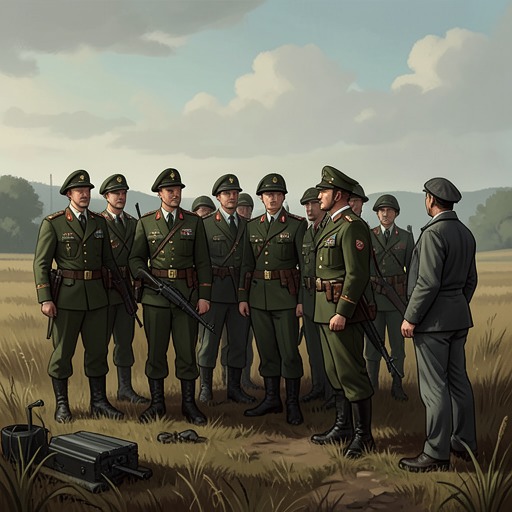
The Army of the Republic of Texas is introduced through Major Greer’s explanation to Peter Jaxon: the soldiers accompanying Greer are not the old U.S. Army, because that institution no longer exists. They belong instead to Texas’s own army. A hand-cranked radio carried by Corporal Muncey underscores the force’s practical, improvised means of communication, while its armed personnel and chain of command give it an organized military presence.
At the garrison, Brigadier General Curtis Vorhees identifies himself as a senior commander of the Second Expeditionary Forces, Army of the Republic of Texas. His introduction places the travelers under the authority of an established command structure, with Greer serving as a major and Vorhees asserting direct control over the base.
Independence and Material Foundations
Vorhees traces Texas’s political separation to the period when California also declared independence. In his account, the federal government’s war against the infected had devastated major Texas cities, including San Antonio, Austin, and El Paso. Texas, he says, was comparatively overlooked as California’s secession became a bloodbath and the federal military fell apart.
The governor seized the military assets available as the old Army disintegrated, moved the capital to Kerrville, and fortified it. Oil became the decisive foundation of the new polity: Vorhees describes approximately five hundred million barrels held in underground salt domes near Freeport, part of the former Strategic Petroleum Reserve. In his formulation, oil supplies power, and power makes electric lighting possible. The account makes Texas’s independence more than a political declaration: it rests on control of energy and the capacity to maintain the systems on which a defended settlement depends.
Territory and Scale
Vorhees contrasts Texas with the Colony, which is also walled but has far fewer resources. Texas, he explains, has more than thirty thousand people inside its walls, over fifty thousand acres under irrigation, and a fortified supply line to an operating refinery on the coast. Those figures establish a society with agricultural production and an energy network, not merely a military outpost.
His description is not an assertion that all of Texas is safe. Much of the state remains dangerous or damaged: he singles out Houston as polluted and infested, and describes other major cities as devastated by war. The fortified center and its supply system therefore coexist with a hostile wider landscape; Texas’s strength is substantial, but unevenly distributed.
Encounter with Peter’s Party
The Army enters the travelers’ story through their arrival at the military base and their meeting with Greer and Vorhees. Vorhees is struck by the claim that Peter’s small party has walked all the way from California, a distance that emphasizes the gulf between the isolated communities and the larger political world beyond them. The travelers’ arrival turns the Texas force into a point of contact between the Colony’s local understanding of survival and a broader regional order.
The exchange also revises Peter’s sense of the world. The old national military has not simply vanished into universal disorder: it has been replaced, in Texas, by a force that inherited weapons and other assets, asserted sovereignty, and built a fortified system around energy and food. The Army of the Republic of Texas thus represents both the political fragmentation of the former Union and the possibility that organized power can persist after it.