Battery Stack
The Passage (Justin Cronin Edition)The Battery Stack is the First Colony’s indispensable but failing reserve of electrical power: three salvaged units that have kept the settlement supplied with energy long after the world that made them disappeared. As their cells decay beyond repair, the batteries cease to be background infrastructure and become a measure of the Colony’s remaining time. Michael’s diagnosis makes their material limits a communal threat: turbines may continue to turn, but without a functioning stack to store and regulate their current, the lights—and the society organized around them—cannot endure.
Definition and Place in the Colony
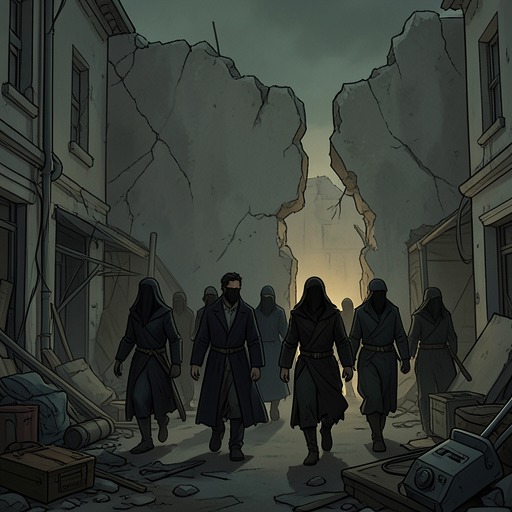
At the base of the cutout between the Colony’s north and east walls, in a zone of perpetual shade, the Battery Stack stands beyond the last houses of the North Quarter and the Big Shed. It consists of three gray masses of humming metal, wrapped in wire and pipe and still resting on the sunken wheels of the semi-trailers that hauled them up the mountain in the Time Before. The stack is not an abstract power source: its bulk, placement, and salvaged transport equipment preserve the physical history of how the old world’s machinery was brought into the settlement.
The batteries sit within a landscape Peter knows in intimate detail. From the Long Path, Old Town, and the Armory to the Household’s meeting plaza at Sunspot, the Sanctuary, fields, barns, greenhouses, and Storehouse, the Colony is a network of inhabited spaces and daily work. The stack serves this whole lived-in world from its shaded position at the settlement’s edge. Its failure therefore threatens more than a machine or a single building; it endangers the conditions that make the Colony’s ordinary life possible.
Operation and Dependence
The Colony’s wind turbines can keep turning, but the Battery Stack is needed to store and regulate the current they produce. That distinction makes the system vulnerable even when its energy source remains available: one windless night could be enough to expose the consequences of batteries no longer able to do their work. The stack has endured far beyond its expected service life, but the age that once made its continued operation seem miraculous has become the source of its danger.
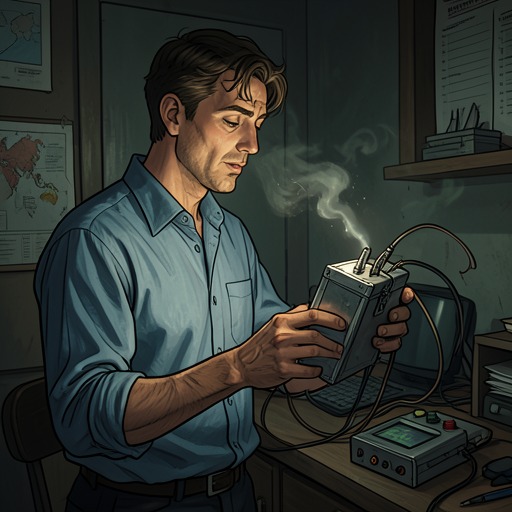
Michael sees the deterioration in the monitor’s green bars on his old, battle-hardened CRT. The cells were designed to last perhaps thirty or fifty years; nearly a century after the old world, they can still hold some charge, but their performance is no longer reliable. The monitor registers the failure not as a single spectacular breakdown but as a small, recurring disruption in the Colony’s day-to-day life, a technical warning that the familiar flow of power is becoming less dependable.
Michael’s Diagnosis and the Countdown
Michael establishes that the batteries cannot be restored by ordinary repair. Gaskets can be retrofitted, corrosion cleared, and controllers rewired, but these measures are only temporary work: the membranes themselves have failed. Their polymer pathways are clogged with sulfonic acid molecules, leaving the essential components beyond repair. The units were built to be replaced, not fixed, and the Colony has no replacement stack. Michael can imagine only an impossible return of the U.S. Army carrying a new one from a factory.
His forecast is stark. He expects the lights to fail within a year or two at the outside. Later, when he gives Elton a more immediate assessment, he specifies that number five is in the worst condition, numbers two and three are somewhat better, and numbers one and four show irregular charge. That morning, the charge is twenty-eight across the board, and it has never risen above fifty-five by First Bell. Elton translates these readings into a nearer timetable: brownouts within six months and total failure within thirty. The difference between the longer estimate and Elton’s operational projection does not erase the direction of the evidence; both describe an approaching end to reliable power.
Secrecy and Consequences
Before the condition becomes a discussion with Elton, Michael has told only Theo. He has not told Gabe Curtis, nominally the head of Light and Power but largely withdrawn since becoming ill, nor Sanjay, Old Chou, or even his sister Sara. Michael and Elton have effectively been left to run the shop. His decision to confide in Theo makes the impending failure a burden carried privately before it becomes a public crisis: Theo is Michael’s friend and part of the Household, and Michael may be hoping he will help explain the news when it can no longer be withheld.
The prospect is especially severe because Michael understands that he may have to announce it to the entire community: the lights will go out, and there will be no repair that can prevent it. His imagined announcement reduces the Colony’s future to darkness and the deaths that may follow. The Battery Stack thus binds technical diagnosis to social responsibility. Michael is not simply watching a machine fail; he is anticipating the moment when he must tell people that the system supporting their lives has no remaining remedy.
A Machine Against Time
The stack’s decay belongs to a larger erosion of human works. Rust, corrosion, wind, rain, mice, insects, and the passage of years steadily return the products of civilization to the earth; the old world, Michael reflects, was built to take a hundred years to die, one final light at a time. The Battery Stack makes that slow process local and measurable. Its membranes and charge readings turn the broad history of technological decline into a problem with numbers, components, and a deadline.
Its significance lies in the contradiction at the heart of the Colony’s survival. The batteries have outlasted the society that produced them, making a remnant of the old world appear almost permanent; yet the Colony’s dependence on that remnant has never made it self-sufficient. The stack is both a functioning inheritance and a failing one. As it loses the capacity to hold and regulate power, the material object that once seemed merely to serve daily life becomes visible as the limit on how long that life can continue.