Caleb Jones
The Passage (Justin Cronin Edition)Caleb Jones, nicknamed Hightop, is a young survivor whose courage repeatedly exceeds the authority adults claim over him. He first enters the crisis as an exhausted boy who has escaped an infected station by following Zander Phillips’s strange command to climb back up the tower; later, the same community that depends on his nerve arrests him for opening a gate. He becomes part of Peter Jaxon’s expedition and dies in its escape from Jude Cripp, remembered by the group not as a culprit or a child to be protected, but as one of their own.
Identity and Introduction
When Theo Jaxon questions him after the attack, Caleb is visibly battered by his flight across the valley: his lips are swollen and cracked, a purple bruise marks his forehead, and cuts lace both feet. The loss that seems to trouble him most is his brand-new black Nike Push-Offs, from Foot Locker at the mall, which came off during his terrified run. The detail catches the ordinary boyhood still present inside the emergency: even after days of danger, Caleb can grieve a pair of shoes.
His account of Zander’s behavior begins several days before the group finds him. Zander had stopped wanting to go outside the fence and stayed awake all night, pacing the control room and muttering. Caleb had assumed the station’s isolation was getting to him and expected the arrival of a relief crew to set things right. Instead, Zander’s increasingly disturbing behavior left Caleb stranded in a situation he could not understand.
The Tower and Zander
Caleb’s story of escaping the station turns on an unsettling contradiction. Zander appeared covered in blood, carrying a blade and a wrench, yet Caleb could not tell that he had changed: he saw no orange in Zander’s eyes. With darkness approaching and the station key out of reach, Caleb decided to leave the tower. Unarmed apart from a wrench, he jumped from the ladder, intending to strike Zander and get away.
Zander took the wrench from him, then told him to go back up. He warned Caleb that he would be safe there, and Caleb obeyed. He remained on the tower for three days, exposed and without a clear explanation, until he saw the others on the Eastern Road. Later, Peter Jaxon kills the fully turned Zander, whose station key confirms his identity. Peter cannot make sense of his own impression that the infected man’s eyes held recognition, perhaps even relief; Caleb’s testimony had already shown how Zander’s last actions could retain a trace of protection amid the horror of his transformation.
Arrest and the Colony’s Crisis
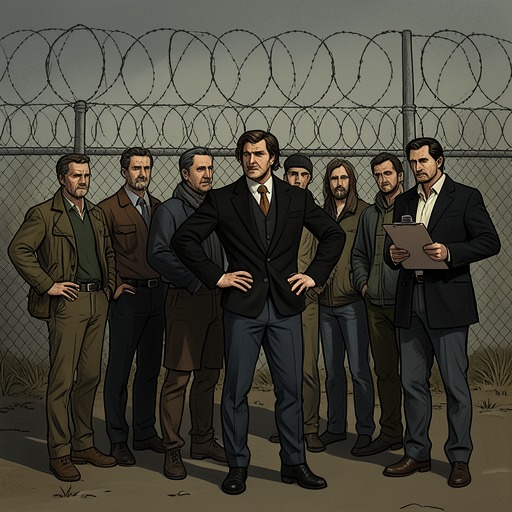
Caleb’s precarious place in the community becomes explicit when Sanjay Patal announces that he is under arrest for opening the gate. Jimmy Molyneau and Ben Chou take him by the arms before he can resist; Caleb can only ask what he is being charged with. The accusation turns a desperate act into a violation of the law, and places the boy at the center of the Colony’s effort to assign blame during a crisis.
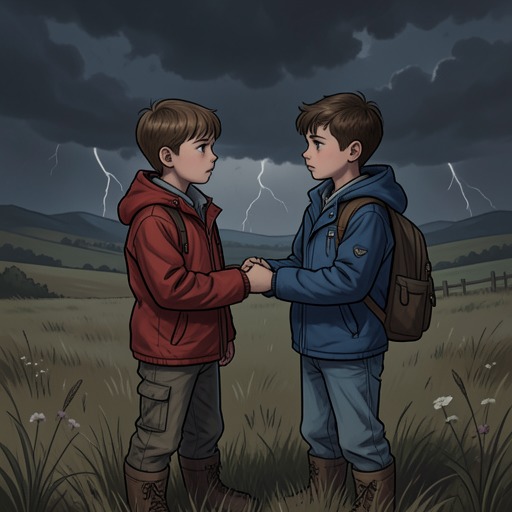
The threat is not abstract to Caleb. After Alicia Donadio helps him, he looks frightened and appears to have been crying; he fears Sanjay will put him out. Alicia promises that will not happen, and Caleb asks what she can do. She leaves him in the lockup with reassurance that she will not be far away, while making clear to Dale Levine and Sunny Greenberg that her concern is personal. Her intervention gives Caleb an ally, but it cannot immediately remove the danger surrounding him.
The crowd’s anger soon makes that danger collective. Sam Chou demands that the girl and those associated with her be put out, arguing that crosses cannot protect the Colony. Voices take up the demand until it becomes a chant, and Peter Jaxon recognizes that Caleb’s fate has become bound to the girl’s: both must be taken somewhere safe. The scene shows how quickly the law’s claim to order gives way to public fear, and how Caleb, already arrested for opening the gate, can be recast as a target when the community seeks someone to blame.
Courage, Companionship, and the Expedition
The picture of Caleb as a frightened boy never cancels the courage others see in him. When Sanjay Patal later reconsiders the proposed punishment, he remembers that Caleb gave the crisis a focus for the community’s anger, but also that the boy accepted full blame before the Household without hesitation. By then, expelling him seems less like justice than a cruel gesture the community would regret. Sanjay orders that Caleb be guarded instead. The reversal matters: the same boy first treated as a convenient culprit is recognized, in daylight, as someone whose bravery exceeded the role adults had assigned him.
Caleb’s practical nerve also finds a place among Peter Jaxon’s companions. When the group is preparing to enter the dark garage, he and Sara Fisher kneel beside an open crate and load rifles. Later, Caleb returns from scavenging with a black shoebox; inside are bright yellow sneakers still wrapped in paper. He kicks off Zander’s boots and puts them on. The shoes are a small but telling recovery of agency: after losing his own pair during his flight, Caleb has found a replacement for himself amid the larger emergency.
Death and Remembrance
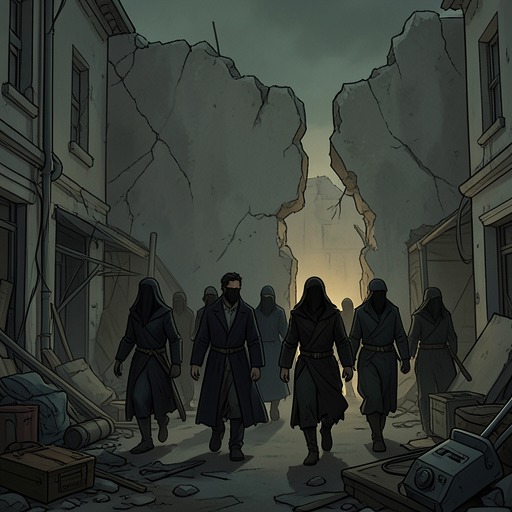
Caleb’s courage reaches its final measure during the escape from Jude Cripp. As the group fights its way onto the train, Hollis Wilson crouches so Caleb can climb onto his shoulders; Peter Jaxon and Hollis then grip his feet and push him over the edge of the train-car door. The rescue is physical and collective, a brief passage from the ground into apparent safety. Caleb has become more than a frightened boy in the company’s care: the others depend on him and work together to get him aboard.
That fragile protection fails when Jude fires. Caleb steps in front of Peter as he reaches for a pistol, and the bullet strikes him in the chest. Peter and Hollis shoot Jude until he falls, but their victory cannot undo the wound. Caleb lies face-up in the dirt, one hand pressed to the entry point, breathing in shallow jerks as Alicia Donadio throws herself beside him. His last visible moments are starkly bodily: blood runs between his fingers, and his eyes remain fixed on the empty sky. The boy who had once escaped danger by climbing above it is killed on the ground while protecting someone else.
The group buries Caleb beneath a cottonwood before setting out again. Michael Fisher makes a marker from scrap metal taken from the train’s hull, etching it with a screwdriver and fastening it to the tree with sheet-metal screws. It bears Caleb’s name, his nickname, Hightop, and the words “ONE OF US.” The improvised memorial answers the earlier accusations against him: the community’s fear had made him a culprit, but the companions who bury him claim him as kin. His death turns belonging from a question of law or usefulness into a bond affirmed by the survivors’ labor of remembrance.