Curtis Vorhees
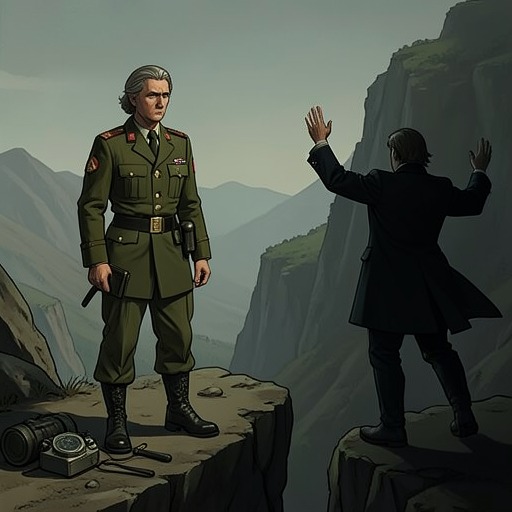
The Passage (Justin Cronin Edition)Curtis Vorhees is the brigadier general commanding the Second Expeditionary Forces, the Army of the Republic of Texas. He gives Peter Jaxon’s wandering party shelter and a choice about its future, then directs his soldiers toward a major viral nest. His authority is public and practical; the charcoal portraits of his wife and daughters found after his death reveal the lost civilian life behind it.
Identity and Command
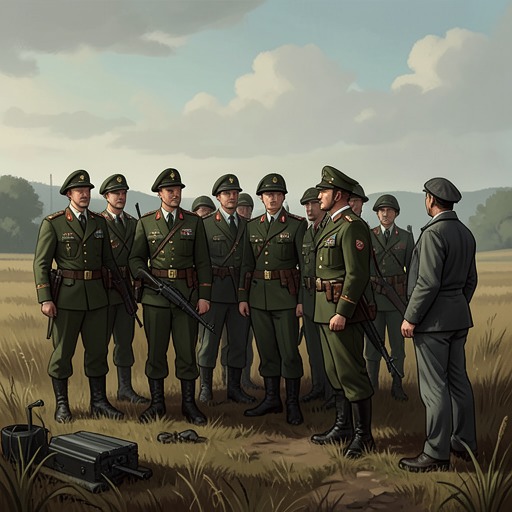
When Peter and his companions enter the garrison, the waiting soldiers’ attention fixes on the women in the group. The interruption of their arrival gives way to the arrival of Vorhees, whose appearance does not match Peter’s expectation of a senior officer: he is shorter than Major Greer, broad-built, and round-heeled in his walk. Yet Peter registers an unmistakable force of authority as Vorhees approaches. His small, dark eyes survey Peter and then the others, briefly assessing each person before he speaks.
Vorhees identifies himself as Brigadier General of the Second Expeditionary Forces, Army of the Republic of Texas, and makes clear that his authority is not incidental to Peter’s stay. He treats the six travelers’ claim to have walked from California with skepticism, but does not dismiss them. Instead, he calls them civilian guests and places them under his command for the duration of their visit. The exchange establishes the terms of their temporary safety: hospitality is offered, but within a military hierarchy that Vorhees controls.
The Offer and the Wider World
Vorhees gives Peter’s group a concrete route onward. In six days, his unit is to move south and meet the Third Battalion at Roswell, New Mexico; from there, a supply convoy could take the civilians back to Kerrville. He recommends accepting that option while leaving the decision to them. This offer places Peter’s choice to continue his journey against a plausible alternative: return to the protection of an established settlement rather than press farther into danger.
During five days of heavy rain, Peter tells Vorhees and Greer the history of the journey: Amy, the Colony, the signal they have sought, Theo and Mausami, and the Haven. He also describes the ninety people waiting on a California mountaintop for their lights to fail. When Peter asks whether the soldiers can be sent to help, Vorhees refuses to promise what he cannot guarantee. His response reflects both the scope of the need and the limits of a force already responsible for its own mission.
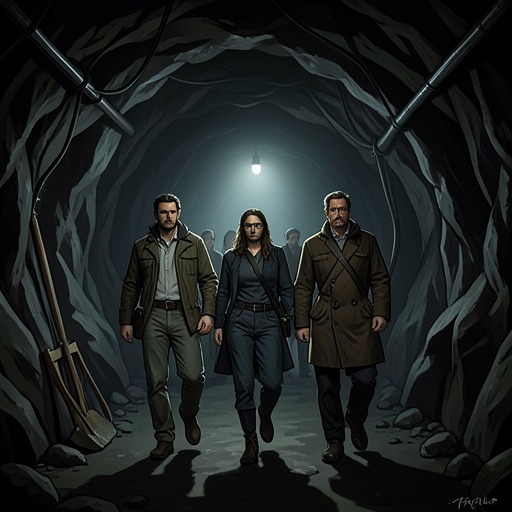
Vorhees explains that the danger beyond the walls is changing. Over the previous sixty months, supply routes from Kerrville have run as far as Hutchinson, Kansas, and through New Mexico into Colorado. The virals have increasingly gathered in clusters and occupied deeper places, including mines and caves, though open countryside can still be traversed without encountering them. The map of danger is therefore uneven: cities remain heavily infested, but the countryside is not uniformly lost.
His account of Texas also places the garrison within the political fractures that followed the first war. Laredo and Dallas are unsafe, Houston has become a polluted viral stronghold, and San Antonio, Austin, and El Paso were largely destroyed. Vorhees connects the devastation to federal attempts to burn out the infected. California’s secession and conflict with the Union coincided with Texas’s own break: the Texas governor seized military assets as the old Army collapsed, moved the capital to Kerrville, and fortified it. Texas retained an advantage that the Colony did not have: oil reserves near Freeport. With oil came electricity, and thus light and the means to maintain a walled population and irrigated land. His explanation shows that survival depends not only on walls but on energy and the political history that secured it.
The Mine and the Decision to Fight
The garrison’s search for an old copper mine becomes the immediate military crisis. Vorhees’s men have spent the summer looking for its entrance, believed to be a viral hot spot. Geological maps and movement tracked with nets had narrowed the search to a roughly twenty-square-kilometer area above the river. Blue Squad’s mission was a final attempt to locate the nest before evacuation. By chance, the squad found a depression in the earth; the first soldier disappeared into it, and the virals emerging from the shaft killed more men before the squad could form a firing line. The survivors split into two groups, one trying to escape and the other, led by Lieutenant Raimey, covering their retreat as daylight ran out.
When Alicia Donadio reports that the mine has been found, Vorhees orders the others back to their quarters and asks her for a report. The brief exchange marks the discovery as a command decision, not simply a frightening encounter: the location of the nest now determines the garrison’s next operation. All night, the camp prepares for battle. A vehicle team is to bring explosives, diesel fuel, and ammonium nitrate with a grenade-cluster igniter called a flusher, which will be lowered by winch into the exposed shaft. Because the underground passages and possible openings are unknown, the plan also requires soldiers to search for other exits and take positions before detonation. Destroying the nest is dangerous partly because nobody can know where surviving virals might emerge.
At dawn, the vehicles are loaded and most of Vorhees’s force assembles at the gate, leaving one squad behind to hold the garrison. Alicia, who led the survivors back by the route along the river, studies a map with Vorhees over a Humvee’s hood. Peter watches the preparations and recognizes that he no longer wants merely to continue on his own journey: he wants to join the soldiers going to war. Vorhees’s campaign therefore becomes a turning point for Peter as well as an operation under the general’s command.
Private Loss and Death
After the battle, the scale of the loss becomes clear: forty-six men are gone, including Vorhees. Greer declines to send out search parties for those who may have been taken up, explaining that the time for the battalion to leave and meet the Third Battalion is running out. Within two days, the camp is being dismantled. The planned movement south continues, with Alicia now leading a small scouting party as a lieutenant after Greer gives her a battlefield commission. Vorhees’s death has left both a human absence and an immediate gap in command, while the unit’s mission continues under Greer.
In the aftermath, Greer shows Peter papers from Vorhees’s desk. Among them are repeated charcoal drawings of the same family portrait: a woman seated with a very young girl in her lap and another girl standing behind them. Peter initially mistakes the precise image for a photograph from the Time Before, but recognizes it as a drawing. Greer confirms that Vorhees had a wife and two little girls before joining the Expeditionary; he had been a farmer, not a lifelong soldier. Asked what became of the family, Greer gives no specific account. The repeated portrait is the surviving evidence of a life the campaign’s official record cannot restore.
Narrative Significance
Vorhees is drawn through the gap between command and private history. At the garrison, authority appears in his evaluative gaze, his control over the travelers’ status, and his willingness to set out a realistic route rather than offer unsupported reassurance. In the field, the same authority becomes a plan shaped by imperfect knowledge: a mine can be located, but its hidden passages and exits remain uncertain. The practical demands of survival never make the threat fully legible.
The family drawings deepen that contrast without resolving it. Vorhees’s public identity belongs to an army that has endured political collapse and fights to preserve organized life; the pictures recall a farmer’s household from before that identity. Their repeated pose offers a quiet counterpart to the garrison’s lists, maps, and operational preparations: a record of whom the lost world contained, rather than a strategy for surviving its remnants. His death during the campaign leaves the portraits as the clearest evidence of the personal past behind the general.