First Colony Lighting and Power System
The Passage (Justin Cronin Edition)The First Colony Lighting and Power System is the infrastructure that keeps the settlement illuminated and its defenses viable, but its failing batteries turn that protection into a countdown. Maintained by Michael Fisher at the Lighthouse, the system depends on a battery bank that cannot be repaired and is already near the end of its life. Its brief interruption coincides with a breach of the Wall; its long-term failure threatens to leave the Colony without light at all. The system is therefore more than a piece of equipment: it is the material limit on a community built to survive in darkness.
Design and Dependence
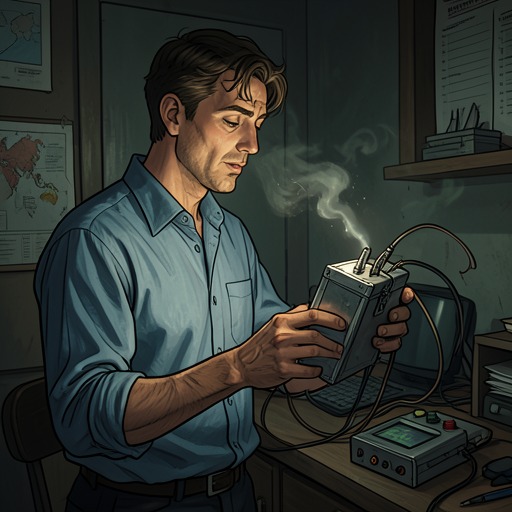
The Colony’s turbines can continue spinning in the wind, but generation alone cannot sustain the settlement. The batteries store and regulate the current, making the power system dependent on components with a finite service life. Michael sees the deterioration directly on the Lighthouse’s old CRT monitor, where the green bars register a battery bank that has lasted far beyond its expected span. Its cells were designed for decades, not nearly a century; the fact that they still hold any charge is a reprieve, not evidence of durability.
The battery failure is not a matter of routine maintenance. Michael can clear corrosion, replace gaskets, and rewire controllers, but those repairs cannot restore the damaged membranes or their polymer pathways. The batteries were built to be replaced, not fixed, and no replacement stack is available. He estimates that the lights may fail within a year or two. One windless night without functioning storage and regulation could be enough to turn the turbines’ motion into no usable protection at all.
Michael’s Work and the Forbidden Radio
Michael Fisher, known as the Circuit, monitors and maintains the system from the Lighthouse. His work is ordinarily almost invisible: keeping the panels functioning lets everyone else live beneath the lights without having to attend to the machinery that makes them possible. The failing batteries make that concealed labor impossible to separate from the Colony’s future. Michael anticipates that he will have to tell the community that the lights are going out, with no practical repair available to avert it.
The same Lighthouse is also where Michael secretly returns to the radio, an instrument forbidden by the Colony. Seventy-five years earlier, the settlement had destroyed its radio and dismantled the mountain antenna because contact with the outside world had helped lead the Walkers to the Colony, and leaders feared that food, fuel, and space under the lights were limited. That decision once seemed defensible to Michael; with the battery bank nearing failure, its cost looks different. The Colony has cut itself off from a possible outside connection just as its own power infrastructure is becoming untenable. The old logbook Michael finds at the Lighthouse and his renewed work on the radio belong to that same effort to look beyond a system that cannot sustain itself indefinitely.
The Three-Minute Failure
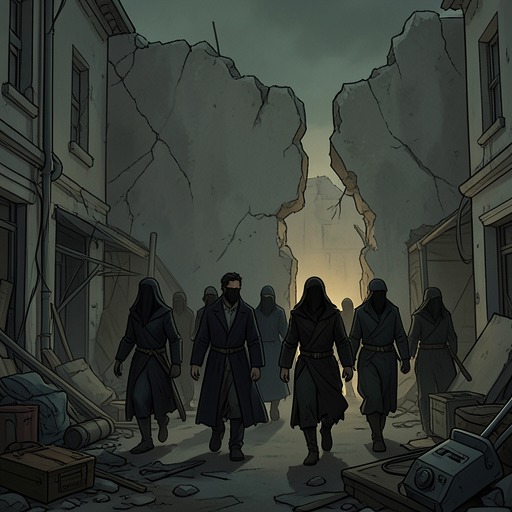
The immediate danger becomes visible when Michael is working on the battery stack and the lights suddenly go out. In the total darkness, he hears Kip Darrell report that the virals are everywhere. He runs back along the catwalk and down the ladder to the Lighthouse, expecting to find the power system crashed. Instead, the CRTs still glow and the meters remain in the green. The main breaker is open; Michael closes it, and the lights return.
The interruption lasts less than three minutes, but the Wall is breached in that interval. At first light, Michael reports a power surge to Ian as the most plausible explanation. He cannot confirm it: the system has no recorded surge, and a short circuit should have caused the breaker to fail again when he reset it. He checks the connections, vents the battery ports, and charges the capacitors, but finds nothing wrong. The brief outage thus remains distinct from the known, progressive decay of the batteries: one is a sudden interruption with no established cause, the other a long-term failure Michael can see approaching.
Ian’s account of the attack establishes the human cost. By the time the lights return, Jimmy Molyneau, Soo Ramirez, and Dana Jaxon have been taken from the base of the Wall. A second pod attacks near Platform Six while the Watch is drawn there; at the unmanned Platform Nine, another group manages to cross the Wall. The power system’s failure does not itself explain every movement of the attack, but the outage removes the Colony’s illuminated protection at the moment the breach occurs. In the emergency meeting, Ian explicitly tells the crowd that Michael is not to blame: stepping away to vent the battery stack was proper, and he could not have foreseen the breaker opening.
The Failure’s Meaning for the Colony
When Michael tells Peter Jaxon and the others about the batteries, the disclosure changes the scale of the problem. Peter receives it with a sense of inevitability, connecting the long decline of the batteries with the arrival of Amy, the Girl from Nowhere. He understands the failing system not as an isolated maintenance concern but as part of the conditions demanding action. Michael says that only a small circle knows the news, including Peter’s brother, which makes the revelation both urgent and tightly held.
The lights have made the Colony’s boundary feel like a durable answer to the world outside. Yet their protection depends on a battery bank whose membranes cannot be repaired, while the community’s prohibition on radio has narrowed its contact with the world beyond its walls. The distinction between a momentary blackout and the coming end of the batteries matters: Michael restores the breaker, but he cannot restore the system’s future. Later, the train carrying Peter’s party reaches the end of its line at Caliente, roughly four hundred kilometers from its starting point, with Utah visible beyond the ridge. The contrast is sharp: the Colony’s lights bind survival to a failing fixed infrastructure, while the journey carries the group beyond the limits that infrastructure imposed. The system’s decisive consequence is not only that it can fail, but that its apparent permanence has delayed recognition of how exposed the Colony remains.