Giles Babcock
The Passage (Justin Cronin Edition)Giles Babcock, known at Project NOAH as Number One and the Talker, is the first of the twelve human test subjects to survive the experimental virus. His transformation turns him into more than an extraordinarily dangerous infected man: he becomes the center of the Many, a collective consciousness whose members share his thoughts and dreams. The novel later reveals the human history beneath that power, tracing it to a childhood shaped by abuse, a killing that led to his death-row sentence, and a fear of death that persists through his transformation. In the final movement of his story, he senses that Amy could undo the world he has gathered around himself.
Identity and Transformation
Project NOAH’s first human trials initially ended within hours, with fever and fatal illness. After successive refinements made the virus less destructive, Babcock was the first prisoner to survive. He was followed by Morrison, Chávez, and the other eventual subjects, but his position as Number One became more than an order of arrival: after becoming infected, he would command an immense community of viral descendants and hold a place among the Twelve as well as a larger, singular presence associated with Zero.
Before infection, Babcock was a death-row inmate. Richards dismisses him as a man whose sanity was already badly compromised, while the staff call him the Talker because he appeared to speak incessantly both before and after the transformation. The nickname marks a striking continuity: the transformed Babcock still makes sounds that Richards cannot understand, while the later account reveals the memories and desires concealed behind that apparently unintelligible speech.
The infected subjects’ bodies acquired a hardened, protein-based outer layer. Richards understood that a small area over the breastbone might be vulnerable, but the supposed weak point was only a theory, and Sykes was unsure whether the creatures could be killed except by extreme force. Babcock’s physical transformation therefore belongs to the same pattern as his mental one: the institution can observe and speculate about him, but it cannot confidently define the limits of his changed state.
Childhood and the Road to Project NOAH
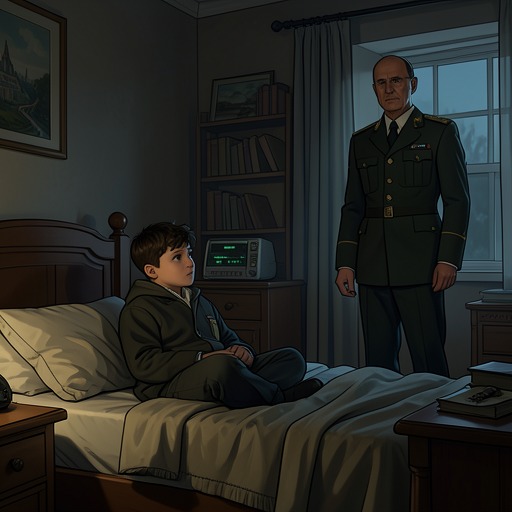
Babcock remembers growing up in a small house in Desert Wells with a mother whose constant talking filled the rooms. His recollections are precise and domestic: sunlight falling on carpet, a worn spot on the stoop, the railing outside, and his mother watching television and smoking in the kitchen. These details give his childhood a recognizable setting, but the recollection is dominated by the fear and punishment within it. His mother struck him and burned his hand with a cigarette; she demanded that he be quiet and insisted that he act like a man.
The memory of silence is bound to the memory of violence. Babcock recalls making himself quiet so that the pain would stop, while also remembering his mother’s taunts and the words that seemed to accumulate inside him. His later reputation as the Talker thus carries a grim reversal: the voice that once had to be suppressed becomes an overwhelming, shared presence, capable of entering the minds of others.
As a boy, Babcock killed his mother with a knife. In his recollection, the act brings an abrupt change in how he sees her: he understands her as a physical being rather than as the voice that had filled and controlled his inner life. Authorities sent him away and condemned him to die for what he had done. The novel does not present this history as an excuse for his later violence; it establishes the human experiences that precede his transformation and the deep connection, in his memory, between speech, suffering, and blood.
Babcock did not want to die. After his death-row confinement, Bradford Wolgast brought him into the chain of events leading to the doctors’ experiments and his infection. Babcock remembers becoming one of the Twelve, alongside Morrison, Chávez, Turrell, Winston, Sosa, Echols, Lambright, Martínez, Reinhardt, and Carter. He also remembers taking from the others: those he killed and those he only partially consumed became part of a larger mental community. His account turns the laboratory’s sequence of experiments into the origin story of a collective that grows by absorbing other lives.
Richards and the Monitors
During his time in containment, Babcock’s apparent chatter unsettles Richards, the security official who watches him through the monitors. Richards listens with headphones, wondering whether the sounds contain language, but cannot make them resolve into words. He sometimes remains at the screens for hours and even falls asleep wearing the earphones. His attention is not explained by any successful communication; the force of the relationship lies in its unresolved pull.
That connection becomes more intimate and threatening when Babcock addresses Richards through the monitored image, claiming that the two belong to one another. Richards dismisses the message, yet the scene gives explicit form to a feeling he had already struggled to name: that Babcock somehow owns a part of him. Richards’s response does not establish that he accepts Babcock’s claim, but the recurrence of the connection makes the surveillance room more than a place of observation. Babcock appears to cross the barrier between prisoner and watcher, while Richards remains unable to decide whether the sounds are meaningless or addressed to him.
During the containment breach, Sykes reports that Babcock looked directly at him but did not kill him. His remark turns the previously private connection between Babcock and Richards into a question of selective recognition: Babcock’s behavior toward Sykes seems to have been different, though the evidence does not settle why. Sykes then becomes ill, and the scene closes on the immediate danger of infection rather than on an explanation of Babcock’s choice.
The Many and the Power to Command
Babcock’s later account describes his transformed identity as both one of the Twelve and a presence above or behind them. He is himself, but he is also bound to a greater viral power associated with Zero. His children carry the seed of the Twelve, and the relationship is reciprocal: they are part of him, while he inhabits their minds. When they sleep, think, or feed, their experience belongs to the collective. The Many call themselves the We of Babcock, a name that makes individual identity subordinate to shared membership.
Babcock treats this collective as his to command. He sends its members to gather the surviving humans, ordering them brought to him rather than killed, so that they can enter his dream and become part of the We. In his account, those who submit may live under his rule and help bring others; those who resist are made to die. The Many are therefore not simply a multitude sharing thoughts: they are a system of forced incorporation, held together by Babcock’s appetite, authority, and promise of continued existence within him.
This account also complicates the idea that Babcock is merely the loudest member of a group of infected subjects. His memories retain a clear distinction between his former life, his transformation, and the collective he builds afterward, even as he insists that these identities coexist. The narrative lets his childhood and his present power occupy the same consciousness: a man who once experienced himself as silenced now gives orders across the minds of others, while converting their words, dreams, and lives into parts of his own.
Amy and the Threat of Undoing
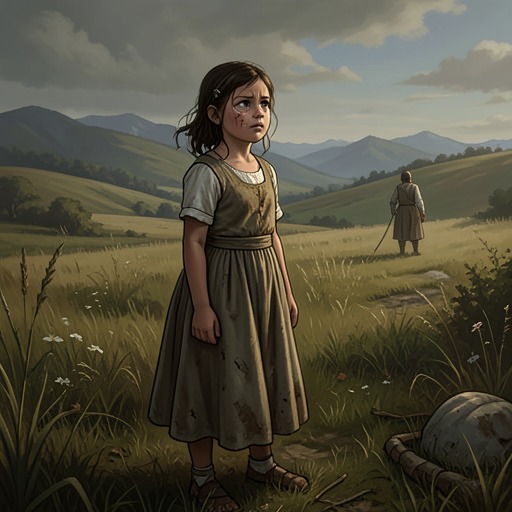
Babcock’s account of the Many ends with a challenge to its apparent permanence. He senses Amy as a disturbance within the collective, a presence capable of undoing what he and his children have made. He warns the brothers that she is approaching and that she is already there. The scene shifts the meaning of Amy’s arrival: to Babcock, she is not simply another person to be absorbed into his order, but the possible means by which that order can be unmade.
The contrast between Babcock and Amy is framed through memory and identity. Babcock’s collective carries an empty space of forgetting in which his presence endures, while Amy makes its members want to remember and, at the same time, want to die. His power offers permanence by binding other lives to his own; her effect threatens that arrangement by reopening what the collective suppresses. The story leaves Babcock poised between command and fear, alert to an approaching force he cannot confidently contain.
Babcock’s significance rests in that double history. He is a product of Project NOAH’s human experiments and the origin of a viral community that extends far beyond his former body. Yet the revelation of his childhood prevents his monstrous authority from appearing without a human past: the Talker once learned silence under punishment, and the boy sent to die became a being who insists that others belong to him forever. Amy’s approach exposes the fragility within that claim, turning his vast collective into something that may still be undone.