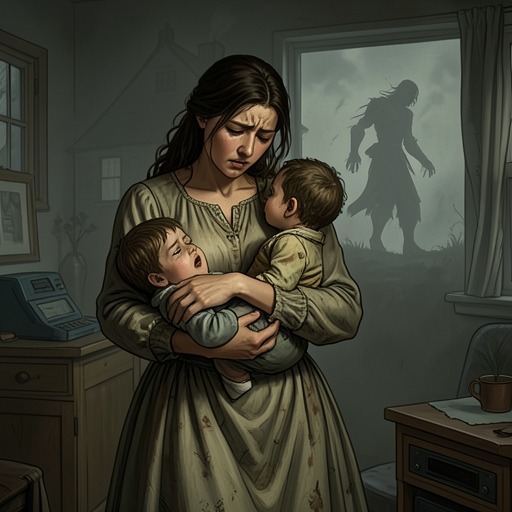
Jeanette shoots the fraternity attacker
The Passage (Justin Cronin Edition)Jeanette shoots the young college-age man who lures her away from the road and tries to take her into a house where his friends are waiting. The encounter turns the revolver she had kept as a private reassurance into an instrument of immediate defense, but survival does not restore safety: Jeanette returns to the motel at dawn and leaves with Amy, while the shooting later becomes part of the fear and accusation surrounding Amy’s arrival in the wider story.
Background and the encounter
Before the attack, Jeanette had begun carrying a revolver in her purse. Its presence had altered how she understood herself: it was a secret, a remaining piece of her own identity, and a reminder that she had been afraid. The young man who stopped for her did not match the danger she expected. He was neatly dressed, appeared college-aged, and drove a Ford Explorer with a rack on top. His manner initially suggested a date rather than an immediate threat.
The pretense became clearer when he refused to drive to a motel. Jeanette began to respond as though he wanted sex in the car, but he instead proposed taking her somewhere nice and paying more than she usually received. He invited her to meet his friends. When she refused and asked to be taken back, his face and expression changed her understanding of the situation: he was no longer a seemingly harmless young man but someone driven by a threatening intent.
The shooting
Jeanette opened the truck door and tried to leave, despite not knowing where she was. The young man got out after her and grabbed her. She understood that the house and the friends inside were part of the danger, and that the situation had become one in which she could not rely on his cooperation. When he tried to restrain her, she struck him and fell; he continued trying to pin her down.
Her purse lay on the grass. Jeanette reached into it, found the revolver, and pressed it against the side of his head before firing. The action is the encounter’s decisive reversal: the man who had controlled where the truck went and whether she could leave did not control what happened next. The gun she had carried as a concealed assurance became the means by which she stopped his attack. The text establishes that he fell away from her; it does not describe his eventual medical outcome at the scene.
Flight and immediate consequences
Jeanette ran to a large road and caught a bus, travelling through unfamiliar neighborhoods and into downtown before waiting for another bus. She was uncertain where she was and did not know the time, having lost her Timex during the struggle. She remembered leaving the gun on the lawn. Her hand remained numb from firing it, but she continued her journey back to the motel rather than seeking help at the scene.
By sunrise she had reached the room where Amy was sleeping beside a television still playing an exercise-machine infomercial. Jeanette washed her face, changed out of the clothes she had worn on the road, and put those bloodstained clothes in a dumpster behind the motel. She packed Amy’s Powerpuff Girls knapsack, gathered clothing and money for herself, woke the child, and left with her. The shooting therefore leads directly into flight: Jeanette’s immediate concern is not to remain at the scene but to get Amy away before someone comes looking for her.
Retelling and wider significance
Later, Sister Arnette hears from a detective that Amy’s mother has killed a young man. Her account places the shooting within the chain of events already engulfing the convent: men had come for Amy, the group had encountered frightening disorder at the zoo, and the sisters had spent hours at the police station answering repeated questions. The shooting also draws reporters and camera trucks to the convent, turning a private act of survival into a public story about Amy’s mother.
The young man is subsequently described as an attacker associated with a fraternity. In First Colony, Ian invokes the girl’s identity as a Walker while arguing that she had it coming, and Sam Chou claims that she is responsible for the deaths and danger facing the community. These later accusations do not establish that Amy caused the attack or the violence blamed on her; they show how the shooting’s aftermath can be folded into a broader campaign of fear and scapegoating. The scene’s significance lies both in Jeanette’s use of the weapon to escape immediate control and in the way later communities turn the event into evidence against the vulnerable people connected to it.