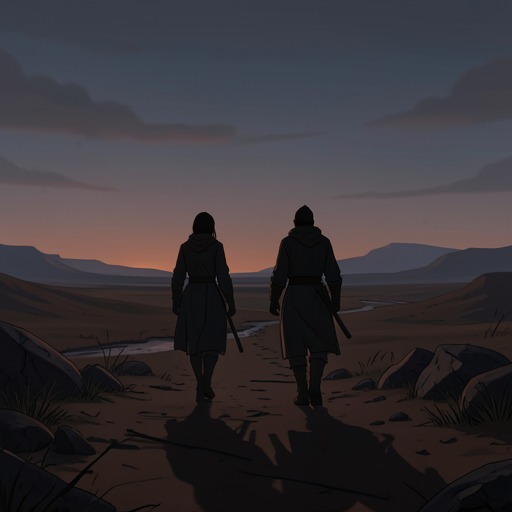
Kerrville
The Passage (Justin Cronin Edition)Kerrville is a walled city in Texas and the principal destination offered to Peter Jaxon’s party after they encounter the Second Expeditionary. The city’s oil, lights, population, and irrigation make it a rare prospect of organized life beyond the isolated settlements Peter knows; the choice to accept a convoy there, however, would mean turning away from the search that brought him and his companions south and west.
A fortified capital in Texas
Kerrville became the capital of Texas after the state’s government and military order fractured. As General Vorhees recounts, federal efforts to burn infected creatures from cities—including the destruction of San Antonio, Austin, and El Paso—were followed by California’s declaration of independence and a period of open conflict. Texas, in Vorhees’s account, was left comparatively outside that struggle. Its governor seized the remaining military assets as the Army fell apart, moved the capital to Kerrville, and fortified the city. The walled settlement thus grew out of both political rupture and an urgent need for defense.
The city’s survival depends on a material advantage Peter’s own Colony lacks: oil. Vorhees says that roughly five hundred million barrels remain in underground salt domes near Freeport, part of the old Strategic Petroleum Reserve. Oil means power, and power means light. Kerrville’s defenses enclose more than thirty thousand people, while the surrounding territory includes fifty thousand irrigated acres and a fortified supply line to a working refinery on the coast. The description presents a settlement supported not just by walls, but by energy, food production, and a protected route linking the city to fuel processing.
A refuge with limits
Kerrville is offered as a destination, not a guarantee of safety. When Peter asks why it is safe, Vorhees corrects the premise: it is not completely safe. He describes Texas as broadly dangerous, naming Laredo and Dallas as places to avoid and the remains of Houston as heavily polluted but still inhabited by infected creatures. Earlier wars had largely levelled San Antonio, Austin, and El Paso. The city’s security is therefore relative: its walls and resources make it a viable refuge, but they do not make the surrounding state harmless.
Nor does Kerrville restore the world that existed before the catastrophe. The old national union has broken apart; Texas survives as a fortified political and military community whose capital moved because the previous order failed. Vorhees’s account makes the city’s lights a sign of continuity, but not of a return to ordinary life. The power supply and irrigation sustain a community inside its defenses, while the dangers beyond them remain substantial.
The convoy and Peter’s choice
The possibility of Kerrville becomes concrete when Vorhees tells Peter that the Second Expeditionary will move south in six days to meet the Third Battalion in Roswell, New Mexico. From there, the unit can send Peter’s party back to Kerrville with a supply convoy. Vorhees presents the arrangement as a choice. Peter has not considered that the expedition might end there, and the offer forces him and his companions to weigh a protected destination against continuing toward their original purpose.
The prospect unsettles Peter because it answers several needs at once. In Kerrville, the party could find safety, lights, and the Army they had been seeking. Peter believes that, perhaps by spring, Vorhees might send an expedition to the Colony to bring in its remaining people. At the same time, the party’s short-range radio equipment cannot establish what Amy’s signal means, leaving the most important part of their search unresolved. Peter is tempted to accept, particularly after Alicia is no longer with them, but the thought of Amy makes turning back feel like a choice he might regret for the rest of his life.
Vorhees promises that Peter will see Kerrville if he takes the convoy. That assurance makes the city a real alternative rather than a distant name, but it does not decide the matter for him. The invitation offers return, shelter, and a possible future among thousands of people; Peter’s unresolved responsibility to Amy pulls in the opposite direction. Kerrville’s significance in this part of the story lies in that tension: it is a destination the expedition can reach, and precisely for that reason, a test of whether reaching safety would be enough.
A future imagined by the survivors
Kerrville also matters to Sara, for whom the city represents the possibility that the world is not wholly broken. She wants to see it and imagines the more than thirty thousand people within its walls as evidence of a human society large enough to make an ordinary life possible. The hope is personal as well as communal: she expects to live there with Hollis, whose love she returns. Their relationship gives the promised refuge a future shaped not only by survival but by attachment and the chance to belong.
That hope sharpens the contrast between Kerrville and Sara’s childhood. She remembers having once believed the world was a fine place in which she could take part, before the deaths of her parents and the losses that followed. The prospect of the city revives that earlier belief: perhaps the world is not simply broken, and perhaps she can again be a person living a human life. The novel therefore makes Kerrville more than a fortified location. It is a shared possibility that means safety to Peter’s party, renewed hope to Sara, and a future that remains available only if the survivors choose to go there.