Lacey Antoinette Kudoto
The Passage (Justin Cronin Edition)Lacey Antoinette Kudoto’s life is shaped by a past she cannot consciously remember and a bond she forms with Amy. A survivor of the killing of her family in Sierra Leone, she grows up under the protection of the sisters, carrying an unspoken trauma that others mistake for spiritual reserve. Her care for Amy becomes concrete and perilous: when the child’s presence unsettles the Memphis zoo, Lacey carries her through the spreading disorder, and later she leaves the convent to find her. Lacey’s path connects private survival to the book’s widening catastrophe, while her steadfast protection of Amy gives that catastrophe an intimate human scale.
Identity and Early Life
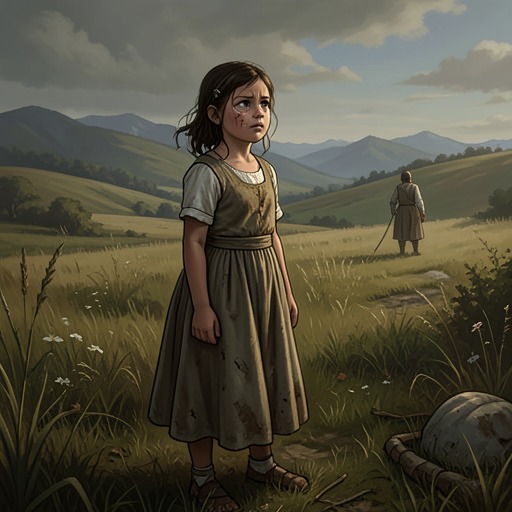
As a child, Lacey is found hiding in a field by United Nations peacekeepers, who turn her over to the sisters. The soldiers have killed her family; afterward, Lacey remains in the field with them for hours. The account Sister Arnette later receives through a psychiatric report explains why Lacey has never spoken of the event: she believes her parents and sisters are still in Sierra Leone, attending palace balls and riding polo ponies. Her mind has been washed of what happened, and the sisters understand her silence as a form of protection, though the knowledge and worry remain Arnette’s burden.
Lacey becomes a model sister, self-contained and unusually mystical in her devotions. That outward composure sits beside a history she cannot narrate for herself. The distinction matters: her faith gives shape to what she can bear, but it does not mean that she knows the source of her own pain. When Amy arrives, Lacey’s explanation that she is helping a friend’s daughter seems implausible to Arnette, who recognizes that the story does not add up. Lacey and Amy leave before Arnette can resolve the deception, making Lacey’s protective choice an act that others can see but not yet understand.
Lacey and Amy at the Zoo
At the Memphis zoo, Lacey and Amy approach the polar bear enclosure amid families gathered to watch the animals. Amy releases Lacey’s hand and goes ahead to the glass. A bear swims up and bumps its nose against the underwater viewing pane; Amy touches the damp glass near its face. The encounter begins in ordinary public space, with Lacey close beside her, but it becomes the first visible sign of the disturbance that will overtake the zoo.
The bears grow frantic, followed by sea lions, grazing animals, elephants, and a charging rhinoceros. The disruption spreads from animal to animal and then to the people in the crowd. Lacey recognizes that something about Amy is involved, even as she tries to get the child away from the glass and carry her through the maze of paths. Amy clings to her and cries out, “what I am, what I am”; people run and call for their children as the zoo’s usual order breaks down. A man with a camera points Lacey out to a security guard, identifying Amy as the child at the center of the commotion. Lacey’s immediate response is not to explain or investigate but to carry Amy onward, placing the child’s safety ahead of the scrutiny gathering around them.
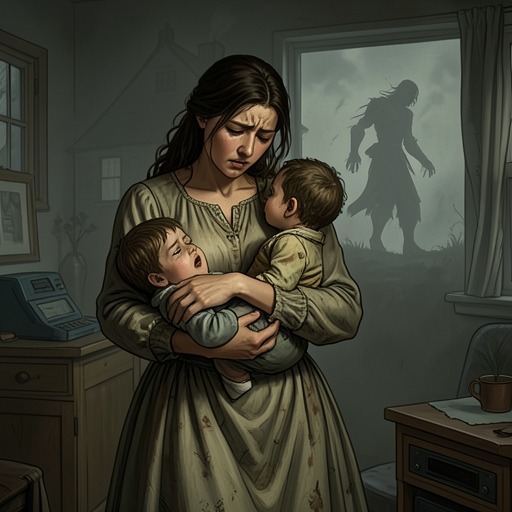
Afterward, Lacey sits on a curb in Memphis beside Claire, who tries to reassure her that they are safe. Lacey knows they are not. The voices she has heard since her childhood in the field have warned her, and the zoo’s disorder makes that warning newly legible. In her mind she sees armies and flames, graves and cries of the dead, darkness spreading across the earth, and cities emptied into a silence lasting a hundred years. The vision joins the personal and the planetary: she sees Amy as a child who cannot be saved from a future of isolation, and recognizes in that fear an echo of her own childhood abandonment. Her grief is not a detached prophecy; it is bound to the child she is trying to protect.
Departure and Journey
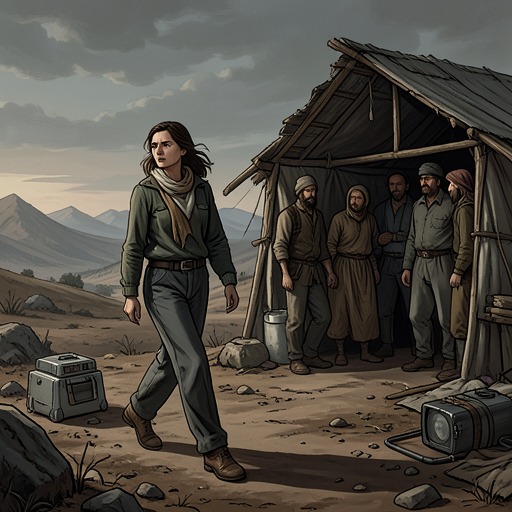
When the sisters finally open Lacey’s room, they find the bed untouched and the window open. Lacey is gone. Her departure follows the zoo crisis and the vision in Memphis, but she does not set out with a mapped destination or a practical plan. Soldiers are searching for her, yet she experiences a new, strong energy and moves toward the place she understands simply as where Amy is.
The journey proceeds through whatever means are available. Lacey takes buses, rides in a truck with Labrador retrievers and a crate of piglets, and walks on days when she knows walking is what she must do. At times she eats; at others, she knocks on a door and asks to sleep in a bed. The women who answer welcome her inside and lead her to a prepared room without demanding an explanation. The route has no stated itinerary, but her sense of direction remains consistent: she is moving toward Amy. Eventually she climbs a long mountain road and knows that she has arrived, with the surrounding sunshine experienced through her religious understanding as the glory of God.
Finding Amy and the Work of Protection
At Project NOAH, Bradford Wolgast first fails to recognize the person holding a sleeping girl against her chest. When he realizes it is Lacey, he addresses her as Sister Lacey; she answers him as Agent Wolgast. Phil Doyle shares Wolgast’s bewilderment at the meeting. The brief exchange confirms the result of Lacey’s unexplained journey: she has found Amy and brought her to the people involved in the effort to retrieve the child.
Lacey’s role is therefore neither simply that of a convent sister nor that of a guide with knowledge of the wider crisis. She protects Amy through immediate acts of care, then follows an obscure but persistent sense of obligation across distance until she reaches her. The zoo scene places that care under public pressure; the open window and unplanned road journey show its cost; her arrival at Project NOAH makes it useful to Wolgast and Doyle’s mission. Across these reversals, the person whose own history has been erased becomes a guardian for a child whose identity and future remain difficult for others to understand.
Narrative Significance
Lacey’s story repeatedly sets bodily response before explanation. At the zoo, she sees the animals’ agitation, carries Amy away, and only gradually understands that the disturbance is connected to the child. Her childhood trauma likewise exists first as a break in memory and a history held by others. The book thus presents her not as someone who possesses a complete account of events, but as someone who acts faithfully amid what she cannot fully know.
Her devotion also connects personal memory to religious imagery without resolving the catastrophe into a simple lesson. The vision of a devastated future is inseparable from her fear for Amy, while the journey toward the child takes the shape of a pilgrimage without a named destination. Lacey’s importance lies in this combination: she is both a survivor whose past has been concealed from her and an active protector who responds to danger through care. In a narrative where the scale of disaster threatens to make individuals disappear, her attachment to Amy keeps one vulnerable life in view.