Lacey's cabin
The Passage (Justin Cronin Edition)Lacey's cabin is the mountain home Sister Lacey Antoinette Kudoto and Jonas Lear build from the remains of the Chalet, a place where survival becomes a shared domestic life and where the history of the catastrophe is kept for those who come after. When Peter and Amy follow the Mountain Beacon through the snowy woods, they find a lit house, smoke rising from its chimney, and Lacey taking in laundry while she sings. The scene’s quiet ordinariness is the cabin’s decisive contrast: in a world shaped by infection and abandonment, it has become both a refuge and a living record of what happened.
Discovery in the Mountain Clearing
Peter and Amy first see the beacon rising among the trees, beside a wide depression full of debris and the remains of human habitation. The antenna is a substantial metal tower anchored with steel cables in concrete; a gray, spiked orb crowns it, with paddle-like objects beneath. Peter brushes snow from an inscription identifying the structure as belonging to the United States Army Corps of Engineers. The military mark points toward an earlier world, but the signal leads not to an active installation: it brings the travelers to a secluded home.
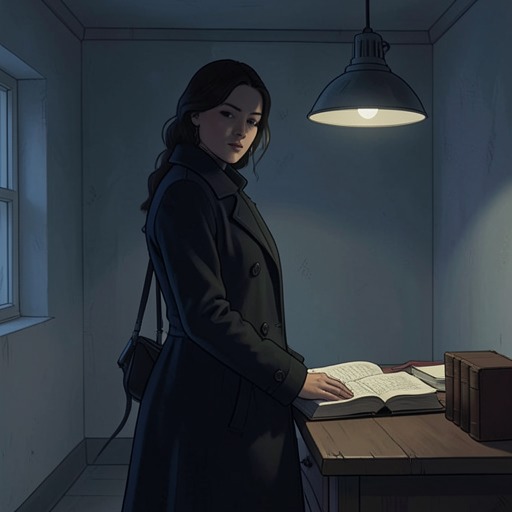
As they approach, they hear singing before they see the singer. Peter finds Amy already moving toward the edge of the clearing, where a woman stands in the dooryard of a small log house. Its windows glow, smoke curls from the chimney, and blankets hang between trees. Lacey wears a heavy wool cloak and rope sandals, her bare toes in the snow; she continues her work, apparently unaware of the two visitors. The domestic details make the cabin feel startlingly inhabited against the surrounding ruins. The song resolves as Peter and Amy draw near, and the place that seemed at first a sign of human absence becomes a home with someone still living in it.
Built from the Chalet's Remains
The cabin is the result of years of work by Lacey and Jonas, whom she remembers as the good doctor and calls Jonas Lear. They build it in a glen from materials salvaged from the abandoned compound. The house is not much larger than the shacks Lacey recalls from the dusty roads and red-clay fields of her youth, but it is made to last. Its solidity is practical rather than grand: a home fashioned by two people who have survived the old world’s destruction and must make a life in what remains.
They take lumber from the burned remains of the Chalet and tools, nails, sacks of concrete, and a mixer from the storage buildings. They pour the cabin’s foundation posts and lift fieldstones into place to make its hearth. The roof demands another solution. For a summer they strip shingles from the old barracks, only to find the asphalt torn and leaking; they finally pile sod on top, making a roof of dirt and grass. The structure thus carries the compound’s material history into a different use. What once belonged to a military installation becomes the means of shelter, heat, and shared daily life.
The abandoned compound yields hundreds of guns as well. Lacey and Jonas spend a period dismantling them until the weapons are reduced to a vast mound of nuts, bolts, and glossy metal pieces, not even worth burying. This labor gives the cabin’s setting a distinct relation to violence: weapons are plentiful in the place from which the couple builds their home, but they choose to render them unusable. The cabin is not described as a fortress or an arsenal. Its defining work is the conversion of the ruins’ materials into a dwelling, and of guns into inert scrap.
A Shared Life and Its Ending
The cabin becomes the setting for Lacey and Jonas’s long life together. Jonas leaves only once, in their third summer, to search for seeds. He takes the one rifle he has kept and provisions in a pickup, promising to be gone for three days. Two weeks pass before he returns from the direction of Grand Junction with the promised seed packets. Lacey recognizes the despair on his face and understands that his pledge to come back has helped bring him home. That night he sits in silence by the fire, looking into the flames; Lacey, unable to lift his grief, offers to live with him as his wife. Their domestic partnership grows from this offer of love and forgiveness, which she comes to understand is also the love Jonas had sought.
The seeds he brings become part of the cabin’s lasting life. Decades later, Lacey keeps their descendants in jars on the shelves: zucchini, tomatoes, potatoes, squash, onions, turnips, and lettuce. When she tells her story to Peter and Amy, the house is warm and fragrant, its two low-ceilinged rooms separated by a curtain, the fire glowing and a pot of stew warming in its cradle. Its contents are modest, but they hold the duration of the life made there: a hearth built by hand, a garden sustained across years, and food ready for unexpected visitors.
Jonas’s death also belongs to the cabin’s intimate landscape. In old age, gray and frail, he digs a grave for himself in a clearing where he can see the valley and the distant mountains. He tells Lacey the hole is for when he is gone, so she will not have to dig it herself in summer. He works through the day and into evening, pausing for breath, and refuses her help. The next morning, after returning to the bed he built from joined timbers and lengths of rope, he is dead. The grave and the handmade bed mark two forms of preparation for death: one made in the open landscape, the other part of the home they shared.
The Cabin as Refuge and Archive
Fifty-four years after Jonas’s death, Lacey lives on alone in the cabin. The novel places her account of the past inside the present of Peter and Amy’s arrival: she pauses her telling to answer how long it has been, then returns to tending the stew. The decades are held together by ordinary continuities—the seeds Jonas brought, the house they built, the meals Lacey can still offer. Her needs are small, the cold does not affect her, and she may go days or weeks without eating, but she expects Peter to be hungry. The cabin remains a place of care, not simply a monument to the dead.
It is also where the history of Project NOAH is preserved. Before the Chalet fires advanced through its underground levels, Jonas retrieved yellowed manila files along with Amy’s backpack, insisting that someone should know. The papers still smell faintly of smoke when Lacey brings them out for Peter. The first file is an intake profile for Giles J. Babcock, classified for restricted access and routed via Bradford J. Wolgast. Lacey opens it as the beginning of Peter’s education in how the world was made. The cabin’s archive gives its shelter a second purpose: the past that its builders survived is not to disappear with them.
The cabin therefore joins domestic survival to historical disclosure. Its logs, fieldstone hearth, sod roof, seed jars, and warm rooms show the labor by which Lacey and Jonas fashioned a durable life from the Chalet’s ruins; the burned files show that refuge alone cannot answer what happened. Peter and Amy arrive at a home that has endured long enough to receive them, and at the point where private memory becomes evidence for a wider history.