Michael Fisher
The Passage (Justin Cronin Edition)Michael Fisher, called Circuit, is the Colony’s young First Engineer of Light and Power and the keeper of the systems that make life beneath the lights possible. His arc turns technical maintenance into a moral and investigative struggle: when he realizes that the batteries cannot be repaired and the Colony’s power may soon fail, he hides the crisis, secretly listens for other survivors, and follows a recurring military signal to a message about Amy.
Identity and Work
At eighteen, Michael is unusually young to hold the position of First Engineer of Light and Power. Like Alicia, he has reached responsibility early, but his trade is exceptionally specialized. The Fisher men have all been engineers, and Michael was trained by his father soon after leaving the Sanctuary. Most people do not understand how the engineers keep electricity moving up the mountain; they know only that the lights come on each night and the batteries hum. To Michael, that apparently ordinary miracle is a system with limits, dependencies, and an approaching failure point.
His nickname, Circuit, makes his work into his public identity. He spends his days at the Lighthouse monitoring the power network, surrounded by equipment that others see as opaque but that he reads closely. The novel gives his technical perspective unusual narrative weight: where other characters encounter light as shelter, Michael sees batteries, turbines, control systems, and the vulnerable chain connecting them. The difference between the Time Before and the present, he concludes, is not simply the virals but electricity—the infrastructure that keeps a human community from being swallowed by darkness.
The Battery Crisis and Its Cost
Michael discovers that the Colony’s battery cells are deteriorating badly. The wind turbines can continue turning, but they cannot provide dependable power without batteries to store and regulate the current; a windless night could leave the Colony without electricity. The cells were built to last perhaps thirty or fifty years, yet they have continued working for almost a century. Their survival has been extraordinary, but not permanent.
The damage cannot be fixed through the repairs available to him. Michael can clear corrosion, replace gaskets, or rewire controllers, but the battery membranes themselves are spent: their polymer pathways are clogged with sulfonic acid. The batteries were designed to be replaced, not restored. Without a new battery stack from the old U.S. Army, Michael estimates that the lights will fail within a year or two at most. His fear is not only that the machinery will stop; he imagines himself having to announce that the darkness is coming and that the community will die with it.
That prospect makes knowledge dangerous. Michael understands that the batteries are not merely his technical responsibility but part of the Colony’s shared confidence that life under the lights can continue. If he tells the Household, the entire community will learn how little hope he has. He therefore decides to find someone still alive, ideally someone with power and light, before disclosing the crisis. If the search fails, he reasons, the truth would not change the outcome; for now, concealment gives the community time without exposing it to a panic he cannot yet answer.
Breaking the Radio Ban
The Colony’s radio prohibition comes from its early history. In the year 17, seventy-five years before Michael’s present, the decision was made to destroy the radio and remove its antenna from the mountain. Radio contact had once led Walkers to the Colony, and the community had limited food, fuel, and space beneath the lights. In those circumstances, keeping others away could seem necessary. With the batteries failing, however, the same ban becomes a barrier to discovering whether anyone beyond the walls can help.
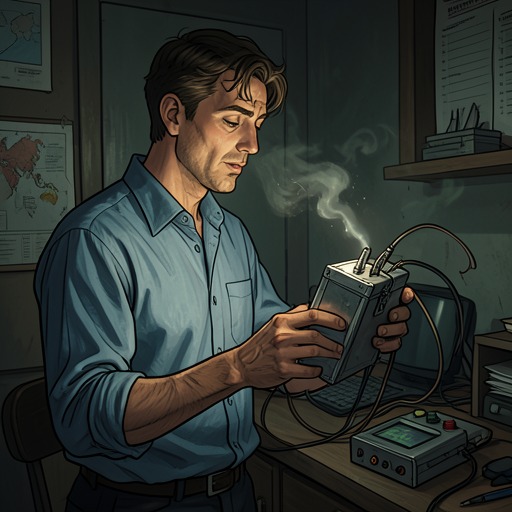
Michael does not ask the Household for permission to put up an antenna because doing so would require him to reveal the battery crisis. Instead, he repurposes an old AM/FM stereo receiver and an oscilloscope from the Lighthouse shed. He fits the receiver into a plain computer chassis, disguising it as equipment that might go unnoticed, connects it to a copper wire antenna running up the chimney, and routes it through the power system’s audio port. By configuring the equalizer to filter out battery noise, he gives himself a way to listen for signals from the west. The improvised receiver cannot broadcast, but it can search. At first, it finds nothing.
Michael’s ingenuity has a cost in isolation and distraction. He habitually treats sleep as wasted time, and his dreams, when he remembers them, are merely variations on circuits, breakers, and relays. The technical problems do not end when he leaves the monitors; they follow him into his rest. Yet the discovery of an old logbook changes what he is looking for. Later, he takes a greater risk by extending a much longer antenna toward the top of the Wall, using copper wire and cable stripped by hand, and working in the shadow of the structure to avoid being seen by the Watch.
The Ghost Signal
Michael calls the faint transmission a ghost signal: an intermittent digital fragment at 1,432 megahertz, a frequency listed in the radio-operator’s manual as unassigned. It first appears after the supply party returns. Michael and Elton establish that it repeats every ninety minutes, transmitting for exactly 242 seconds before falling silent. Its strength increases with each cycle, especially at night, giving the impression that it is moving up the mountain toward the Colony.
The sequence itself seems to offer a clue. Michael notices that 1,432 is made from the first four positive integers in repeating order, and that the pattern appears to cycle without a break. He cannot yet say what the numbers mean, but the signal feels less like a coincidence than a message whose structure he has not deciphered. He continues counting the minutes between transmissions, letting the search consume his attention even as the battery monitors offer no reassurance: despite a hard wind through the pass, the cells are already below fifty percent.
After working through the night, Michael recognizes that the frequency is not truly unassigned. It belongs to the military, and the repeating digital transmission is a short-range signal cycling as it searches for its mainframe. By dawn, it is practically at the Colony’s doorstep. That answer changes the signal from an abstract puzzle into immediate evidence that military equipment—or the system it is trying to reach—is close.
Amy and the Message in the Device
Michael becomes part of the investigation surrounding Amy when he reaches the ward and recognizes the buzzing as the signal he has been tracking. He enters despite Alicia’s warning to keep his voice down, eager to demonstrate that the ghost signal has arrived. The device removed from Amy’s neck is brought to the Lighthouse, where Michael examines it on a leather mat beside his CRT.
The transmitter contains a memory chip unlike any he has seen: exceptionally small, with two tiny gold brads and no obvious ports. One connection leads to the transmitter; the other connects to a delicate arrangement of beaded wires. Michael considers whether the wires function as an antenna or as sensors supplying data to the chip. To find out, he hard-solders the unknown circuitry to the mainframe’s memory board, risking a system crash and the Colony’s lights. His willingness to take that risk reflects the urgency of the signal and the mounting evidence that Amy’s device holds an explanation.
The transmitter’s tiny power source is a capsule battery, probably nuclear, according to Michael’s estimate. More consequentially, its stored data contains 545,406 groups. The transmitter has recorded Amy’s temperature every ninety minutes for ninety-three years, four months, and twenty-one days. From those measurements, Michael concludes that Amy is one hundred years old. The age established by the chip turns the device from a curious transmitter into a record of a life spanning the Colony’s history.
Michael then compares the device’s coordinates with the Lighthouse’s old logbook. Eighty years earlier, the Colony had received a beacon at those same coordinates on a military distress frequency, using old-style Morse code. The note beside the entry reads, “If you found her, bring her here.” Michael establishes that the beacon is still transmitting and explains that running cable up the Wall was necessary to get a reliable signal. His discoveries connect the message, the military transmission, and Amy: the signal is not only approaching the Colony but belongs to a longer attempt to direct someone toward her.
Relationships and Narrative Role
Michael’s close ties make the consequences of his work personal. When Theo and the others are preparing to leave, Michael runs after them to ask where Mausami is and whether she is riding with them. Alicia calls him Circuit and urges Theo to keep moving. Later, Michael recalls that he had seen Theo’s expression change after Mausami married Galen: something seemed to have gone out of Theo, and Michael doubts it could return. The loss of his friend weighs on him during the search for the signal. Though Alicia tells him that his work on the motherboard did not cause Theo’s death, Michael continues to feel responsible, as if he were part of a chain of events leading to it.
Michael’s perspective also brings the Colony’s large-scale predicament down to specific instruments and decisions. Its survival depends on systems that have outlasted their intended lifespan, while its isolation depends on a ban imposed when resources seemed too scarce to share. He is neither able to repair the batteries nor willing to announce their failure without first exhausting another possibility. The radio search gives that conflict a material form: a disguised receiver, a cable climbed toward the Wall, a timed transmission, and a message preserved in an old logbook. Through Michael, the lights cease to be a permanent backdrop and become a fragile achievement whose future may depend on what the Colony dares to hear.