Peter Jaxon
The Passage (Justin Cronin Edition)Peter Jaxon is a son of the First Family whose defining task is to protect others in a world organized around the belief that infection destroys the person it inhabits. His life turns on the growing strain between that inherited certainty and what he witnesses: a friend transformed beyond recognition, a brother in peril, and a mysterious girl whose arrival redirects the survivors’ journey toward the buried history of the disaster.
Identity and the Colony’s inherited truths
Peter is identified as the son of Demetrius and Prudence Jaxon, a member of the First Family, and a descendant of Terrence Jaxon, who signed the One Law. The narration also gives him a chain of honorifics—Peter of Souls, the Man of Days, and the One Who Stood—placing the young man on the gate within the language of a much larger history. In that moment, however, his immediate purpose is starkly personal: on a fading summer evening, near the end of his old life, he waits above the Main Gate to kill his brother.
The beliefs that shape Peter’s judgment were taught to him when he left the Sanctuary at eight. The Teacher explained that a virus entered through a bite, took the soul, and left the body to walk the earth; the infected person, in the Colony’s accepted account, was gone. Peter has lived with this as the foundational truth from which other truths follow. His nights at the gate nevertheless leave him asking why the taken-up return home, and whether any trace of the person they were might remain. The questions do not yet displace the rule he was taught, but they expose the unease beneath it.
Duty, violence, and the cost of protection
At the gate, Caleb is on the other side of a metal barrier, pleading to be let in while the virals retreat into the shadows. Peter’s duty is inseparable from a decision about who may enter and what danger can be admitted with them. The scene establishes the pressure under which he acts: protection requires judgment at the very point where a mistaken judgment could put the people inside at risk.
That burden becomes personal when Peter confronts Zander Phillips. The former acquaintance has fully turned and tries to force his way through a hatch; the station key around his neck confirms who he had been, but Peter recognizes that the viral before him is no longer Zander in any straightforward sense. Peter kills him, and the decision is presented as necessary. Afterwards, seated in the control room with ice wrapped in a wet rag against his injured ankle, he cannot name an emotion about having killed someone he knew. The act has settled the immediate danger, but the difference between the familiar name and the changed being remains too strange for him to process.
In the days that follow, Peter replays the night: what happened on the roof, Caleb’s account of the tower, and Theo’s bitter tone when the brothers discussed guns. The weapons acquire a significance Peter had not previously recognized. He had treated the Time Before as a world severed from the present, with no bridge between what came before and what came after; beyond the Colony, he assumed, lay an open grave of forgotten history. He had also supposed that his father went into the darkness simply to find other survivors. The guns prompt him to reconsider that assumption and, with it, how much of the past he has mistaken for something irretrievably lost.
Theo and the responsibility of kinship
Peter’s bond with Theo is shaped by a promise to their mother. Before she died, Prudence entrusted Auntie with something for Peter, saying he should receive it when he was ready. Peter’s first understanding of his mother’s final instruction was direct: take care of Theo because his brother was not as strong. At Auntie’s bedside, surrounded by remnants of the past, Peter remembers those words and the circumstances in which he cared for Prudence. The memory then changes shape for him; he senses a different emphasis in it, and therefore a different meaning. The instruction remains an obligation, but no longer seems simple enough to be reduced to physical protection.
That responsibility becomes urgent during the attack in the atrium. A viral drops through the roof and lifts Theo, while another seizes him by the ankle and throws him out through the opening. Theo vanishes before Peter can prevent it. Later, when Peter reaches him, he grips Theo by the shoulders and asks whether he is hurt and able to walk. His response is practical and immediate, but it carries the history of a brother he has been told to guard and has already seen taken from him once.
Peter’s protective instincts also shape what he is willing to give up for others. When Hollis raises the possibility of turning back from the journey toward Colorado, Peter is surprised; he had assumed they would continue. The possibility of danger to the Colony complicates that forward drive. Theo, Finn, and the woman Alicia and Mausami identify as Liza Chou came from there, and the virals’ apparent interest in keeping people alive suggests that events cannot be understood as a simple attack. Peter must weigh the expedition’s purpose against the possibility that people at home need warning, as well as Mausami’s ability to continue on foot with an injured leg and the group’s limited ammunition and lack of vehicles.
Amy and a widening account of the world
Peter’s first response to the girl who arrives is recognition without an adequate explanation. Sara sees him in the doorway and wonders how he could know who the girl is; it seems impossible. Peter explains that she saved him at the mall, protected him when the virals attacked, and sent them away. His certainty about what happened precedes any fuller understanding of who she is. The arrival gathers people into new relationships, a pattern Peter later remembers as bodies drawn together and separated, then returned to one another by an unknown force.
A friend presses Peter to look beyond the actions of the virals and ask what they are. The question opens a gap between the Colony’s doctrine and the evidence accumulating around him. Peter’s earlier questions about returning infected people, his experience of Zander, and Amy’s ability to affect the attack all bear on that uncertainty. The material does not resolve the question here; it shows Peter becoming willing to treat the category itself as something that needs examination.
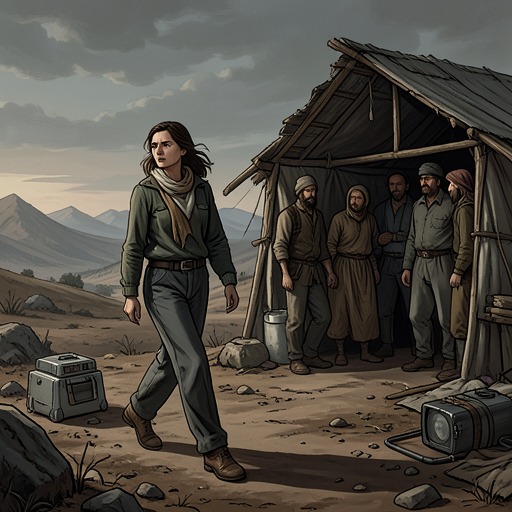
Amy’s presence also changes the direction of Peter’s journey. As the group leaves the farmstead, he notices that she is leading them: their part is increasingly to follow. He recalls the message Michael showed him at the Lighthouse, whose words accompany his steps toward an unfamiliar world and the hidden heart of the past, the place Amy came from. Peter is no longer pursuing only the familiar objective of reaching a destination. His movement is increasingly guided by the person whose arrival has made the old divisions of the world seem incomplete.
From survival toward chosen action
When the group reaches the soldiers’ preparations at the gate, Peter watches Alicia among them and feels the desire to join the war. The wish marks a change in his relation to conflict: he has long acted to protect a boundary, but now he wants to take part in a larger struggle. Yet his commitments remain personal as well as strategic. When injured, he tells Hollis that Sara, Michael, and Hollis should take the convoy, and insists that this is what he wants. His choice places the others’ safety ahead of keeping his closest companions with him.
Peter’s understanding of the past also becomes more concrete through documentary evidence. In a file, he finds a report from Cole to Colonel Sykes of the U.S. Army Division of Special Weapons concerning Dr. Jonas Lear and Project NOAH. A second document, dated five years later, orders twelve human test subjects transferred from Telluride, Colorado, to White Sands, New Mexico, for operational combat testing. Peter takes time to assemble what the papers imply, but he recognizes the meaning of combat. The world beyond the Colony is not only an abandoned landscape: it contains records of deliberate human actions connected to the catastrophe.
His later question about what would happen if they could find the people they were seeking keeps that investigation open rather than reducing it to a settled answer. At the farmstead, the group arrives by motor and finds the houses empty and abandoned, with no sign that Theo and Mausami have heard them. The silence makes return uncertain even after the journey has brought them back to a familiar place. Peter’s story thus holds protection, discovery, and loss in the same frame: the gate may be defended, the past may be approached, and the people he loves may still be absent.
Narrative role
Peter’s development is a movement from inherited explanation toward difficult attention. He begins by enforcing a clear distinction between living people and soulless infected bodies, yet the encounters that define him keep testing what that distinction can explain. Killing Zander is necessary within the crisis, but it does not make the former relationship disappear from Peter’s thoughts. Theo’s disappearance turns family duty into immediate loss; Amy’s arrival makes the survivors’ movement feel governed by a force they cannot yet name; and the Project NOAH files connect the present danger to a human history Peter once assumed had no bridge to his own.
The narration’s images of thresholds and movement help give that change its shape: Peter waits above the Main Gate, steps into the stars, follows Amy toward an unknown past, and returns to a house that offers no assurance of reunion. His significance lies not in possessing the answers but in continuing to act while his account of the world is changing. The titles attached to him suggest a future legend, while the scenes that form him remain particular: a gate to guard, a brother to find, companions to protect, and evidence whose implications he must learn to read.