Project NOAH
The Passage (Justin Cronin Edition)Project NOAH is a secret research and military program whose attempt to extend human life becomes a plan to weaponize the virus it studies. Its history links Jonas Lear’s scientific theory to Cole’s national-security ambitions, the deaths of early test subjects, the transformation of death-row inmates, and the government’s eventual move to operational combat testing. The name evokes Noah’s ark and preservation, but the project’s trajectory is toward containment, secrecy, and the prospective use of infected people as weapons.
Origins and Strategic Purpose
Project NOAH begins as a proposal brought to Richards by Cole, who recruits him in Ankara for an off-the-books security role. Cole presents the program as a new Manhattan Project: a major undertaking that would weaponize the human form and create something permanent. He cannot yet disclose the details, but insists that security must be central as the project’s pieces come together. The pitch makes the project’s military ambition clear before its scientific basis is fully explained.
That basis is VSA, short for Very Slow Aging. Lear’s research proposes that a virus or family of viruses could restore the thymus gland and thereby extend human life and increase physical robustness. Richards has read Lear’s papers, including work published in Science and the Journal of Paleovirology, which hypothesizes that an agent with such effects may have acted at selected points in human history. The possibility is speculative, but Project NOAH makes it a government program with immense resources and a classified security structure.
Richards suspects that Lear’s investment in the work is also personal. Lear’s wife, Elizabeth, died of lymphoma before Cole recruited him, and Richards wonders whether the project is partly an attempt by a grieving husband to undo her death. Lacey later tells Peter that Lear believed he could not unmake the world by himself, though he never quite accepted that belief. These accounts do not reduce the project to one motive: scientific ambition, personal loss, and national-security aims converge without resolving into a single explanation.
Research, Subjects, and Containment
A doctor in La Paz first alerted the Centers for Disease Control to four American patients with symptoms resembling hantavirus. They had been terminal cancer patients and members of an ecotour organized by Last Wish; they said they had become separated from a larger group in the jungle and eventually reached a remote trading post. Their unusual survival and reported history made the cases significant to the developing investigation. The patients’ account tied the medical mystery to the expedition that would draw Project NOAH into the Bolivian jungle.
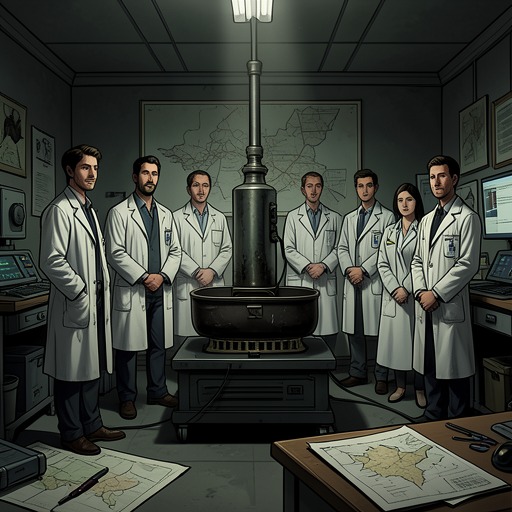
The research becomes catastrophic there. The group encounters infected former tourists, and the expedition is devastated; Lear, Fanning, a soldier, and a graduate student named Fortes are among those who survive. Richards recalls that Special Weapons ordered that anyone who failed to reach the evacuation point be left behind, and a missile strike ensured there were no further survivors from the site. The operation is then concealed: by the time Fanning is secured and Lear is at the Colorado facility, the South American events have been erased from the system.
The program’s experimentation has already killed hundreds of monkeys and many dogs and pigs, as well as several homeless men. Its first human test subjects die within hours, but later refinements weaken the virus enough for a group of former death-row inmates to survive. Eleven of the inmates are described as glowing, and their altered bodies pose a containment and security problem rather than a straightforward therapeutic success. The accounts of subject numbers vary with the stage being discussed: Richards describes eleven surviving inmates at one point, while the later program reaches twelve subjects, with Fanning counted separately.
The virus also makes the facility dangerous to its own staff. Richards recalls a technician becoming ill in a decontamination chamber after exposure; Richards seals the level, and the technician dies. The chamber is purged, and the level remains closed for a seventy-two-hour quarantine before being reopened. This incident shows that containment is not merely a procedural backdrop: the research material can cross the boundary between experiment and institution, making a local failure a potential wider threat.
From Research Program to Combat Deployment
Carter’s transformation marks a decisive change in what the program believes its subjects can do. His flip takes thirty-six days, the longest observed at that stage of experimentation. Richards identifies him as the most difficult subject and as the last stage before the virus reaches the form associated with Amy. During the breach, Carter moves with extraordinary speed and attacks a man; staff use intense lights to force him back before they can lower the gate. The incident makes the danger visible to observers who had previously relied on reports from Bolivia.
The researchers’ attention to Amy is, at this stage, subordinate to the program’s wider objective. Richards says that Special Weapons no longer regards her survival as decisive, even as Wolgast tries to bring her around. He reasons that if she dies, Wolgast’s presence with her will not matter. This calculation exposes the project’s shift from care for an individual subject to the strategic value assigned to experimental outcomes.
Once the twelve subjects are assembled, Project NOAH is designated for transition to Operation Jumpstart. Richards is told that the subjects will be moved to White Sands in a week, after which the program will be out of his hands. Cole had once imagined them as weapons for use in places such as caves in northern Pakistan, deserts in Iran, or buildings in the Chechen Free Zone. Richards recognizes the logic as both dangerous and potentially uncontrollable: he believes the proposal violates international treaties and doubts that such weapons could be confined to their intended targets.
Secrecy, Public Crisis, and Retrospective Disclosure
The program’s secrecy shapes what different people can know. Wolgast is told only a limited version of the background because he must ask test subjects to sign away their lives and needs to tell them something. Later, as the infection spreads, official explanations remain contested: a presidential address presents Colorado fever as an act of terrorism, while officials acknowledge that information from inside the quarantine zone has broken down. Public uncertainty and conspiracy claims grow alongside reports of outbreaks and government containment measures. The result is a widening gap between what institutions know, what they disclose, and what people outside the facility can infer.
For the survivors who come later, Project NOAH’s concealed history becomes a question of responsibility. Peter reads files describing Lear’s project and a later order transferring twelve human subjects from Telluride to White Sands for operational combat testing. He understands the central reversal: the Army he had expected to return was responsible for what had happened. Lacey confirms that Lear was involved, while distinguishing his actions from simple malice; she says that he left the files for whoever came back, so they would know what happened there.
The name’s biblical resonance is therefore double-edged. To the children brought to the Sanctuary, the place is explained as an ark that will keep them safe until the war is over. Elsewhere, Sykes sends Wolgast to the story of Noah, and Wolgast finds the line that Noah lived nine hundred and fifty years before he died. In the project’s own history, preservation and extended life have become entangled with lethal experimentation and military planning. Project NOAH’s significance lies in that contradiction: an institution named for shelter and survival helps create the catastrophe from which later generations need shelter.