Second Expeditionary garrison
The Passage (Justin Cronin Edition)The Second Expeditionary garrison is a fortified military compound near the Colorado border, encountered by Peter Jaxon and his companions after their long journey from California. Its imposing defenses and signs of military organization turn the idea of an army into a physical reality, while their restricted status inside it makes clear that protection and freedom are not the same thing.
Setting and Defenses
Peter’s party reaches the garrison in midafternoon after marching north from a river, over a ridge, and along a muddy track marked by hoofprints and tire tracks. Clouds gather, rain begins, and Peter catches the smell of woodsmoke in the wind as Major Greer’s patrol leads them toward shelter. The route has been difficult enough that Peter recognizes how easily they could have missed the track on their own.
The compound sits in a bowl-shaped valley below the ridge. Canvas tents and vehicles occupy an area of less than half a square kilometer, enclosed by a timber wall at least fifteen meters high, its posts sharpened at the top. Floodlights stand on tall poles around the perimeter, and soldiers patrol a catwalk along the wall. The vehicle fleet includes at least six Humvees, two large tankers, and smaller trucks, pickups, and five-ton vehicles with mud-choked tires; horses graze in a paddock at the far end. A large flag bearing red, white, and blue blocks and a single white star flies above the center.
Command and Military Organization
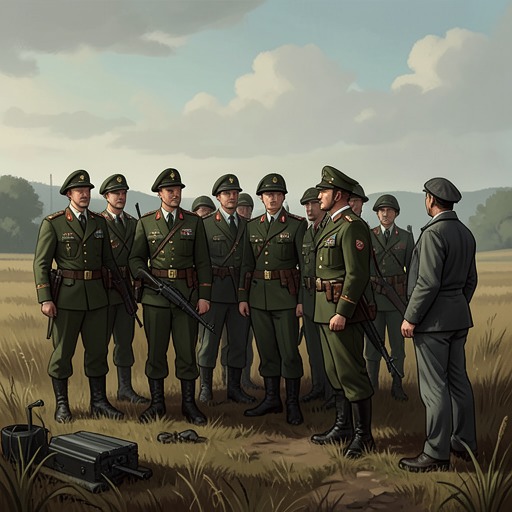
Greer’s unit consists of fifteen soldiers who have been patrolling in the woods for weeks. Their camouflage is streaked with mud and charcoal, and their equipment and bearing make them appear closely integrated with the forest they have been traversing. Greer carries a rifle and a holstered pistol; as the garrison comes into view, his men quicken their pace at the prospect of a hot meal, a cot, and a roof.
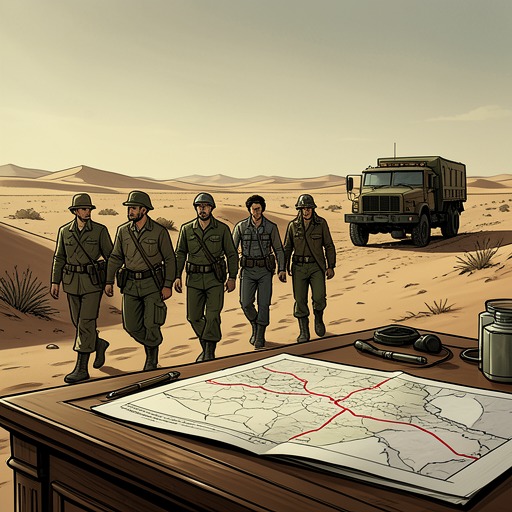
The party is brought into a tent that serves as a command space. Its earthen floor, sagging canvas roof, potbellied stove, and paper-covered trestle tables give the room a makeshift quality, but a soldier operates a radio beneath a large map. Beaded pins mark an irregular V: one arm runs north from central Texas across Oklahoma into southern Kansas, while the other heads through New Mexico and then north to the Colorado border, where the garrison stands. The map is labeled as an intermediate political map of the United States and retains the imprint of a Cincinnati mapmaker, joining a remnant of the old country to the military’s present campaign.
Brigadier General Curtis Vorhees identifies himself as commander of the Second Expeditionary Forces, Army of the Republic of Texas, and makes clear that he is the senior authority at the garrison. Greer’s quiet welcome to Peter’s group—“Welcome to the war”—gives the map’s routes their immediate meaning: this is not simply a remote shelter, but a military headquarters situated within an ongoing conflict.
Arrival and Significance
The garrison offers a striking contrast to the exposed country through which Peter’s group has traveled. From the ridge, the lights and dense arrangement of buildings and vehicles make the small compound seem to Peter like an entire city, the heart of a world he had believed in without ever imagining. Michael’s observation that the garrison has lights underscores the importance of power and infrastructure in a landscape where such things are scarce.
The arrival is not a straightforward release from danger. The group’s packs are returned, but their weapons are withheld; they are told they are under protection, yet cannot leave as they wish. That distinction places them in a guarded, dependent position even as the compound supplies the shelter the travelers need. The garrison thus appears at once as refuge, military stronghold, and threshold into a larger political order whose reach is charted on the wall inside its command tent.