Sierra Leone
The Passage (Justin Cronin Edition)Sierra Leone is the West African homeland of Sister Lacey Antoinette Kudoto and the landscape in which she first experiences what she understands as the voice of God. The novel renders it through fragments of childhood—palm fronds, water over rocks, cocoa fields, and a family’s home—rather than through a broad account of the country. Those remembered places anchor Lacey’s spiritual identity and the traumatic vision that later returns to her in a dream.
Homeland and Early Life
Lacey tells Jeanette that she comes from Sierra Leone, in West Africa, and explains to the young Amy that it is far away. The exchange gives the country an immediate personal meaning: it is not simply a point of origin but the distant home from which Lacey has traveled to serve at the Convent of the Sisters of Mercy in Memphis, Tennessee. Her gentle introduction of herself and attention to Amy make the distance between the two places part of the scene’s quiet intimacy.
Her memories locate childhood in a village surrounded by natural sounds. Palm fronds rustle in the ocean wind above the village; a stream runs over rocks behind her house; and, later, Lacey walks to school through cocoa fields. These surroundings are not merely scenic details. They are the first medium through which she perceives a presence in the world, before she has language for what she hears.
The Voice in the Landscape
When Lacey is about six or seven, she asks Sister Margaret, who runs the convent school in Port Loko, what the whispers are. Sister Margaret tells her that they are the voice of God. Lacey recognizes the explanation as something she already knew, and keeps their exchange private, as though it established a confidence shared between the two of them.
The voice is neither ordinary speech nor simply an external sound. Lacey experiences it as coming from within her and from everywhere around her, like a whisper made of light, moving as gently as a breeze across water. At times it recedes for weeks or even a month, leaving the world seeming ordinary again. In those intervals, she imagines that other people live without the presence she hears; the thought of their isolation makes her so sad that she can cry for days. A French doctor examines her but finds nothing wrong. By the time she enters the Sisters at eighteen, Lacey understands the recurring voice as a call addressed to her by name.
Childhood Memory and the Dream
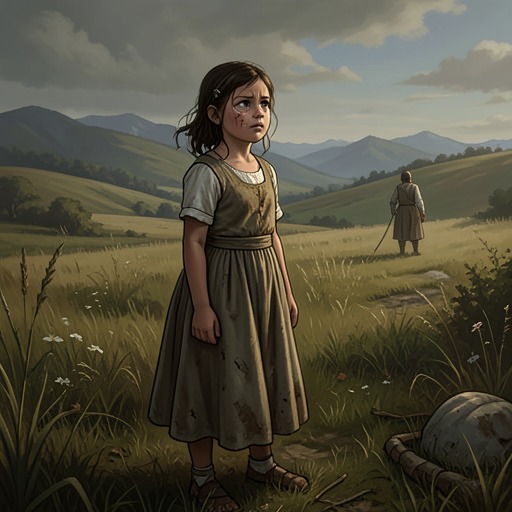
Lacey also remembers herself as a child angry with her mother for refusing permission to attend a carnival before she had finished her lessons. She was excited by the promised horse tricks, ran away at night, and hid in the fields behind the family yard, expecting her mother to discover her absence and regret the punishment. The dark and cold frighten her; she eventually returns home and gets into bed, and no one learns she left. In telling Amy this story, Lacey makes the distant country intimate through a familiar childhood quarrel, a private act of defiance, and a retreat back to the safety of home.
A later dream returns Lacey to those fields but changes their meaning. She is beneath a low palm bush while her sisters run away and armed men move through the area. She hears her mother shouting for the children to flee, yet remains frozen, unable to move. Gunfire breaks the darkness in flashes; in those brief instants she sees the house, the fields, and the men sweeping the ground with rifles. The dream’s fragments of bodily terror—wet legs, smoke, sweat, and the taste of blood—make the landscape a place of remembered violence as well as childhood refuge.
Distance, Calling, and Return
The dream ends with the voice telling Lacey not to move. A man approaches, his shadow passes over her, and then he is gone; when she opens her eyes, the fields are empty and she is alone. This scene does not explain the dream’s relation to any specific historical event, but it sets the voice she associates with God against an image of danger that she cannot escape through movement. Sierra Leone therefore holds both sides of Lacey’s remembered beginning: the everyday world whose wind and water first seemed to speak to her, and the terrifying field in which fear immobilizes the child she was.
The narrative brings these memories together from Lacey’s later life in Memphis. The village, the school at Port Loko, the family house, the fields, and the distant convent are disclosed through recollection rather than through a continuous return to the country. Sierra Leone’s significance lies in that remembered geography: it is where Lacey first hears her calling, where she learns to name it, and where the novel’s dream imagery binds spiritual listening to vulnerability and loss.