The Starry Sky
The Passage (Justin Cronin Edition)The Starry Sky links the vanished world before the catastrophe to a future the inhabitants of the Colony can barely imagine. For Auntie, the stars are the most missed sight of her childhood; for Peter, they are an inheritance from his father and a revelation beyond the Colony’s walls. Their absence is not simply darkness: the artificial lights that keep the settlement safe have also blotted out the heavens, making protection and loss part of the same landscape.
The sky remembered
In Auntie’s account of the Time Before, the stars are a childhood memory handed down by her mother. From her bedroom window, she could look over the roofs and watch points of light suspended above the houses. Her mother taught her that, if someone watched long enough, the stars could form pictures: spoons, people, animals. Auntie once thought that looking at them was like looking directly at God. Darkness, in that childhood understanding, was what made the divine visible.
That memory gives the stars a personal as well as cosmic scale. Auntie recalls Christmas lights and moving figures in store windows, but says that the stars are the one thing she would most like to see again before she dies. Her longing belongs to a vanished ordinary life, not merely to an abstract idea of a lost world: a familiar view from a bedroom window has become irretrievable.
Auntie’s recollection also records the moment the loss became collective. On First Night, after the children had been brought to the Sanctuary and the gates sealed, the Colony’s lights came on so brightly that they blotted out the stars. Auntie stood outside with Terrence, shivering in the cold, and understood that this was where they would live from then on. In all the years that followed, she never saw the stars again. The Colony’s illumination stands at once for refuge from danger and for the closing of a world beyond its walls.
Inherited memory
The stars survive in the Colony not as a sight but as remembered testimony. Auntie speaks of them often, and Peter’s father described them as spread across the sky in numbers impossible to count. When he told stories of the Long Rides and the places he had seen, their light was in his eyes. Peter grows up with this inheritance, but without direct experience of the heavens: the stars are initially part of his father’s stories and Auntie’s memories, attached to a wider world he has not known.
Auntie’s work as a keeper of memory makes that inheritance deliberate. Her hand-stitched, lambskin-wrapped book preserves the old world and the community’s beginnings in her small handwriting, made with a crow feather and homemade ink on paper she forms from boiled sawdust. She writes about the world before, the train that brought them to the Colony, and the people who lived through First Night. The stars belong to this record because their disappearance is part of the Colony’s history, and because a remembered sky lets later generations know that the enclosed settlement is not all that once existed.
The burden of remembering is personal for Auntie. Many of the First Ones have died or been taken up, and she fears that without her writing their names and experiences would disappear with them. Her account turns the stars into one strand of a larger archive: a view of the heavens survives through a chain of witnesses even while the physical view remains hidden.
Peter’s first sight
Peter’s encounter with the stars comes after he has spent nights on the Wall waiting for Theo to return. From the firing platform he can hold the Colony’s terrain in his mind: its fields and buildings, the Sanctuary, the Sunspot, and the humming battery stack. In that familiar, carefully watched enclosure, Auntie’s stories and his father’s descriptions give the coming night sky an importance he has inherited but not yet tested for himself.
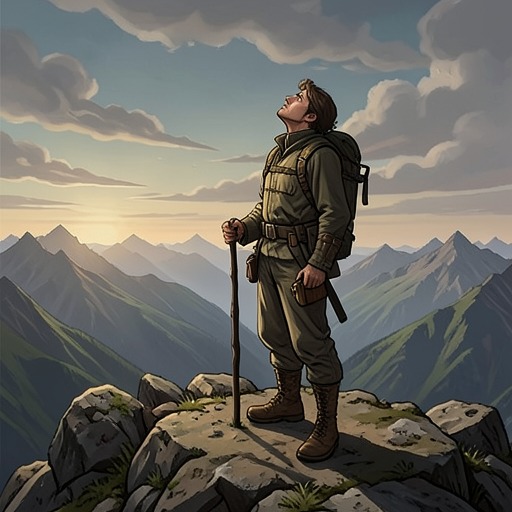
When Peter and Alicia reach the roof, he steps out of the hatch and into the open sky. The sight first overwhelms him physically: panic catches his breath, his knees bend, and his free hand searches for something solid. Then his eyes adjust, and the stars multiply across the darkness. They are the very stars his father had seen on the Long Rides. Their appearance transforms inherited description into direct knowledge, and the sensation of stepping into the sky marks a sharp contrast with the bounded, illuminated Colony below.
Peter keeps looking. The sky seems so dense with stars that he imagines he could reach out and brush them with his hand. Their beauty carries his thoughts outward to the oceans he has encountered through names in a book—Atlantic, Pacific, Indian, Arctic—and to his father standing at the edge of the sea. He also recalls Auntie’s association between the stars and God, and wonders whether they are what she meant by the God of the Time Before. The scene connects the stars to the wider world his father traversed, to Auntie’s spiritual memory, and to Peter’s own newly opened sense of scale.
Light, absence, and return
The stars’ central contradiction is built into the Colony’s survival. Its bright lights help make a defended home, yet their glow conceals the heavens that Auntie and Peter’s father remember. When Peter waits on the Wall, the approaching night promises the stars, but the gate’s opening and the Colony’s lights interrupt that expectation. The same illumination that marks safety also repeats the loss established on First Night.
Auntie and Peter thus encounter the same absence from different sides of time. She remembers seeing the stars and mourns their permanent disappearance; Peter knows them through stories and then discovers them for himself. His sight does not erase Auntie’s loss or restore the old world, but it makes her remembered account newly present. The sky becomes a point where private memory is transmitted, tested, and renewed across generations.
The image also resists the Colony’s apparent completeness. Peter can inventory its walls, paths, fields, and machinery, yet the stars disclose a world that cannot be contained by that mental map. Their return to view does not promise safety or solve the dangers facing the characters. Instead, it alters what the enclosed world means: beyond its systems of defense and artificial light lies an immense reality that the Colony’s inhabitants had inherited only as story, and that Peter can finally see.