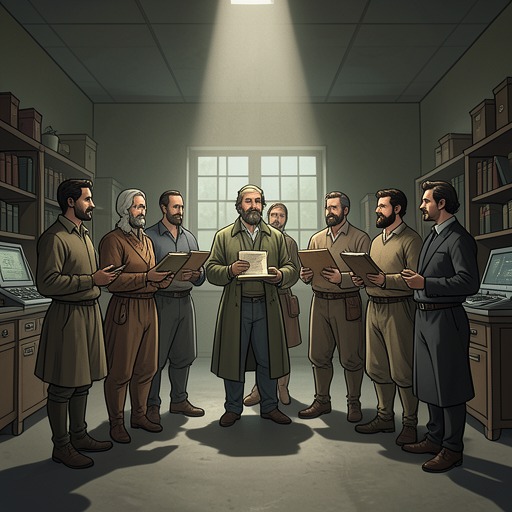
Under the lights
The Passage (Justin Cronin Edition)“Under the lights” is both the First Colony’s literal refuge and a compact expression of its social order. For generations, light has meant protection and continuity; as the power system decays and a Walker arrives from beyond the walls, that shelter is revealed as fragile and conditional.
A life organized beneath the lights
For ninety-two years, eight months, and twenty-six days after the last bus climbed the mountain, First Colony’s inhabitants had lived under the lights, under the One Law, according to custom, and under the protection of the Watch. The Household governed them; the Army was absent. The repeated phrase places illumination within a whole structure of law, routine, security, and isolation, not simply as a feature of the settlement’s infrastructure.
That duration gives the lights the weight of an inherited world. The inhabitants have had only themselves and those they have made for company, and their settled day-to-day depends on boundaries that have held for generations. The phrase therefore carries both comfort and confinement: the lights mark a protected interior, while the life beneath them is cut off from the larger world.
The material fragility of protection
The security represented by the lights depends on aging equipment. Michael sees the batteries’ decay on the green bars of his battle-hardened CRT. Though built to last perhaps thirty or fifty years, the cells have continued working for almost a century; the wind turbines can keep turning, but without batteries to store and regulate their current, one windless night could extinguish the system. The membranes are no longer repairable, and Michael estimates that the lights may fail within a year or two.
The radio ban belongs to the same history of protection through restriction. The radio had once led Walkers to the Colony, an outcome the Builders had not planned for, and the decision was made seventy-five years earlier to destroy it, remove the mountain antenna, and scatter its parts in the dump. Michael can understand the original calculation: the Army knew where the settlement was, and food, fuel, and space beneath the lights were limited. But with the batteries failing, preserving a closed system no longer seems sufficient to preserve the people inside it.
An arrival tests the boundary
The appearance of a young Walker forces the settlement’s old calculations into the present. Sam Chou first reacts angrily to the prospect that someone must pay for the gate being opened, even though the person at risk is a defenseless boy who may have believed someone on the catwalk told him to do it. Looking back, Sam recognizes how little attention he had paid to the girl whose arrival caused the crisis. To him, she means that someone is still alive outside the Colony, perhaps many people; she also unsettles the balance on which his familiar life depends.
Sam’s thoughts expose the tension within the phrase. The lights have kept the community safe, but the scarcity of food and fuel has made exclusion seem like common sense. He is not convinced that the Army is coming, yet the girl’s presence raises a different possibility: outsiders may come seeking shelter under the lights. His unease shifts the question away from what should be done to the boy and toward what the Colony should do about the girl. Protection becomes inseparable from the decision about whom it protects.
When light fails
The Colony’s dependence on illumination becomes immediate when the lights go out. Michael runs from the catwalk to the Lighthouse in darkness, shouting for Elton and expecting the system to have crashed. Instead, the CRTs still glow and the meters remain in the green. He finds the main breaker open; closing it restores the lights. At first light, he reports a power surge to Ian, although he can find no supporting system log and no fault in the connections.
The episode distinguishes a functioning power system from a secure one: the lights can return, but their sudden absence cannot be explained away by the ordinary signs of equipment failure. Elsewhere, in a place threatened by virals, Peter recognizes that the fumes are so dense he can scarcely breathe and that the building will go up like a torch. The contrast sharpens the phrase’s significance: light can signify shelter, but fire and electrical failure can also make enclosed spaces lethal. “Under the lights” remains a promise only so long as the infrastructure, and the choices made in its name, continue to hold.