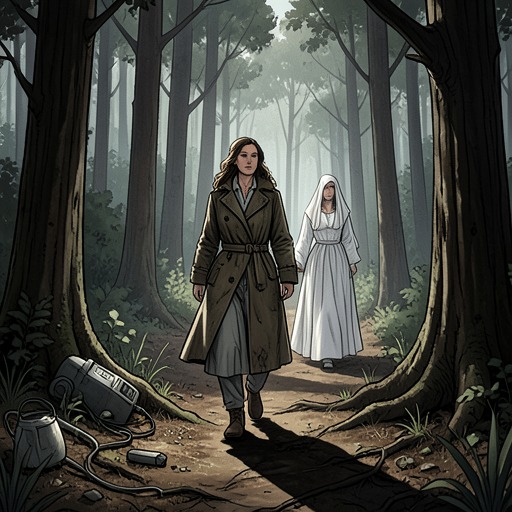
Viral infection (being taken up)
The Passage (Justin Cronin Edition)Viral infection (being taken up) is the process through which the virus enters a person and transforms them into a viral. It shapes both the physical dangers of life beyond the Colony’s walls and the laws by which the Colony regulates contact, illness, and death; its most enduring uncertainty is whether transformation erases the person entirely or leaves some trace capable of remembering home.
Infection and Its Visible Signs
The Colony’s account of infection begins with direct physical contact: anyone, whether a First Family member or a Walker, who touches a viral must be quarantined for at least thirty days. Infection is also associated with a set of observable symptoms, including seizures, vomiting, aversion to light, changes in eye color, blood hunger, and spontaneous disrobing. The law treats such signs as grounds for immediate confinement and, potentially, execution by the Watch. Contact and symptoms therefore operate as distinct thresholds: the first imposes a required period of separation, while the second allows the authorities to take more immediate and severe action.
The physical change is not always instantaneous or externally complete. The Colony recognizes a quickening: a period in which a person becomes ill and shudders, and may tear off their clothing while staggering. People at a later stage are considered especially dangerous, and some have killed relatives who were standing watch for their return. The progression makes infection a public threat as well as an individual condition; those nearest to a returning person may face danger even when they have come to carry out the expected act of mercy.
Rules, Quarantine, and the Watch
The Colony’s laws place infection inside a wider system of public security. Quarantine applies regardless of a person’s standing as a First Family member or Walker, formally extending the same minimum isolation requirement across that distinction. But the law also grants the Watch discretion to confine or execute anyone exhibiting listed symptoms. The result is a regime in which infection is managed not only through separation but through coercive judgment: bodily signs can determine whether a person remains at liberty, is confined, or is killed.
That system is shaped by an account of infection taught as settled truth. When Peter left the Sanctuary at eight, Teacher explained that the virus entered through a bite, usually at the neck, stole the soul, and left the body to walk the earth indefinitely. Under this teaching, the former person was gone. The explanation gives the Colony a clear rule for interpreting infection, but it also makes the observed behavior of returning virals difficult to reconcile with the doctrine: they come back to the place where they once lived, and many wait at its gate rather than resist the people who meet them there.
Return, Mercy, and the Uncertain Soul
People who have been taken up may return after three days, five days, or as long as a week. Many are Watchers, members of scavenging parties, workers sent to the power station, riders with the herd, or members of crews who go outside to work. Exposure is possible even in daylight wherever virals can move through shade. The danger is thus part of ordinary labor beyond the walls, not a risk confined to deliberate expeditions or nighttime attacks.
The returned are not all in the same condition. Some have completed the transformation; others arrive while still in the quickening, visibly sick and potentially dangerous. Yet many offer no resistance. They stand at the gate beneath the lights and wait to be shot. Peter considers whether that behavior reflects a surviving awareness of their former humanity, perhaps enough for them to want death. His question conflicts with what he was taught: if the virus has taken the soul and left only a body, why should a viral return home at all?
This uncertainty is embedded in the Colony’s practice of the Mercy, the vigil for a missing person who may have been taken up. Peter stands for his brother Theo during the seventh and final night, after which Theo will be declared dead and his name put on the Stone. The custom joins mourning to the possibility of return, but sets a limit on how long the community will wait. The same society that expects the taken-up to come home must eventually record the missing as dead if they do not.
Relationships and the Cost of Recognition
The rule-bound account of infection does not make the process emotionally abstract. Wolgast’s memory of his daughter Eva, who died three weeks before her first birthday, shapes his understanding of the people recruited into Project NOAH. He recognizes a connection between the mistakes that people inherit from others and his own history of loss; after Eva’s death, he had lived as though carrying the empty space where she had been. His response to the people involved in the project is therefore informed by grief as well as by his work with them.
A sharper collision between doctrine and recognition occurs when Hollis shoots a viral and realizes, at the instant the arrow reaches its target, that it is his brother Arlo. The key glinting at the viral’s neck and the expression Hollis reads as mournful gratitude expose the personal identity concealed by the category of monster. Recognition comes too late to avert the killing. The scene gives the Colony’s practice of mercy its hardest contradiction: an act intended to end the suffering of someone already considered lost can become the moment a relative discovers that the person is still recognizable.
Significance
Being taken up defines the boundary between a person the Colony can protect and a body it fears, confines, or destroys. The laws offer procedures for contact and symptoms, while the Mercy gives families a set time to await the missing; neither system resolves whether infection eliminates the self. The returned person’s journey home and the possibility of recognition resist the certainty of the teaching Peter received, even as the danger of the quickening makes hesitation consequential.
The state’s decisive ambiguity is therefore not simply whether a viral remains dangerous. It is whether danger and personhood can coexist. Peter’s question about the soul, Hollis’s recognition of Arlo, and the Colony’s ritualized response to return each expose a limit in the same governing belief: the body may have changed, but the signs that it once belonged to someone continue to matter to those who wait at the gate.