Viral infection and transformation
The Passage (Justin Cronin Edition)Viral infection and transformation names the process by which infection takes hold and changes a person into a viral. The novel makes that change legible through its consequences for the living: illness can move from uncertain diagnosis to an approaching death, while those confronting the infected must decide whether to fight, wait, or grant a requested death. Its most consequential scenes resist treating every viral as an anonymous threat: recognition, duty, and remembered relationships persist at the point where a person seems to be lost.
Infection and the approach of transformation
The process is introduced as a frighteningly fast illness whose cause remains uncertain. After bats attack an expedition camp, the survivors report that the bitten and scratched have developed what resembles an accelerated form of Bolivian hemorrhagic fever. The expedition has contacted the CDC, but without tissue analysis no diagnosis is certain. The report gives infection a specific narrative shape: exposure is followed by severe illness, and the expedition’s planned extraction becomes doubtful because so many people are sick or dead.
The attack also establishes that the danger is not abstract. The writer reports four deaths in the first assault, including Claudia, and says that Tim, who tried to pull the bats away from her, is the sickest and may not survive the night. On the following night, the swarm returns despite a defensive perimeter; three soldiers and Cole are killed. These events do not establish a clinical account of transformation, but they show the circumstances in which infection becomes an immediate question of survival for an isolated group.
Recognizing a person in a viral
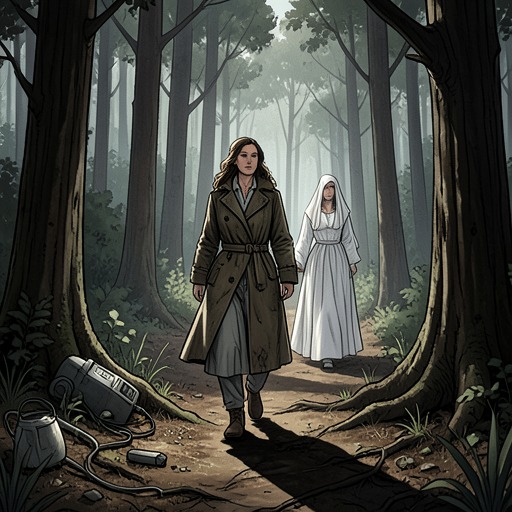
Hollis’s killing of the viral identified as Arlo makes recognition part of the transformation’s human cost. During an attack, Hollis draws the creature toward him and prepares a crossbow shot. He notices a glint at its neck, then sees what he understands as mournful gratitude in its eyes. The recognition arrives as the arrow is already in flight; he says Arlo’s name at the moment it strikes. Only afterward does the full consequence settle: Hollis has killed his brother.
The scene turns a seemingly clear act of defense into an irreversible familial loss. The object at the viral’s neck and the look Hollis reads in its face briefly make the creature legible as someone he knew, but that knowledge comes too late to recall the shot. Transformation therefore does not simply divide humans from monsters in this account. It creates a dreadful interval in which a person may be encountered as a threat and recognized as kin within the same instant.
Choices at the threshold of death
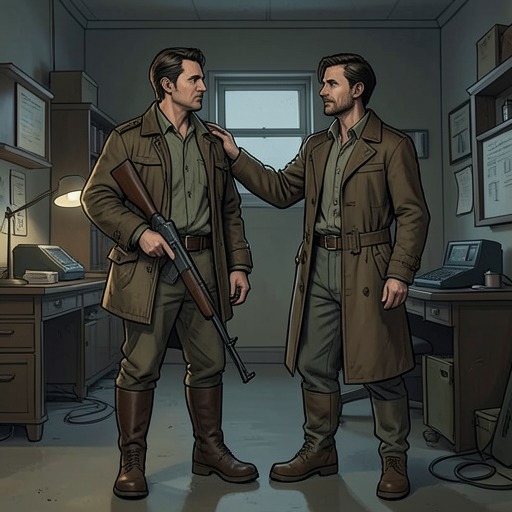
Muncey’s case presents a different response to infection: the infected soldier anticipates that he will not recover and asks for control over how he dies. He explains that a viral attacked him before Alicia killed it, and acknowledges that Alicia brought him home when she could have left him. When his body begins to shake, the soldiers around him instinctively reach toward their blades, but Greer stays beside him without flinching.
After the spasms pass, Muncey speaks calmly and asks to be killed with a blade, saying he wants to feel it coming out of him. He asks that Alicia perform the act because she was the one who brought him back. Greer accepts the request as the right of a soldier of the Expeditionary. In this exchange, the approaching transformation is framed not as a spectacle but as a decision involving the infected man’s agency, military belonging, and gratitude to the person who rescued him. The evidence records his request and the permission it receives; it does not describe the act itself.
Alicia’s unresolved change
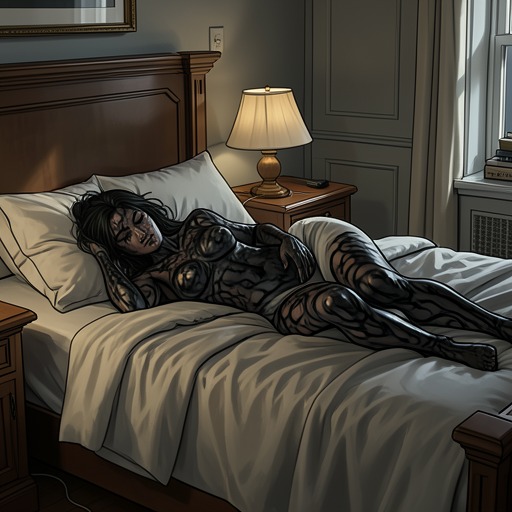
Alicia’s transformation remains uncertain in the aftermath of the fight at the mountain house. Peter identifies the substance in a vial as Amy and gives Alicia half of it. The group waits through the day and night while Alicia lies in a twilight state; by morning, she strains against her restraints. Peter’s attempted blade stroke is abruptly stopped when Alicia seizes his wrists. Her restraints give way, and Peter recognizes that she has become more powerful than a human being.
The interrupted blade is a reversal: the group had been waiting to see whether Alicia would succumb, but the force that stops Peter’s action reveals a change already underway. The evidence establishes neither a completed account of Alicia’s new condition nor its ultimate outcome. Instead, the scene leaves infection and transformation at a threshold: Alicia is no longer simply the wounded companion the group was watching, yet what she has become remains beyond their understanding.
Loss, memory, and the meaning of the turn
Across these episodes, the turn is measured not only by altered strength or severe illness but by what others must do in response. Hollis’s shot becomes a killing of his brother when recognition arrives; Muncey’s approaching death becomes a matter of choice and comradeship; Alicia’s recovery becomes alarming when her physical power exceeds Peter’s. Each scene changes the meaning of an action that might otherwise appear straightforward—defense, mercy, or care.
Wolgast’s reflections connect this recurring moral burden to earlier losses. He understands that his grief over Eva, who died three weeks before her first birthday, left him feeling like a living dead man and shaped his ability to respond to Anthony Carter and the other men recruited for the project. He also realizes that the choice of him for the federal assignment was connected to Eva’s death. These passages do not explain the biological mechanism of transformation, but they place the novel’s concern with altered life beside grief, borrowed choices, and responsibility for other people. Infection threatens to erase the person; the people who remain must still reckon with the person they knew.