“What would you have done”
The Reader“What would you have done?” is Hanna’s recurring question to the judge during her trial, where it turns an appeal for practical understanding into a test of the limits of explanation. The first time, she genuinely wants to know what she could have done differently; when she asks again after describing the circumstances surrounding the church fire, she expects no reply. The difference between those moments captures the expression’s changing force: it demands moral imagination but cannot make a difficult situation an answer to the charge.
First Question in Court
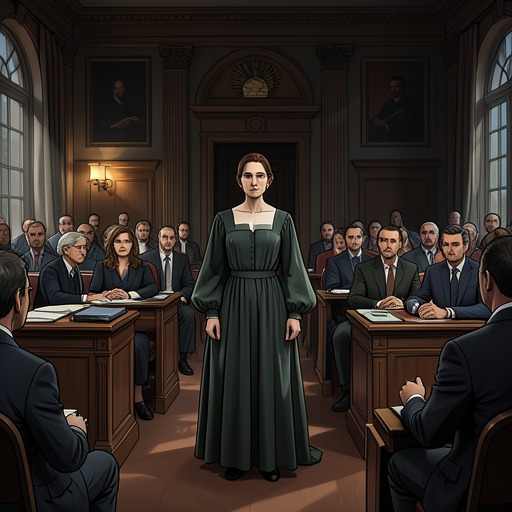
The question follows the judge’s challenge to Hanna’s account of returning prisoners to their deaths. Hanna does not understand what he is asking of her. When she asks what he would have done, the narrator stresses that she means it seriously: she does not know what she could or should have done differently and turns to the judge as someone who seems to know.
Her question reverses the usual direction of a trial. It is not customary for defendants in German trials to question the judge, and the courtroom falls silent while the judge considers whether he must answer. His irritation appears to serve as a mask, buying him time under the expectation that he cannot simply dismiss her. The exchange briefly makes the judge, rather than the defendant, answerable to the question of what action was possible.
The judge eventually says that there are matters one must refuse to become involved in, even at the cost of life and limb. His answer places a boundary between danger and moral permission: the presence of risk does not erase the obligation to refuse. Hanna’s question therefore receives a principle, not a reconstruction of the choices she faced or a resolution of her responsibility.
The Repeated Question and the Church Fire
Later, Hanna describes the guards’ claim that they could not let their prisoners escape because they had been responsible for guarding them. She says they did not know how many of the women would survive the next few days; many had already died, and those still alive were weak. Realizing that her explanation is worsening her case, she tries to describe the situation more clearly and turns to the judge again: “What would you have done?”
This time she knows there will be no answer and does not expect one. The judge silently shakes his head. The repeated words no longer open a pause in which the court might imagine her uncertainty; they mark the failure of that appeal to change the terms of judgment.
The narrator acknowledges the conditions Hanna describes: night, cold, snow, fire, the women screaming in the church, and the sudden departure of the people who had commanded and escorted the female guards. Yet the account distinguishes imagining the confusion from treating it as mitigation. The difficulty of the situation does not turn the guards’ decisions into an accident or a conflict between equally compelling duties. In that contrast, the question’s central limit becomes clear: understanding the pressure surrounding an action is not the same as excusing what was done or left undone.
Wider Moral and Narrative Resonance
The expression also echoes the seminar’s debate over the Nazi past. Michael and his fellow students considered themselves explorers bringing suppressed horrors into public view; they condemned the generation that had served the perpetrators, failed to stop them, or tolerated them after 1945. Their inquiry included the difficult relationship between written law and the law actually interpreted and enforced when crimes were committed. The trial and the question addressed to its judge thus sit inside a broader argument about whether legal and moral responsibility can be settled by pointing to rules, circumstances, or the conduct of others.
Michael later reflects that collective guilt, whatever its validity as a legal or moral concept, was a lived reality for his generation. The shame attached not only to the crimes of the Third Reich but to the continued presence of old Nazis in public institutions and the habits of conformity that had been handed down. Accusing the older generation could turn passive shame into activity, but it did not abolish shame. When Michael recognizes that Hanna’s crimes were worse than the guilt of others in his surroundings, his accusation turns back on him: he had loved and chosen her, even if he tells himself he knew nothing of what she had done.
Near the end of the novel, Michael tells another person that Hanna had been illiterate for most of her life and learned to read and write in prison. Asked why he sent her tapes, he answers that they had been in a relationship when he was fifteen. That disclosure does not settle what his earlier knowledge or silence means; it places his personal attachment beside the public questions raised at the trial. Across these contexts, “What would you have done?” asks for a judgment rooted in circumstances, while the novel resists letting either understanding or personal history stand in for accountability.