Cassette player
The ReaderThe cassette player is the practical and symbolic hinge of Michael Berg and Hanna Schmitz’s long-distance connection. Packed with recorded readings and sent to Hanna in prison, it lets Michael’s voice cross the barrier between them without opening a conversation; Hanna then uses the machine to follow printed books word by word, turning a device for receiving stories into part of her path from dependence toward independence.
Sending the Machine and the Readings
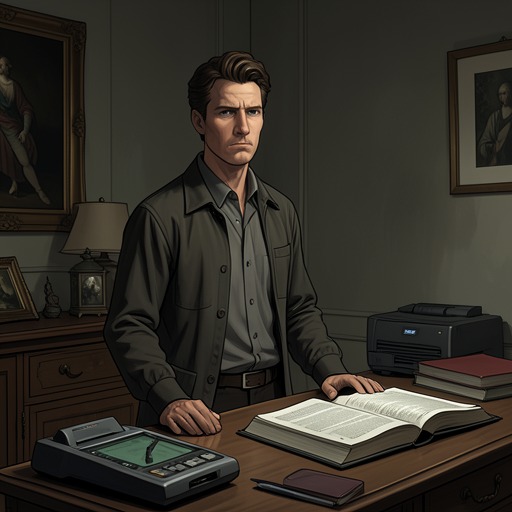
After his separation from Gertrud, Michael reads aloud at night, when insomnia and memories of his marriage, daughter, and Hanna circle through his thoughts. He records the readings for Hanna, but waits months before sending them: first he completes the Odyssey, then adds stories by Schnitzler and Chekhov, and delays contacting the court to learn where she is imprisoned. At last, he sends a package containing a cassette player and numbered tapes, ordered from Chekhov to Schnitzler to Homer, to the prison near the city where Hanna was tried and convicted.
Michael’s preparation makes the machine part of a deliberately one-sided exchange. He reads what he wants to read, including works by Keller and Fontane and poems he eventually learns by heart. When he begins writing himself, he records his own pieces for Hanna too, revising them if reading aloud shows that they are not finished. Yet the recordings contain no personal remarks: he announces the title and author, reads the text, pauses, closes the book, and presses Stop. The player delivers his voice while preserving the silence between them.
A Repeated but Unequal Contact
Michael sends the first package in the eighth year of Hanna’s imprisonment and the last in the eighteenth, when her plea for clemency is granted. The recordings accumulate over a decade, but the relationship they sustain remains strikingly constrained. Michael never asks after Hanna or tells her about his life on the tapes; their contact is mediated by books rather than conversation. In the fourth year, Hanna sends a short note thanking him for the last story, a rare written response that makes her side of the exchange visible.
The machine also imposes practical limits on Hanna’s effort to learn. She borrows from the prison library the books Michael reads on tape and follows the sound against the printed page, word by word and sentence by sentence. Repeated switching on and off, rewinding, and fast-forwarding wear the player down until it keeps breaking and must be repaired. Because repairs require permission, the prison warden eventually discovers what Hanna is doing. The device’s breakdown is not incidental: its repeated failures register the intensity of a painstaking process that its ordinary use could not have anticipated.
The Machine in Hanna’s Cell
After Hanna’s death, the warden shows Michael her cell as she lived in it. Among the bed, closet, table, chair, sink, and toilet, the cassette machine stands on a shelf with books, an alarm clock, a stuffed bear, two mugs, instant coffee, and tea tins. The tapes Michael made are arranged on the lower shelves, though not all remain there: Hanna regularly lent some to the aid society for blind prisoners. The player and recordings have thus become part of her everyday surroundings and, through her lending, part of a wider prison community.
The shelf gives the machine a meaning beyond its role as a delivery tool. It sits beside the books Hanna used to learn and the tapes she made useful to others, joining reception, study, and generosity in one material trace of her life. The object that once carried Michael’s voice into her cell remains after their mediated contact has ended, visible among the belongings through which he reconstructs a relationship he had kept distant and largely silent.