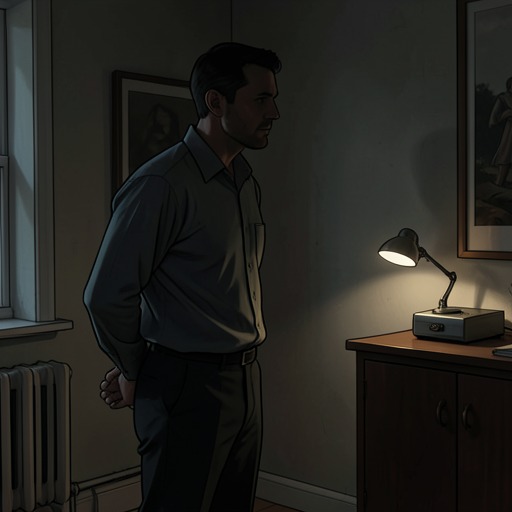
Disavowal
The ReaderDisavowal is Michael Berg’s term for a betrayal enacted not by revealing Hanna Schmitz’s secrets, but by keeping their relationship unacknowledged. Its force lies in the gap between outward discretion and inward knowledge: Michael may appear merely private, yet he knows that he is withholding something important. The novel connects this private concealment to Hanna’s guarded account of her own life and, later, to the silences surrounding her trial, making disavowal a pattern of distance with consequences for both intimacy and memory.
Definition and First Signs
Michael describes disavowal as a form of betrayal that can be mistaken from the outside for tact, consideration, or avoidance of embarrassment. Unlike a conspicuous betrayal, it leaves no obvious act for others to identify. The person withholding the truth, however, knows what the silence means. In Michael’s account, disavowal gradually removes the supports of a relationship, just as surely as a more visible betrayal would.
The pattern begins in a relationship that is intimate but sharply bounded. Hanna tells Michael that she grew up in a German community in Romania, came to Berlin at sixteen, worked at the Siemens factory, entered the army at twenty-one, and later held various jobs, including several years as a streetcar conductor. She is thirty-six and has no family. Yet she recounts these facts as though they belonged to an unimportant stranger, and questions about her parents, siblings, life in Berlin, and army service meet her exasperation rather than elaboration. Her brief rebuke, “The things you ask, kid!”, captures the limit she places on his curiosity.
That limit persists in their everyday relationship. Michael never discovers what Hanna does when they are apart; she gives him only the space in her life that she chooses to share, and he recognizes that wanting more information can feel presumptuous. When he asks questions, she may evade them, take his hand and place it on her stomach, or recite the household work awaiting her: laundry, ironing, sweeping, shopping, and gathering plums before the child eats them. These concrete routines offer a glimpse of her life while also keeping its larger shape inaccessible. The novel presents her silences as evidence of a boundary, without reducing them to a single motive.
Michael’s Concealment
Michael’s own disavowal develops among his new school friendships. He becomes especially close to Holger Schlüter, who shares his interest in history and literature, and spends time with Holger and Sophie on the way to and from the swimming pool. At first Michael tells himself that he is not close enough to his friends to speak about Hanna. Later he waits for the right opportunity and words; eventually, he decides that introducing her belatedly would make their relationship seem wrong or make his earlier silence look guilty.
Those explanations do not erase his recognition of what he is doing. He presents himself as letting his friends into the important parts of his life while excluding Hanna, and understands that the omission is a betrayal. The silence is consequential precisely because it does not require him to make a false public accusation or expose one of her secrets. He can preserve the appearance of ordinary openness while denying the relationship a place in the story he tells about himself.
A storm briefly brings Michael and Sophie together under the overhang of a garden shed in Neuenheimer Feld. The scene belongs to the same social world from which Hanna is absent: the friendships and flirtations that draw Michael toward his classmates coexist with a relationship he does not acknowledge to them. His divided loyalties are not resolved by a decisive confession. The account instead emphasizes how postponement becomes its own choice: what begins as a temporary failure to find the right moment hardens into an omission he knows he is sustaining.
Departure and Retrospective Guilt
When Hanna leaves, Michael’s silence becomes part of his retrospective explanation for the loss. He learns that she has quit her job and registered a move to Hamburg without providing an address. During the days that follow, he keeps his distress from his family, attends school and the swimming pool, and retreats to an out-of-the-way place there. He feels physical longing, but identifies guilt as worse: when he saw Hanna, he had not immediately run to her.
Looking back, Michael connects that failure to the half-heartedness of the preceding months and to his betrayal by disavowal. He interprets Hanna’s departure as punishment for having denied her, while also exposing the uncertainty built into that interpretation. He tries to persuade himself that the woman he saw was not Hanna because he could not make out her face; nevertheless, he knows it was her, and that the moment has passed. The movement from uncertain recognition to acknowledged knowledge mirrors the structure of disavowal itself: evasion remains possible, but it does not make the underlying fact unknown.
Silence at the Trial and Narrative Role
The pattern recurs in a different register at Hanna’s trial. When asked whether she joined the SS despite Siemens having offered her a foreman’s job, Hanna does not answer. Her lawyer challenges the premise of the question, but her silence remains. Later, after Hanna has looked directly at Michael in court, he imagines an explanation she might give for selecting weak and delicate prisoners: that they would have been unable to endure the building-site labor and would otherwise have been sent on the next transport to Auschwitz, so she had wanted to make their final month bearable. But the lawyer does not ask, and Hanna does not volunteer an explanation.
Michael’s imagined defense is not testimony from Hanna; it reveals the account he longs for her to give. The distinction matters: the narrative places his wish beside her actual silence without turning the wish into established fact. Disavowal thus concerns not only the concealment of a relationship, but also the limits of what can be said on another person’s behalf and the temptation to fill silence with a preferred explanation.
Years later, a former seminar colleague recalls that Michael attended the trial every day and asks whether his interest was in the proceedings or in the defendant. Michael cannot find an answer that would either confess or deflect the truth. His private history remains difficult to voice even when another person recognizes that something lay behind his attention. Across friendship, separation, courtroom silence, and retrospective narration, disavowal is shown as an omission that can preserve appearances while deepening distance—and as a failure of speech that continues to govern how Michael remembers and explains the past.