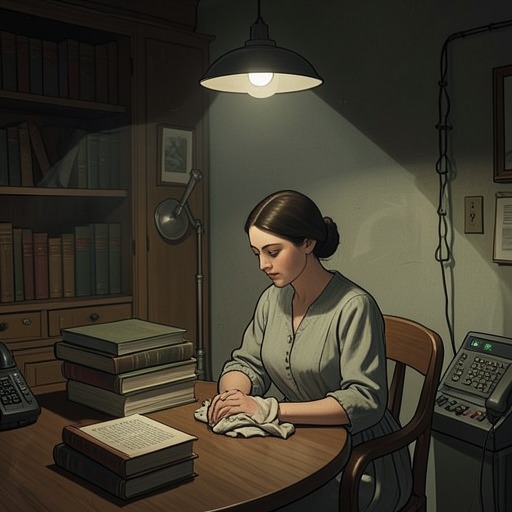
Hanna Schmitz's illiteracy
The ReaderHanna Schmitz’s illiteracy is a persistent condition that shapes how she moves through ordinary life, protects her privacy, and appears before the court. It helps explain her dependence and some of her behavior, but the novel refuses to make it an all-purpose excuse: Hanna remains responsible for her crimes as an SS guard. In prison, learning to read and write brings her toward independence, even as the effort exposes the years and possibilities the condition has cost her.
A hidden condition and its consequences
As a teenager, Michael Berg is struck by Hanna’s bearing and movements, though he cannot explain his attention to her. Only later does he connect the encounter to her particular relation to her body and the world around her. This retrospective account frames Hanna through what Michael can perceive and what he cannot yet know. Her illiteracy remains concealed, but it will eventually clarify why the question of exposure carries such force in their relationship and at her trial.
The condition is not presented only as a private inability to decipher words. Michael later understands illiteracy as dependence in everyday activities: finding a way or an address, choosing a meal, and relying on familiar patterns and routines. Concealment itself consumes energy that might otherwise go toward living. The account therefore gives the condition practical consequences, while showing how shame and the effort of concealment can make those consequences harder to disclose.
The court and the struggle over truth
At trial, Hanna’s answers reveal a stark mismatch between her willingness to acknowledge facts and her grasp of how legal proceedings turn statements into evidence. She contradicts what she considers false and admits what she cannot deny, including her participation in selections in the camp. But she does not understand the court’s tactics or the formulas by which guilt and innocence are argued. Her court-appointed lawyer fails to compensate for that disadvantage, and Hanna does not trust him enough to rely on his judgment.
Michael recognizes that her conduct can be misread. Her difficulty familiarizing herself with the indictment and a manuscript, he believes, helps explain why she lacks the strategy that the proceedings demand. When she eventually gives up trying to engage, she answers only direct questions, briefly and sometimes beside the point, and remains seated while speaking. What the court may interpret as indifference or defiance is, in Michael’s understanding, also shaped by incapacity and exhaustion.
The recognition does not absolve her. Michael rejects the idea that Hanna chose criminality in order to hide her illiteracy. He understands her career differently: she turned down a promotion at Siemens and entered guard work, and she selected prisoners to read to her because she wanted to make their final month bearable before their inevitable deportation to Auschwitz. Yet her compassionate purpose within that circumstance does not undo her participation in the camp system or the suffering that it involved. Illiteracy explains part of her conduct and vulnerability; it does not erase her guilt.
Michael considers telling the judge that Hanna cannot read, believing this might correct the impression that she is uniquely incorrigible and could reduce her sentence. He also understands the price of that intervention: Hanna would have to be exposed against her will. In his judgment, she would not trade her self-image for fewer years in prison. Her insistence on her own truth and justice is compromised by concealment, but remains hers; the effort to preserve it helps account for decisions that appear self-defeating from outside.
Learning in prison
In prison, Hanna begins to learn through Michael’s recorded readings. She borrows from the library the books he reads on tape and follows the words and sentences as she listens, repeatedly switching the machine off and on and rewinding or fast-forwarding. The tape player breaks down under the strain of this use. When she asks for a writing manual and starts writing as well as reading, she no longer tries to hide what she is doing; she is proud of succeeding and wants to share that happiness.
Her first note makes the achievement visible in its physical form. Written in forceful, awkward letters on lined paper, it presses through to the other side. The address is impressed on both halves of the folded page. Each letter appears to require a fresh effort: the lines restart, and their slants, heights, and widths vary. Michael reads the note with joy, then sees in the writing the struggle behind the accomplishment. His pride is joined by sorrow for Hanna’s delayed and failed life, and for the more general losses incurred when a necessary change comes late.
The notes continue, each only a few lines long. Hanna thanks Michael, requests or rejects particular authors, comments on literature, and records observations about prison and the natural world: forsythia flowering, summer storms, birds preparing to fly south. Her remarks sometimes direct Michael’s attention to things he might otherwise pass over. Because she has little knowledge of literary history, she often reads older writers as though they were contemporaries, an effect that makes the past seem like a foreign country rather than a remote period.
Reading, knowledge, and belated freedom
Once able to read, Hanna seeks books about the concentration camps. She first asks Michael for a general bibliography and later for books on women in the camps, both prisoners and guards. Michael contacts the Institute for Contemporary History, which supplies a specialized bibliography. The sequence is significant: literacy does not leave Hanna’s earlier history behind but enables her to approach it through accounts of victims, perpetrators, and the camps themselves.
Her writing and reading mark a movement from dependence toward independence, but the narrative refuses a simple tale of rescue. Michael wonders whether a missed opportunity can ever be recovered, or whether what arrives late is still better than what never arrives. Hanna’s new capacity is real, and she takes pride in it; it also comes after a life in which concealment has shaped her choices, and after imprisonment for crimes that literacy cannot undo. The condition thus remains both a concrete lived difficulty and a source of shame and secrecy, without becoming a substitute explanation for her actions.
When Michael later explains their history to another person, he says that Hanna had been illiterate almost all her life and learned to read and write only in prison. That account ties together the relationship, the trial, and the recorded readings: a capacity Michael once did not recognize becomes visible through the labor of learning, while the years of silence and his own failure to write back remain part of what the achievement cannot repair.