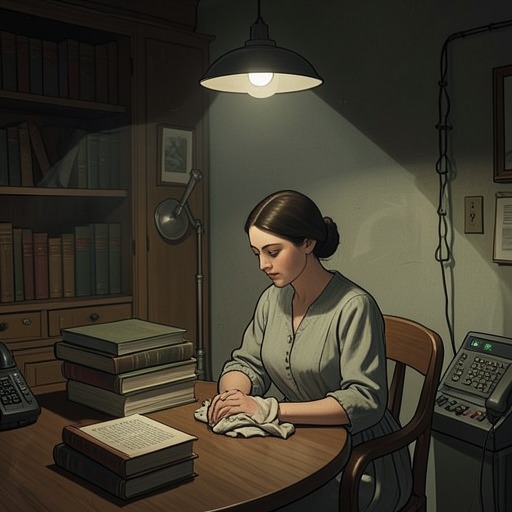
Hannah's camp report
The ReaderHanna Schmitz’s camp report is both an attempted account of the night when prisoners died in a locked church and a document that helps expose the guards’ shared effort to manage blame. Its significance at trial lies not simply in what it records, but in the gaps between its account, the defendants’ explanations, and the surviving archival evidence. When another defendant identifies Hanna as its author, the report turns from disputed paperwork into a personal admission with consequences for the defense and for the way responsibility is assigned.
The events behind the report
The report concerns the bombing that ended the prisoners’ westward march. Several hundred women had been locked in a village church by the troops and guards. A bomb struck the steeple; the fire spread to the roof, and the burning rafters fell into the nave. The doors remained locked, and the guards did not open them. The prisoners died in the fire. The account of the night is therefore inseparable from a question the report cannot make disappear: what the guards did while the women were trapped inside.
The evidence presented at trial did not give the court an uncomplicated view of the episode. The mother and daughter who survived had been inside the church and could not testify about events outside it. Other witnesses remembered the defendants in the village, but their own possible failure to rescue the prisoners complicated what they could say. The defendants could invoke confusion and the absence of their commanders, yet those explanations had to be assessed against the lives at stake and against evidence that did not depend on any single witness’s view.
An archival record and its limits
The presiding judge compared the defendants’ explanations with a report in the SS archives. The document listed guards killed or wounded in the bombing, named those who transported wounded guards to a field hospital, and described guards who stayed behind to prevent fires from spreading and prisoners from escaping. It also referred to the prisoners’ deaths. The defendants’ names did not appear in it. That omission did not directly identify them, but the narrator explains the inference drawn from it: the defendants were among the guards who remained, and those guards had kept the church doors locked while the fire continued.
The defendants rejected the archival account, arguing that its stated duties were implausible and that it failed to reflect what they had experienced or done. The distinction between what the record explicitly said and what it suggested matters. It was not, in the narrator’s telling, a simple written confession naming the defendants; rather, the court read its lists and absences as evidence that narrowed the possible account of who stayed behind and what those guards were responsible for. The camp report entered this contested field of evidence, where documents, recollections, and inferences did not have identical force.
Authorship becomes the issue
At trial, the other defendants’ lawyers were already using Hanna’s admissions to isolate her from their clients. The surviving witnesses’ testimony could not precisely establish who had carried out the monthly prisoner selections, given the camp’s hierarchy and the presence of other guards and troops. In the church case, the survivors could not see what happened outside. Hanna’s willingness to concede damaging facts therefore threatened to make her the focus of the prosecution while giving the other defendants room to distance themselves from her.
When the judge asked whether Hanna had written the report, the defendants first described a collective discussion about what to say. They had not wanted to blame those who had left, but they also had not wanted to invite charges against themselves. One defendant then pointed to Hanna as the writer. The prosecutor proposed comparing the report’s handwriting with Hanna’s. As the judge, prosecutor, and defense lawyer discussed whether handwriting could be identified after more than fifteen years, Hanna tried to intervene and grew alarmed. She then admitted that she had written it, removing the need for an expert comparison. The report’s authorship, initially asserted by an accuser and approached through a proposed evidentiary test, became Hanna’s own admission.
What the admission establishes
Hanna’s admission establishes that she wrote the report, but the passage does not present it as a complete explanation of the night or as proof of every disputed detail. Before admitting authorship, she says that the women discussed what to write and describes their shared aim: not to place blame on the guards who had left, while also avoiding charges that they themselves had done wrong. The report thus appears within a collective act of self-protection, even as the other defendants try to make Hanna alone answer for it. The tension between collective discussion and individual authorship is central to its courtroom significance.
The report also brings the trial’s evidentiary problem into focus. Witnesses had limited access to what occurred; the archival record suggested more than it stated outright; and the defendants offered accounts that conflicted with the record and with one another. Hanna’s admission supplies a concrete link between her and the written account, but it does not erase those differences in what can be known. The document matters because it sits at the intersection of testimony, institutional record, and a defendant’s concession—not because it makes uncertainty vanish.
Responsibility and the meaning of the record
The report’s importance extends beyond the question of handwriting. It gives written form to the guards’ effort to describe the aftermath without implicating those who had departed or exposing themselves to charges. At the same time, the archival record’s reference to guards remaining behind to prevent escape makes the defendants’ claimed separation from the church’s fate difficult to sustain. The story holds these materials in tension: one report reflects an effort to control blame, while another, read through its names and omissions, helps reconstruct responsibility.
That tension also bears on the narrator’s later reflection about indifference. In discussing the trial, he rejects the idea that camp violence can be explained merely as hatred or obedience: perpetrators could treat their victims as matters of indifference. He also recognizes the shame attached to having loved Hanna and the failure of pointing at her to free him from his own involvement. The camp report is not itself a statement of those reflections, but its contested authorship belongs to the same moral landscape: the court asks who acted, who remained, who wrote, and who can be held responsible when the surviving account is incomplete.