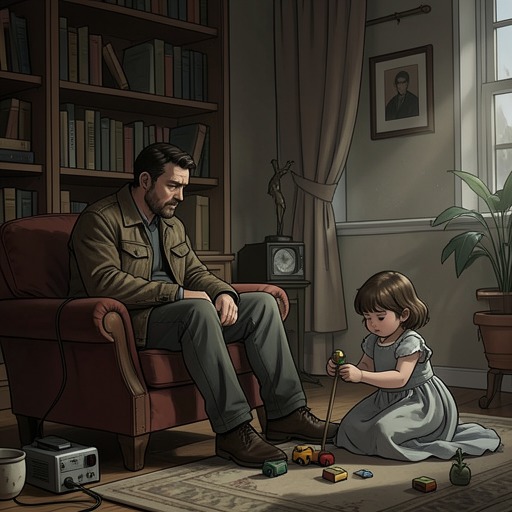
Julia
The ReaderJulia is the daughter of Michael Berg and Gertrud, and her experience of her parents’ strained marriage gives their separation its most immediate human consequence. She longs for warmth and a stable family life; after the divorce, her attempts to keep both parents close become part of Michael’s lasting sense that the decision deprived her of something she had a right to expect.
Family and Early Life
Michael and Gertrud marry while both are clerking for the law, after Gertrud becomes pregnant. They live with Julia in a three-room apartment in a modern building, while both parents work. Michael’s unresolved comparison between Gertrud and Hanna shadows the marriage: even when he and Gertrud hold each other, he feels that something is wrong and hopes the feeling will disappear. The account does not present Julia as the cause of that distance, but her presence makes its consequences part of a family life that cannot simply be reduced to the couple’s private unhappiness.
Experience of the Separation
Michael and Gertrud divorce when Julia is five. They part without bitterness and remain loyal to one another, but Julia experiences the division as a loss she cannot readily understand. For a long time, she does not grasp what divorce means. When she visits Michael, she wants him to stay; when she visits Gertrud, she wants her mother to come too. Departures sharpen the separation: Julia watches Michael from the window as he gets into his car, and he remembers the sight as heartbreaking.
Julia is especially attuned to the emotional atmosphere between her parents. When they are open and warm with each other, she is at ease, as if entirely in her element. When she senses tension, she moves between them, trying to assure each that they are good and that she loves them. The same child who longs for a little brother, and probably would have welcomed more siblings, thus appears in Michael’s recollection as wanting not only affection but a fuller, shared family life.
Michael’s Retrospective Guilt
Michael comes to view the divorce as having denied Julia both her wish and her right to the warmth and safety she sought. The fact that he and Gertrud made the decision together does not, in his judgment, divide or lessen that guilt. His recollection distinguishes their continued loyalty as former spouses from the family unity Julia wanted: their lack of bitterness could not give her the shared home she had hoped to preserve.
Julia is represented through Michael’s retrospective narration rather than through an independent account of her adult life. Her role is nevertheless more than incidental: her responses make visible the cost of the parents’ separation, while Michael’s regret reveals how his private marital history becomes an enduring question of responsibility toward his child.