Survivor's Daughter's Campground Memoir
The ReaderThe daughter’s camp memoir records her and her mother’s experience in Auschwitz and a satellite camp near Cracow, including the forced march west and the fire in a village church where prisoners had been locked in. The book is both testimony and a problem of mediation: its sober distance resists easy identification, while its details supply the court with evidence and become entangled with Michael Berg’s troubled imagination of the past.
Origin and place in the trial
The daughter was one of two prisoners who survived the bombing that ended the prisoners’ westward march; her mother was the other. The daughter wrote a book about the camp and the march and published it in America. Her account helped bring the events before the court: the police and prosecutors tracked down both women, and the daughter came to Germany to testify, while the mother remained in Israel and was to be deposed there. The court’s German version of the daughter’s book was not published until after the trial, though its manuscript was available to the trial participants.
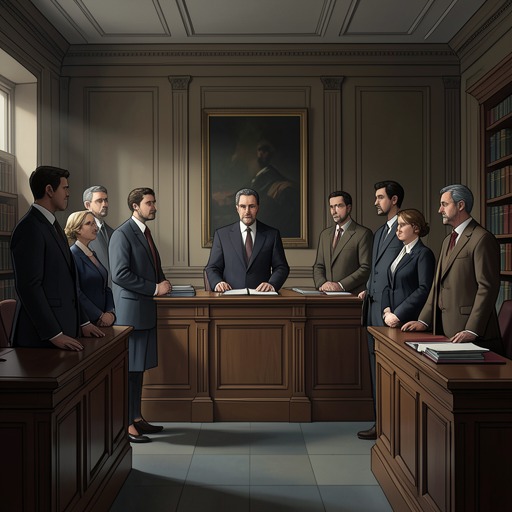
The memoir’s evidence mattered in a trial of five women who had served as guards in a small satellite camp near Cracow after being transferred from Auschwitz in early 1944. The charges included the camp’s monthly selections and the treatment of prisoners on the night the march ended. When the presiding judge proposed that the German manuscript not be read aloud into the record, because all participants had access to it and it had been prepared for publication, the proposal became a point of difficulty for Hanna. The book thus entered the courtroom not only as testimony about the past but as a document whose place in the proceedings had to be negotiated.
The camp and the march in the memoir
The daughter describes the camp near Cracow as the last stop for her and her mother after Auschwitz. Compared with Auschwitz, the work was easier, the food better, and the sleeping arrangements less crowded: six women shared a room rather than a barracks of a hundred. The prisoners could gather wood on the way back from the factory, and the camp was warmer. Yet the monthly selections remained a constant danger. Around sixty of approximately twelve hundred women were sent back to Auschwitz each month, and the daughter understood that those no longer able to work were the ones selected. The prospect of surviving depended on outlasting that process or on the war ending before the calculated twenty-month average life expectancy.
The camp’s closure turns this precarious interval into a forced march west. The prisoners’ clothing was inadequate for winter, and many wore rags or newspaper tied around their feet. They were driven to run as well as march; many collapsed, and after a week almost half were dead. The daughter’s formulation for the march is the phrase “death trot, death gallop,” which gives the journey a blunt, accelerating rhythm rather than the more familiar label alone.
The final stage brings the prisoners to a village church, which initially seemed a better shelter than the barns or walls used on earlier nights. The guards and troops had taken the priest’s house, while the prisoners were put in the church; the women had also received something warm to eat. After bombs fell, fire spread from the steeple to the roof. The prisoners were locked inside, and the guards could have opened the doors but did not. The burning roof fell into the nave, while the church walls contained the fire; most of the women died there. The ironclad doors were eventually burned through, but only hours later.
The memoir also explains how the daughter and her mother survived. When panic began, the mother fled to the narrow gallery because she could not bear to remain among the other prisoners. Her motive was escape from the crowd, not a plan to find safety; the gallery’s position against the wall nevertheless kept mother and daughter from the burning beams. They remained there until the fire had passed, then waited through the following day and left at dawn the next morning. Villagers who saw them gave them clothing and food and allowed them to continue on their way.
Testimony, style, and distance
Michael first reads the memoir in English, an unfamiliar and laborious undertaking. He works through it closely but does not feel that he has made it his own: the unmastered language creates, in his account, an unusual combination of distance and immediacy. Years later, rereading the book, he reaches a different conclusion about that distance. The memoir itself does not invite the reader to identify with its subjects or to find them readily sympathetic; its restraint extends to the mother, the daughter, fellow prisoners, guards, and uniformed security forces.
That distance does not mean that the daughter cannot observe or analyze. Michael notes that she describes her own adolescent behavior, including its precociousness and cunning, with the same sobriety she applies elsewhere. She does not turn survival into self-pity or present it as a basis for self-congratulation. The result is an account that remains emotionally uninviting while still scrutinizing the people and circumstances it records. Its manner of telling becomes part of what the novel asks readers to consider: testimony can preserve close observation without offering a familiar route to sympathy or moral ease.
The book’s account of Hanna is especially uncertain. Hanna is not named or made identifiable in it. Michael wonders whether one description of a young, attractive guard who carried out her duties conscientiously and unscrupulously could refer to her, but the text does not establish that identification. The daughter also recalls a different guard, known as “Mare,” whose appearance and diligence were paired with cruelty and lack of control. The overlap between descriptions leaves Michael to ask whether Hanna was being compared with that guard, but the memoir does not resolve the question. Its account is evidence about the camp, not a definitive key to Hanna’s identity within it.
From courtroom account to private memory
At the trial, the daughter’s testimony supplements what Michael had read. After taking a seat in the public benches, she remembers that Hanna had favorites among the younger, weaker prisoners. Hanna gave those women better food and accommodation, spared them work, and had them brought to her in the evenings. The prisoners had not been allowed to say what happened during those visits, so others assumed that the favored women were being exploited before being sent on transports. The daughter corrects that assumption: the women read aloud to Hanna, evening after evening. She had forgotten this until the questioning brought it back, and she asks whether the arrangement was truly better than the alternative of exhausting labor. The testimony complicates the defendants’ conduct without undoing the account of the camp’s violence or the church deaths.
The memoir’s narrative distance meets Michael’s own emotional numbness during the trial. He recalls that he could summon memories of Hanna and imagine the acts of which she was accused, yet could not make the two kinds of image produce feeling. He compares the experience to an arm numbed by an injection: the mind registers an action without restoring sensation. The daughter’s book, meanwhile, remains alien to him even when he reads it thoroughly. Together, the testimony and his response show how proximity to evidence does not guarantee emotional access.
Michael’s memories of Hanna also merge with imagined scenes of the camps. He sees her as a guard near the burning church and in the routines of camp life, then places those images beside remembered scenes from their intimacy. He recognizes that these imagined pictures are crude clichés and unfair to the woman he knew, but they remain powerful enough to alter his memories. The memoir’s refusal to make Hanna identifiable intensifies this conflict: it offers no certainty that can reconcile the person Michael loved with the defendant he watches in court.
Public memory and the limits of images
Michael later reflects that his generation’s early knowledge of the camps depended on a narrow body of photographs and testimony: images of Auschwitz’s gate, bunks, collected belongings, the entrance to Birkenau, and the corpses photographed at Bergen-Belsen. Some survivor accounts appeared soon after the war but then disappeared from publishers’ lists until the 1980s. In the interval, the available images returned repeatedly in public consciousness and hardened into clichés. The daughter’s memoir belongs to this difficult history of transmission: it records experience, but its account does not simply make the past vivid or emotionally assimilable.
Michael contrasts that earlier, comparatively static imagination with a later public culture in which television and films, including the television series Holocaust and the films Sophie’s Choice and Schindler’s List, enlarged the world of the camps in collective memory. He argues that such works do more than register familiar images; they also supplement and embellish them. The memoir’s spare, distancing manner consequently stands against a public imagination increasingly able to move through representations of camp life, while raising the question of how representation can clarify history without substituting crafted images for the limits of what was directly witnessed.
That difficulty persists when Michael visits Struthof, hoping that seeing a concentration camp will displace the clichés he carries. His impressions join the few images he already has of Auschwitz and Bergen-Belsen and freeze with them instead. The memoir’s significance therefore lies not only in what it recounts but in the problem it exposes: testimony can give specific form to events, yet the reader’s images and feelings remain shaped by distance, repetition, and the media through which the past is received.