The legacy of the Nazi past in postwar Germany
The ReaderThe legacy of the Nazi past in postwar Germany is both a public question of justice and a private inheritance of shame. In the novel, a trial of former camp guards draws a student generation into judging not only the defendants but also the society that had tolerated them. The reckoning persists beyond the courtroom: it shapes Michael Berg’s historical work, his sense of responsibility, and the images through which he and his contemporaries can imagine the camps.
The Trial and the Limits of Legal Judgment
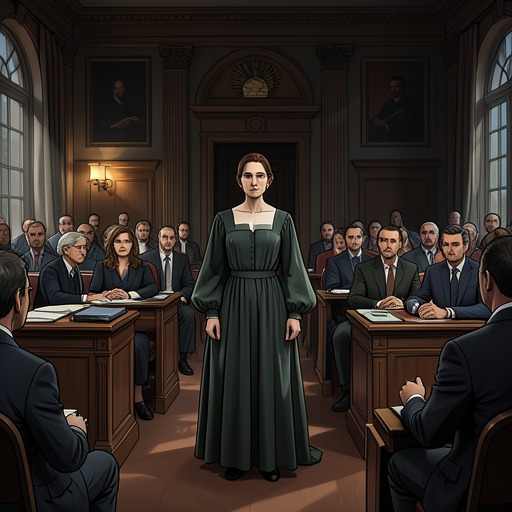
A university professor makes a trial of camp personnel the subject of a seminar, organizing students to follow the proceedings and assess them. Their discussions turn on the prohibition of retroactive justice: whether it is enough that the relevant ordinances existed when the crimes were committed, or whether law must also be judged by how it was interpreted and enforced at the time. The professor, a returning exile who remains an outsider among German legal scholars, takes part with scholarly force but without pretending that legal scholarship alone can settle the matter.
The students see the trial as an opening onto a wider social judgment. They consider convictions necessary, but only a prelude: in their view, the generation that had been served by the guards, failed to stop them, or allowed them to remain in society after 1945 is also under scrutiny. Their confidence in this mission makes them call themselves the students of the camps. Looking back, Michael recognizes that their effort to expose the past could itself repel others, and that they sometimes displayed the horrors they had learned about with a triumphal certainty.
The trial makes the distinction between individual prosecution and social reckoning especially stark. The charges include the monthly selection of prisoners: around sixty women were sent from Auschwitz to the camp and a similar number sent back, less those who had died. Those deemed unable to work were returned, although the factory’s labor was largely devoted to repairing bomb damage. Another charge concerns the bombing that ended the death march. Several hundred prisoners were locked in a village church; after bombs struck nearby buildings and the church steeple, the fire spread to the roof and nave. The guards could have unlocked the doors but did not, and the women died in the fire. The legal proceedings address specific acts, while Michael’s account keeps asking what a society’s law and conduct permitted around them.
Family History and Inherited Shame
The students’ judgments reach into their own families. Their parents had occupied different positions under the Third Reich: some fathers had served in the war, including as officers in the Wehrmacht or Waffen-SS; others had held posts in the judiciary or local government. The group also included parents who were teachers or doctors, and a student whose uncle had been a senior official in the Interior Ministry. Michael’s father had lost his philosophy lectureship after scheduling a lecture on Spinoza and supported his family during the war as an editor for a publisher of hiking maps and books. Even so, Michael recalls condemning him to shame, though the only charge he could bring was that the postwar generation had tolerated perpetrators in its midst.
Later, Michael considers whether the student movement’s generational conflict was driven by the Nazi past or whether that history supplied its form. Parents’ authority had been weakened by crimes committed under the regime, by watching those crimes, or by tolerating and accepting perpetrators afterward. Yet the issue extended beyond children who could accuse their own parents. For some, confronting the Nazi past was the substance of the conflict, not merely its language.
Michael describes collective guilt as a lived moral reality for his student generation, without claiming that its legal or moral validity is settled. Shame came not only from family histories but from continuing public signs: Jewish gravestones defaced with swastikas, former Nazis making careers in the courts, administration, and universities, the Federal Republic’s long failure to recognize Israel, and the greater transmission of conformity than of emigration or resistance. Naming the guilty could turn passive shame into energy and accusation, but it did not abolish the shame. Michael’s own position remains uneasy: he no longer feels able to condemn his parents as he once did, yet his attachment to Hanna makes accusation personal, and pointing at her also turns his attention back toward himself.
Memory, Evidence, and Numbness
The courtroom does not produce a steady, uncomplicated experience of witnessing. During the weeks of the trial, Michael feels emotionally numb. Memories of Hanna’s former intimacy with him sit beside his knowledge of the charges, but he experiences them as disconnected, almost as if the person who loved her were someone else. He also observes how repeated exposure changes the courtroom’s response. Judges and lay members initially show shock at testimony, sometimes struggling to maintain composure; later their faces return to normal, and they can whisper, smile, or grow impatient. Students who attend once a week are horrified anew, while Michael, present daily, watches with detachment.
The shift is not presented as a simple reconciliation between past and present. Michael is troubled by his comparison of perpetrators, victims, survivors, the dead, and their descendants, even as he recognizes how numbness can spread among those forced to live with accounts of the camps. His private numbness eventually gives way after he becomes ill and is hospitalized; the questions, accusations, fear, and pain that had been suppressed return. The delayed return of feeling makes the trial’s impact something that continues after the evidence has been heard.
The record of the camps also changes over time. Michael recalls that his generation knew a limited set of photographs and accounts: Auschwitz’s gate, the bunks and confiscated belongings, the entrance to Birkenau, and the photographs of corpses at Bergen-Belsen. Many prisoner testimonies published soon after the war had vanished from publishers’ lists until they began to reappear in the 1980s. Later, books and films—including the television series Holocaust, Sophie’s Choice, and Schindler’s List—made the camps part of collective imagination in a more extensive, active way. Michael contrasts this later familiarity with the earlier imagination, in which a few images and testimonies returned repeatedly and hardened into clichés. Even visiting Struthof does not break that pattern for him: his impressions join the images he already has and freeze with them.
Historical Work and the Continuing Past
After the seminar professor dies, a newspaper obituary and the possibility of attending the funeral awaken Michael’s memories of the trial. His subsequent career as a legal historian gives him a place to escape into the past, but he rejects the idea that history offers a safe distance from the present. Studying history means building bridges between the two; research into law under the Third Reich makes their connection especially plain. In this sense, an apparent retreat into scholarship can become another way of attending to the present and future, because the legacy of the past continues to mark those who live with it.
Michael also finds genuine pleasure in studying legal codes and drafts from the Enlightenment, whose authors believed that the world could be brought into good order. For a time, he believes legal history progresses toward beauty, truth, rationality, and humanity despite reversals. He later recognizes that confidence in progress as an illusion and imagines a history that, after disruption and confusion, arrives at its own starting point and must begin again. This unsettled view refuses to treat legal development as a guarantee that society has left its failures behind.
The legacy is also carried through the acts of reading and record-keeping that outlast the trial. In prison, Hanna reads works by Primo Levi, Elie Wiesel, Tadeusz Borowski, and Jean Améry alongside Rudolf Hess’s autobiography, Hannah Arendt’s report on Eichmann in Jerusalem, and scholarly books about the camps. After learning to read, she orders a general bibliography and later asks for books about women in the camps, prisoners as well as guards. The books and testimony do not resolve the moral and historical questions raised by the trial; they show how the past continues to be approached through evidence, study, and acts of attention long after a courtroom’s proceedings have ended.