
A Collision Between Plans and Change
The Reason I JumpThis flow traces the conflict between a desire for predictability and the unavoidable changes that can make plans feel restrictive or frightening.
increasing Bearing strength in each event
 decreasing
Bearing strength in each eventdecreasingA Plan Becomes Fixed
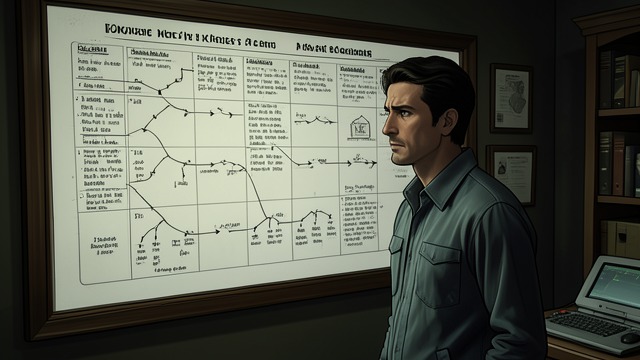
A Plan Becomes Fixed
A vivid arrangement
Naoki Higashida says that a visual schedule can make a plan feel definite and deeply imprinted. Once it is fixed in memory, its order and timing become hard to treat as provisional.
Structure turns restrictive
A tool intended to reassure may instead make him feel like a robot with every action programmed. The conflict begins when useful structure becomes a standard against which the present is continually judged.
The Unexpected Change

The Unexpected Change
A plan breaks
Naoki Higashida understands that plans sometimes change, but says his brain still protests when an arrangement does not proceed as expected. The difference between intellectual understanding and emotional acceptance is stark.
Panic in the mismatch
A changed schedule can leave him flustered and panicky. Simply adding a new picture to the schedule may not undo the force of the original expectation.
Watching the Clock

Watching the Clock
Checking for agreement
Naoki Higashida can find himself repeatedly checking the time to see whether the activity still matches the schedule. Attention shifts away from the experience and toward measuring compliance with the plan.
Pleasure constrained
The schedule may reduce uncertainty but also make enjoyment harder. The conflict is not between planning and disorder alone, but between reassurance and overcontrol.
Talking Through the Day

Talking Through the Day
A verbal alternative
Naoki Higashida suggests that helpers talk through a day's plan beforehand rather than relying on a visual schedule for every event. Repeated questions may occur as he gradually becomes familiar with the plan.
Slow confidence
This approach takes time but may help him develop understanding without making the arrangement feel unchangeable. The proposed resolution depends on patient communication rather than a single universal tool.
Flexible Support

Flexible Support
Tools matched to purpose
Naoki Higashida allows that pictures can help explain how to perform an action or make an object. His objection is specifically to visualizing future places and events in ways that may spoil the experience.
Support as adaptation
The conflict resolves through attention to the individual and the task. A helpful aid is one that supports understanding without making uncertainty more frightening.
in the answer about visual schedules
when a scheduled activity changes
during activities governed by a vivid schedule
before a planned day's activities
near the end of the schedule discussion
