Shun chooses to return to his family
The Reason I JumpShun’s choice to return to his family turns the story’s afterlife journey into a costly act of care: he accepts that becoming his parents’ child again will erase the memories and identity that make him Shun. The decision follows his discovery that his mother’s grief is not easing, and it leads to her first step toward recovery, a family’s attempt to begin again, and the birth of Nozomi.
Causes and Stakes
The choice grows out of the collision between Shun’s continuing love for his parents and the separation imposed by death. When the memory of his fatal accident returns, he recalls freezing as a car that had run a red light struck him on his way to the supermarket. He remembers coming round outside the supermarket and then understands that he is dead. His immediate response is shock and sustained crying; death is not an abstract condition but the loss of the life and family he wanted to keep.
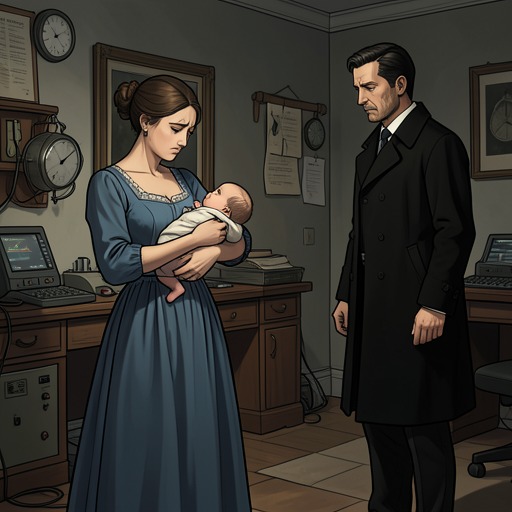
After arriving in Heaven, Shun visits his parents’ home. He cannot speak with them, but seeing their faces and hearing them talk about him helps him remain brave. That limited comfort breaks when he sees his mother staring at his photograph, not eating, and weeping that she cannot go on living without him and wants to be where he is. She collapses face down on the table. Shun cries too and gently hugs her shoulders, though she cannot see or hear him. He had thought she was recovering; witnessing her despair shows him that his presence in Heaven cannot, by itself, relieve her suffering.
Shun returns to Heaven with the knowledge that his parents may grieve for the rest of their lives. He thinks that their lives might eventually return to normal, but the prospect no longer feels certain. Unable to help them from where he is, he asks God for help. The stakes are therefore divided: remaining himself preserves his memories and his afterlife, while returning to his family may ease their loss only by ending the self who remembers them.
The Offer and Its Cost
God first answers with the ordinary limit of death: Shun’s parents will see him again in Heaven when their own lives end. Shun understands, but that promise does nothing to lessen his anguish at their present grief. He says that he cannot live happily in Heaven while knowing how much pain they are enduring. His plea turns the afterlife conversation from consolation toward action.
God then names a possibility Shun had not expected: he could be born to his parents once again. The offer brings an immediate surge of hope. Shun’s heart leaps, his voice becomes ragged with excitement, and he thinks he would go back to them at once. But the return has a condition. Once born, he will no longer be Shun: all memories of being Shun will cease to exist. The prospect makes the choice more than a reunion in another body. It is a return that cannot preserve the personal continuity Shun has been trying to protect.
Shun hesitates, wondering what rebirth can mean if he will no longer be himself. He now better understands why Kazuo and his other friends have stayed in Heaven for so long. The story gives the hesitation real weight: the promised return can restore a child to his family, but it cannot let Shun retain the memories, identity, and conscious relationship that make this return matter to him now.
The Decision
The decisive change comes when Shun visits his mother again and finds her gravely unwell. In her delirium she calls his name and says she wants to see him. Shun tries to reach her, but his voice cannot reach her; he feels that even a future reunion in Heaven would not bring back the mother he remembers if her spirit and will to live have failed. He concludes that he caused this grief and must do what he can before it kills her. His earlier fear of losing himself gives way to the more urgent fear of losing her.
The narrative states the principle that marks this turn: “The future is a thing we build.” Shun gathers his courage and speaks calmly to God, asking to be returned to his mother. The calmness of the request contrasts with the painful uncertainty that precedes it. He does not discover a way to avoid the cost God has explained; he chooses the return despite it, because his mother’s need has become more important than keeping his former self intact.
Reunion and Aftermath
The transition is rendered through many-coloured orbs, each containing a tiny gold sphere, which pop one by one, followed by a chiming sound Shun seems to recognize from long ago. The scene then shifts to his mother waking in a hospital room. When his father asks how she feels and offers to fetch a doctor, she says that Shun came to see her in a dream. She reports his reassurance: “I’m right here, always, so you’re not to cry any more, okay?” The dream does not undo the death, but it gives the mother a way to experience connection rather than separation alone.
With tears in her eyes, Shun’s mother recognizes that she needs to pick herself up. His father takes her hand and agrees that Shun is watching over them; together they speak of beginning again. Their recovery is not represented as forgetting him. The first snow of the year falls outside the hospital window, and the story imagines its crystals as formed from Shun’s tears and as God’s proof that a boy named Shun once lived in the world. His mother calls the snow beautiful, and his father remembers that Shun loved it. Grief is joined to a continuing bond: the parents can look toward a future while retaining a sign of the child they lost.
Nozomi and the Meaning of Return
Five years pass. As promised, a new baby arrives in Shun’s family in the year after his decision: a girl named Nozomi, meaning “Hope.” She is due to start kindergarten that spring. The name and the family’s changed circumstances give the choice a visible consequence: the household that had been broken by Shun’s death has welcomed another child, and his parents have a future to care for.
The ending brings the return close to the original accident without claiming that Shun remembers his former life. Nozomi runs ahead toward the supermarket, thinking of buying chocolate, and bumps into someone because she is not watching where she is going. The scene echoes the destination on Shun’s fatal trip, but presents it through the ordinary motion of a young child. The promised rebirth is thus fulfilled as a new life within the same family, not as Shun’s conscious restoration. Its hope depends on both sides of the loss: the parents’ bond with the son who died endures, while the child who arrives is Nozomi, whose life begins without the remembered identity Shun sacrificed.