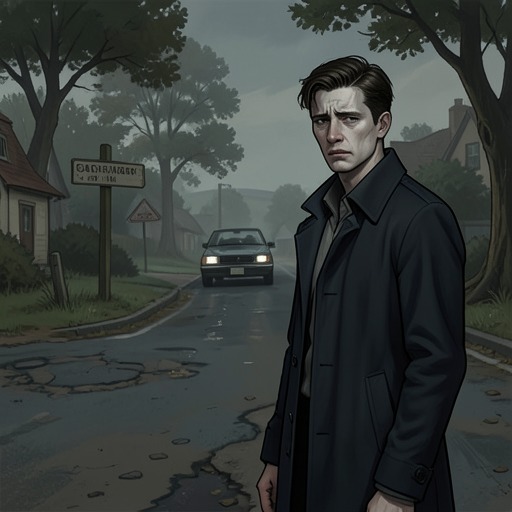
Shun travels to Heaven
The Reason I JumpShun travels to Heaven after discovering that the car accident he barely remembers was fatal. Guided there by the old man he met outside the supermarket, he crosses from bewildered fear into the afterlife, where his concern for his family persists and eventually shapes his choice about returning to them. The journey’s importance lies not in leaving earthly attachments behind, but in carrying them into a new state of existence.
The Death Revealed
Shun’s passage begins in confusion. Crouched on the ground and hugging his knees, he cannot understand what is happening to him. The old man appears, recognizes him, takes his hand, and reassures him that they can go back together. Only then does he explain that Shun no longer belongs to the world of the living and did not notice the moment of his death.
The explanation restores the missing accident in fragments. On the way to the supermarket, Shun had tried to dodge a car that ran a red light, but froze and could not move. He remembers being struck and, even then, thinking about the mess the accident would cause. Now the recollection makes the consequence undeniable: he is dead. His eyes fill with tears, and he keeps crying until they dry, while his mind remains blank. The abrupt return of memory turns a disorienting present into a loss he can name, but understanding does not make him ready to accept it.
The Journey West
The old man motions for Shun to follow and sets off toward the west. Shun follows as though pulled by an invisible cord, but death has not freed him from fear: he still trembles at the prospect of what comes next. The old man puts an arm around his shoulder and tells him they are going to Heaven. Shun admits he has never been there before, and the old man laughs at the obviousness of that observation.
Even as they prepare to leave, Shun’s thoughts turn toward his mother. When the old man asks whether it is time to go, Shun begins shaking and wishes his mother were there. The old man gives him a concerned hug and says he will be gone only for an instant. Shun is confused; the scene grows hazy, and he collapses. His departure is therefore framed less as a willing escape than as a transition he cannot yet comprehend, eased by the old man’s steady physical comfort.
Arrival in Heaven
During a deep, dreamless sleep, Shun wonders why people have to die when he still has so much he wants to do. He opens his eyes before an ancient man in white robes and recognizes him as God, whose appearance recalls the figure Shun saw at the art museum. Shun jumps to his feet to pay his respects, then panics when he realizes that his feet—and the rest of his body—are gone.
God tells him that a body is no longer needed and that the things which once tied him down have disappeared. The reassurance does not erase Shun’s fear, but God gives him a simple account of his new situation: nothing is going to happen to him because he has arrived in Heaven. Shun looks around at darkness scattered with pulsing stars, more stars than he ever saw where he used to live. Their beauty draws his attention away from his death. God allows him to do as he wishes for the time being, observing that he remains attached to his former life and has unfinished business to consider. Heaven is introduced both as a place of wonder and as a pause in which Shun’s earthly attachments remain active.
Presence Among the Bereaved
Shun’s afterlife does not remove his connection to his family. When he sees his mother dressed in black and crushed by grief, he can only apologize to her inwardly. Although she apparently cannot see his body, her hand touches it, and Shun feels the familiar warmth of being cuddled when he was very small. The moment makes presence and absence coexist: his mother’s gesture reaches him, but neither can speak directly to the other.
Later, Shun visits his parents’ home and finds his mother staring at his photograph, not eating, and weeping that she cannot go on living without him and wants to be where he is. Shun is shaken because he thought she was beginning to recover. He cries and gently hugs her shoulders, knowing that she cannot see him; he stays beside her as she weeps until dark. In Heaven he has spoken with many people and visited every corner of Earth, but these experiences do not outweigh the immediate pain of witnessing his mother’s grief. Seeing her suffer turns his continuing attachment into a decision about what he might do for the living.
A Return Made Possible
Shun tells God that he cannot live happily in Heaven while his parents endure such pain. God acknowledges the difficulty and offers an unexpected possibility: Shun could be born to his parents as their child again. Shun responds with sudden joy and wants to return at once. The offer, however, has a condition: once reborn, he will no longer be Shun, because all memories of being Shun will cease to exist. The possibility of reunion is therefore inseparable from the loss of the identity and memories that make it a return for him.
At the story’s close, Shun’s father speaks of beginning again, while the first snow of the year falls at the window. Its crystals have formed from Shun’s tears, and the snow becomes God’s proof that a boy called Shun once lived in the world. His mother calls the snowfall beautiful; his father remembers that Shun loved snow. The journey to Heaven thus reaches back into the family’s earthly life: Shun’s continued existence is figured not as a visible reunion, but through the parents’ remembrance and a natural sign that gives their grief a form they can share.