
The Crew’s Changing Verdict
The Rime of the Ancient MarinerThis flow examines how the crew’s interpretations of the Albatross’s death shift with changing weather and finally collapse under shared suffering.
increasing Bearing strength in each event
 decreasing
Bearing strength in each eventdecreasingThe First Accusation
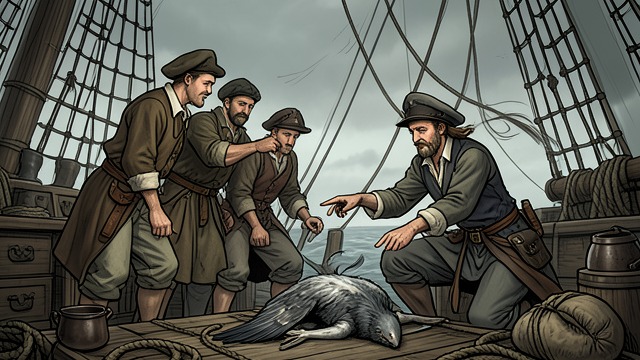
The First Accusation
Causal Blame
The crew says the Ancient Mariner has killed the bird that made the breeze blow. The accusation treats the Albatross as a source of practical help.
Collective Judgment
The sailors make the Mariner’s decision answerable to the group. Their shared verdict also begins a pattern of interpreting weather as moral evidence.
The Verdict Reverses
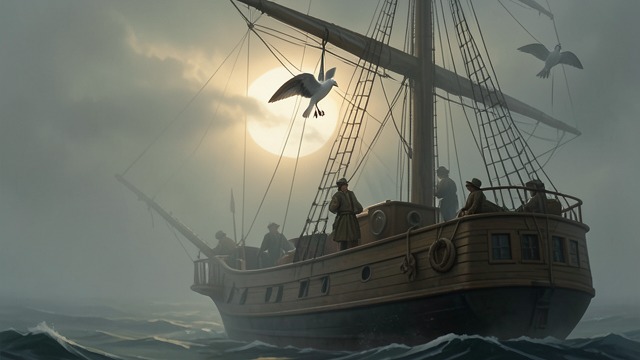
The Verdict Reverses
Changed Explanation
After the sun rises through mist, the crew says the Albatross brought the fog. It now declares that killing the bird was right.
Unstable Authority
The same sailors who condemned the act approve it when conditions change. Their reversal makes the crew’s confidence unreliable and leaves the Ancient Mariner’s responsibility unresolved.
Calm Exposes the Cost
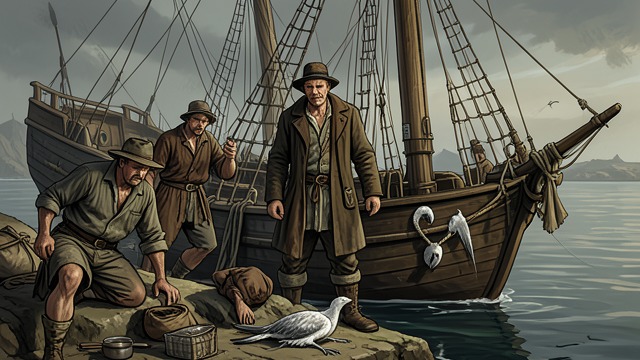
Calm Exposes the Cost
Motion Disappears
The ship stops on the silent sea, and the sailors endure heat and thirst. Neither of the crew’s earlier judgments can restore movement.
Blame Deepens
The Albatross is hung around the Ancient Mariner’s neck. The crew’s gesture turns disagreement into a continuing public accusation.
The Crew’s Death Sentence
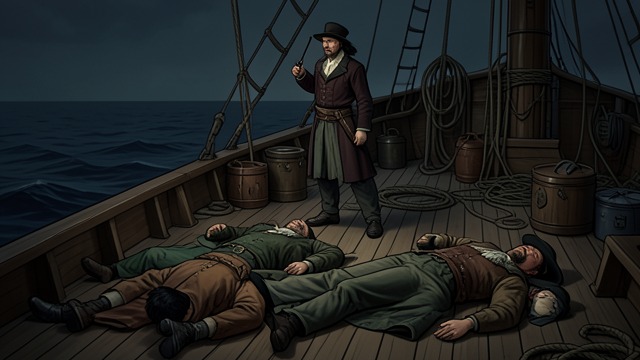
The Crew’s Death Sentence
Fate Cast by Dice
Death and Life-in-Death cast dice as the Spectre-bark reaches the ship. The sailors die one by one, and the Ancient Mariner alone remains alive.
Judgment Beyond Debate
The crew’s shifting interpretations end in irreversible loss. Their earlier confidence offers no protection from the strange forces governing the voyage.
From Accusation to Warning
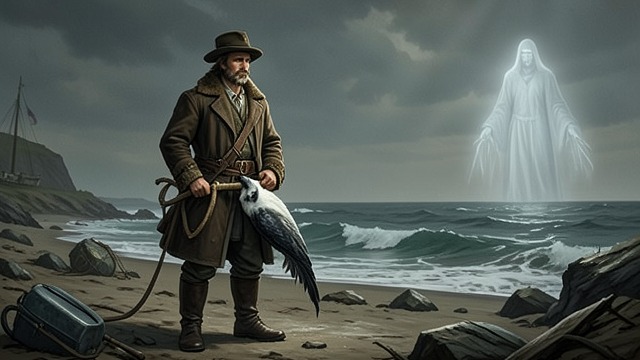
From Accusation to Warning
Isolation Reframes Blame
With the crew dead, the Ancient Mariner can no longer argue with fellow sailors or share responsibility. He confronts the consequence alone.
A Broader Moral Claim
His final lesson extends beyond the crew’s shifting weather-based judgments. The tale asks listeners to value creatures without waiting for proof of their usefulness.
When the favorable wind first continues without the bird
When fog and mist return
After the breeze falls away
When Death and Life-in-Death approach
Near the end of the Ancient Mariner’s account
