Ancient Mariner and the Wedding-Guest
The Rime of the Ancient MarinerThe relationship between the Ancient Mariner and the Wedding-Guest begins in coercion and ends in transformation. At a wedding, the Ancient Mariner stops a guest on his way to the feast and holds him first with a hand, then with the force of his glittering eye. The guest cannot choose not to hear. When the tale is done, the Ancient Mariner moves on, but the Wedding-Guest turns away from the bridegroom’s door, stunned and changed: a listener made, for the moment, the bearer of another man’s burden.
The Encounter at the Wedding
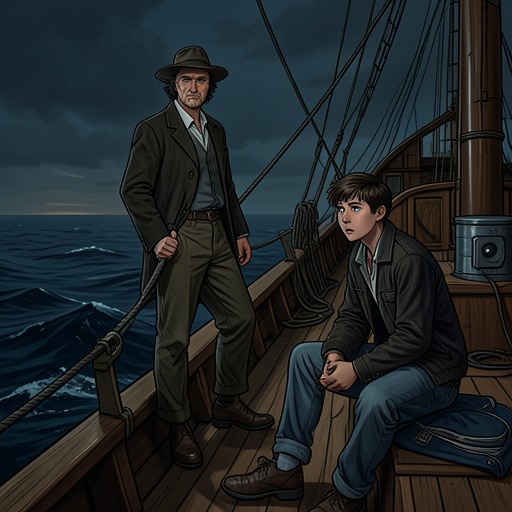
The Wedding-Guest is headed to a celebration where the guests have gathered and the feast is ready. The Ancient Mariner interrupts that forward movement. Identified as an aged seafarer, he stops one of three passing people and begins with the announcement that there was a ship. The setting makes their encounter a sharp contrast: the feast promises communal merriment, while the old sailor draws the guest into a solitary account of danger, guilt, and suffering.
The guest initially resists, telling the Ancient Mariner to let go of him. The old man’s hold drops, but the physical release does not end the encounter. He fixes the Wedding-Guest with his glittering eye, and the guest stands still and listens like a child. He eventually sits on a stone and cannot choose but hear. The relationship is therefore not presented as a willing exchange between equals: the Ancient Mariner’s power to command attention persists after his hand has fallen away, and the guest’s attendance becomes compulsory.
The Tale That Binds Them
The Ancient Mariner’s account carries the Wedding-Guest far beyond the wedding threshold. It begins with the ship leaving harbor, passing below the church and hill, and then enters the storm-driven voyage. A violent storm drives the vessel toward the ice, where the crew can discern neither human nor animal shapes through the frozen barrier. The encounter with the old man thus makes the guest a witness to a story grounded in shipboard labor and peril, not simply a strange interruption or warning.
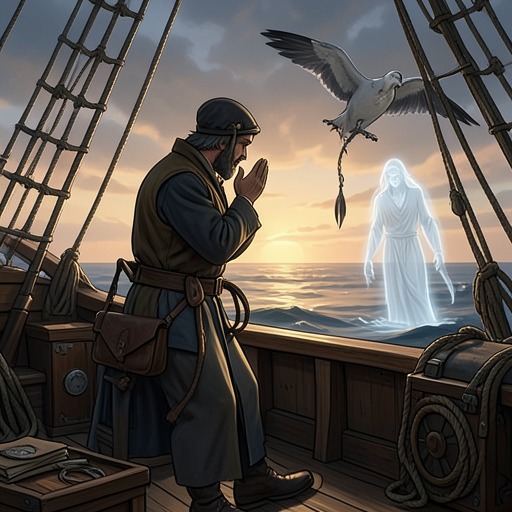
The voyage’s turns give the telling its moral and emotional force. After the ship has passed through the ice, a south wind rises and the Albatross follows; later, the Ancient Mariner looks at the dead crew and attempts to pray, but a wicked whisper prevents the prayer from coming. When water-snakes move through the sea, he recognizes their beauty and feels love for living things rise in him. These reversals—companionship and catastrophe, failed prayer and renewed capacity for love—are the substance the Wedding-Guest is compelled to receive. The listener’s silence holds together incidents that the speaker recounts as parts of a lasting moral ordeal.
The tale also shows a ship moving without a breeze, steered and worked by the dead crew. Later, as rescue approaches, the sound of oars and the Pilot’s cheer reaches the Ancient Mariner; he is turned away by force from the scene. These concrete sounds of seamanship and rescue anchor the supernatural voyage in recognizable tasks and signals. For the Wedding-Guest, the old man’s speech makes both the uncanny movement of the ship and the prospect of rescue part of a single testimony.
A Compulsion, Not a Farewell
The Ancient Mariner explains that his need to tell the tale recurs at uncertain hours. An agony returns, and it lasts until the ghastly story has been told to a listener. He says that the sight of a person’s face tells him who must hear him; the encounter at the wedding is one instance of this repeated compulsion. Their relation consequently exceeds the immediate scene: the Wedding-Guest is not merely the accidental audience of a finished story, but the person selected to receive it at a moment when the speaker must speak.
The telling briefly frees the Ancient Mariner, but it does not end his obligation. Once the tale is delivered, he leaves; his farewell turns from the particular listener toward a wider injunction to love living beings. The Wedding-Guest’s place in the relationship is therefore double. He is compelled to hear an account of the consequences of failing to cherish life, then addressed as the immediate witness to a lesson the Ancient Mariner carries from place to place.
The Listener After the Story
The Ancient Mariner’s departure does not restore the Wedding-Guest to his original course. He turns away from the bridegroom’s door and goes like a man stunned and bereft of his senses. The wedding has not been shown to continue for him as an ordinary celebration: the last image of the guest is his withdrawal from its entrance, with the tale still shaping his response.
The poem describes him as both sadder and wiser. That paired change refuses a simple account of the encounter as either a pleasant moral lesson or mere terror. The Wedding-Guest leaves under the weight of what he has heard, but with a changed understanding as well. The Ancient Mariner’s recurring need to speak finds, in him, a temporary recipient; the guest’s altered departure shows that listening has consequences beyond the end of the narration.