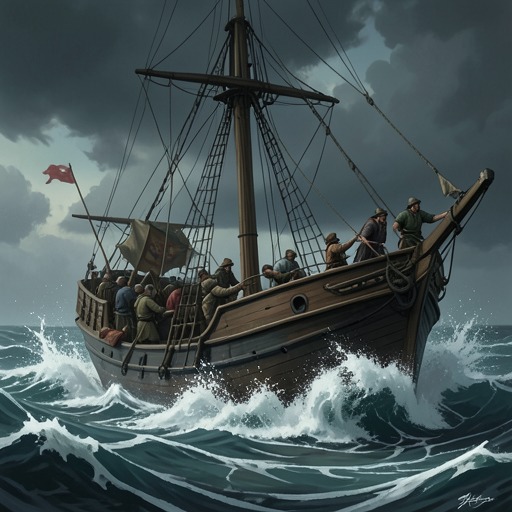
He prayeth best, who loveth best
The Rime of the Ancient Mariner“He prayeth best, who loveth best” is the closing maxim of the Ancient Mariner’s tale and its clearest statement of the poem’s devotional ethic: prayer is measured not by words alone but by love for all living things. Addressed to the Wedding-Guest after the Mariner’s account of sin, suffering, and renewed prayer, the maxim grounds that ethic in a simple relation—God made and loves all creatures, so human devotion must extend to them too.
The maxim and its scope
The Mariner first states the principle in a parallel pair: “He prayeth well, who loveth well / Both man and bird and beast.” He then intensifies it: “He prayeth best, who loveth best / All things both great and small.” The movement from “well” to “best,” and from named categories of life to all things without distinction, makes the lesson broader than sympathy for a particular creature. It describes love as the measure of prayer and extends that measure across the whole created world.
The closing reason is theological rather than merely sentimental: “For the dear God who loveth us / He made and loveth all.” The repeated language of love connects humanity’s relation to God with God’s relation to creation. Human beings are not presented as the sole objects of divine care; every creature belongs within the scope of what God made and loves. The maxim therefore joins reverence for God to regard for living things, rather than treating them as separate duties.
The Mariner’s recovered capacity to pray
The maxim gains its authority from the Mariner’s own experience. At the sight of the dead crew he looks toward Heaven and tries to pray, but a wicked whisper interrupts before a prayer can emerge. Prayer is not available to him at that point; the scene makes his spiritual condition legible through an act he cannot complete.
Later, he sees the water-snakes move, their tracks flashing like golden fire. He recognizes their beauty and exclaims, “O happy living things!” A spring of love rises in his heart, and he blesses them without intending to do so. At that same moment, he can pray again, and the Albatross drops from his neck and sinks. The sequence gives the closing maxim a concrete narrative basis: spontaneous love for living creatures precedes the return of prayer, while the fall of the burden marks a consequential change in the Mariner’s condition.
That change is not described as a formula the Mariner consciously applies. His blessing occurs unaware, and his recovered prayer follows it in the same instant. The episode thus gives the maxim the character of a lesson learned through experience, not an abstract rule detached from the poem’s events. The Mariner’s later words make explicit the connection his earlier transformation enacted.
Devotional context and the limits of self-sufficiency
The poem also frames the Mariner’s recovery in religious language that places it within a larger order of mercy. After the blessing and the return of prayer, he attributes the gentle sleep that comes to him to Mary Queen. His account does not present spiritual relief as solely his own achievement; recovered prayer, rest, and release are associated with grace as well as with a changed response to other life.
The Mariner’s tale includes a further religious contrast in the two voices he hears. One asks whether this is the man who, “With his cruel bow,” laid the bird low, recalling the shooting of the Albatross and keeping the harm in view. The final maxim does not erase that act or its consequences. Instead, the Mariner’s teaching emerges from a story in which wrongdoing, spiritual deprivation, unbidden love, and renewed prayer remain connected.
His eventual appeal to the Hermit likewise distinguishes inward change from seeking religious counsel. On reaching shore, the Mariner begs the Hermit to shrieve him. The closing principle is therefore not a substitute for prayer, forgiveness, or religious mediation. It explains what kind of love belongs at the heart of devotion, while the Mariner’s request to the Hermit shows that his burdened history continues to require confession.
Address to the Wedding-Guest and narrative function
The maxim is delivered directly to the Wedding-Guest as the Mariner takes leave of him. Before this address, the Mariner evokes the varied company of human life—old men, babes, friends, youths, and maidens—and then turns from that gathering toward his particular listener. The movement from a wedding crowd to one hearer gives the conclusion both a public reach and an intimate form: a broad teaching is entrusted to a single person who has been detained to hear the tale.
The lines also recast the Mariner’s compelled storytelling as an act of transmission. He does not simply recount what happened to him; he ends by giving the Wedding-Guest a principle that gathers the tale’s religious and moral consequences into memorable, balanced language. The Wedding-Guest leaves as a sadder and a wiser man. The maxim thus serves as the tale’s interpretive key while also registering its effect on the listener: the Mariner’s experience becomes instruction, and the final emphasis falls not on the catastrophe alone but on love for “all things both great and small.”