Hermit
The Rime of the Ancient MarinerThe Hermit is a religious recluse whose wood slopes down to the sea, placing his solitary life at the threshold between wilderness and the maritime world of the poem. When the Ancient Mariner is brought back to land, the Hermit steps out of the rescue boat and receives his desperate plea for shrift. Though the poem gives him only a brief appearance, his hymns, cheerful insistence that the boat press on, and response to the Mariner’s confession make him the figure through whom the homecoming becomes a spiritual reckoning.
Identity and Setting
The poem introduces the Hermit as a man who lives in the wood above the shore. His setting is defined by that slope toward the sea: he belongs to a place of religious retreat, yet the coast brings him into contact with sailors and the dangers of their passage. His voice carries across this boundary. The Mariner recognizes him by his godly hymns, which he makes in the wood, and anticipates that the holy man will shrieve his soul and wash away the Albatross’s blood.
This anticipated role gives the Hermit a specific significance before the two men meet. The Mariner does not simply hope to reach firm land; he expects to find someone who can hear and respond to the moral burden he carries. His reference to the Albatross’s blood connects the Hermit’s religious authority to the Mariner’s defining act of violence and his continuing need for release.
The Rescue Boat
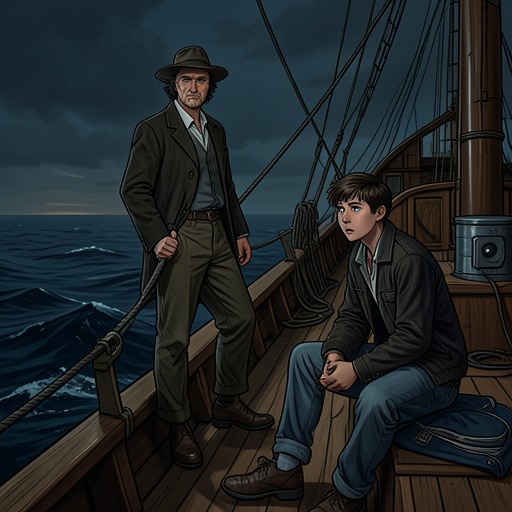
The Hermit enters the final rescue scene as a third figure aboard the approaching boat, alongside the Pilot and the Pilot’s Boy. The Mariner hears the dash of oars and the Pilot’s cheer before he turns toward the rescuers; when he identifies the Hermit, he recognizes the man’s voice and names him as the good Hermit. The moment makes the anticipated meeting concrete: the voice from the wood has come out over the water to meet the returning ship.
The rescue is not free of fear. The Pilot calls the ship fiendish-looking and admits that he is afraid, while the Hermit answers cheerily, urging him to push on. That contrast establishes the Hermit’s composure within a scene where the wrecked ship and its dead crew make approach alarming. His words help carry the boat closer, bringing the Mariner to the encounter he has already anticipated.
The Mariner’s Confession
After the ship sinks and the Mariner stands on firm land in his own country, the Hermit steps out of the boat and can scarcely stand. The Mariner immediately addresses him as a holy man and begs him to shrieve him. The Hermit crosses his brow and tells him to speak quickly. The brief exchange sets confession in motion: the Mariner’s urgent appeal meets a religious gesture and an invitation to tell what has happened.
The Hermit’s importance lies in this role as listener and confessor, rather than in any extended account of his life. The poem first presents his hymns as a sound associated with the wood, then brings that voice into the rescue, and finally places him face to face with the Mariner’s plea. In this sequence, arrival at home becomes more than physical survival. The Hermit offers the human and spiritual point of contact through which the Mariner can begin to give an account of the blood on his conscience.