The Albatross Is Hung Around the Mariner’s Neck
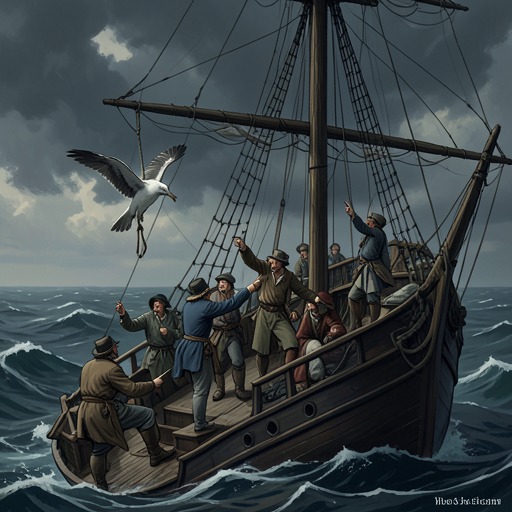
The Rime of the Ancient MarinerThe Albatross Is Hung Around the Mariner’s Neck makes the Ancient Mariner’s responsibility for killing the bird visible: the dead Albatross is hung about his neck in place of the cross. The act follows the crew’s shifting explanations of the wind and weather, and gives their judgment a physical emblem. Yet the emblem does not settle the crew’s own responsibility. Its changing responses reveal a group that first condemns the killing, then accepts it as justified, even as the burden remains on the Ancient Mariner.
Causes and Changing Judgment
The voyage begins as ordinary collective labor: the ship is cheered from the harbour and drops below the kirk and hill. Later, a powerful storm drives the vessel, and a south wind rises behind it. The Albatross follows the ship, accompanying the mariners through this altered weather. The poem’s sequence links the bird’s arrival with the wind that helps the ship move, so the Ancient Mariner’s later killing of it becomes consequential in the crew’s account of their fortunes.
At first, the mariners agree that the Ancient Mariner has done a terrible thing: they say that he killed the bird that made the breeze blow, and reproach him for slaying it. But their verdict changes when the weather changes. When the sun rises and the fog and mist are associated with the bird, they again agree that he killed it, this time adding that the bird had brought the fog. They then call the killing right. The same act is thus judged first as a wrong against the source of a favorable breeze and then as a proper response to mist. The crew’s approval does not erase the deed; it makes their moral judgment contingent on the conditions they attribute to the bird.
The Hanging of the Bird
After the crew’s judgments have turned, the poem describes the Ancient Mariner receiving hostile looks from people both old and young. Instead of a cross, the Albatross is hung about his neck. The cross is named as the object displaced, giving the bird’s placement a religious contrast without explaining it away: a creature killed by the mariner now marks him in the position of a familiar emblem.
The hanging makes the consequences of the killing legible on the mariner’s person. The crew’s earlier words assign blame; the bird at his neck gives that blame a continuing visible form. The poem does not present a separate speech or ceremony at the moment of hanging, nor does it specify who performs the act. What it does establish is the sequence of condemnation and the substitution itself: the crew’s changed verdicts precede the Albatross taking the cross’s place.
Consequences and Narrative Significance
The action concentrates the poem’s movement from a disputed judgment to an enduring sign of responsibility. The mariners’ explanations shift with the weather, but the bird remains attached to the Ancient Mariner as the emblem of what he did. In that contrast, the episode distinguishes collective convenience from personal consequence: the crew can call the killing right when the fog appears, while the mariner still bears the bird.
The voyage’s later scenes retain the tension between visible action and uncertain cause. The helmsman steers and the ship moves on despite there being no breeze, and the dead crew later rise and work the ropes. These developments place the hanging within a larger narrative where ordinary sailing labor continues alongside events that exceed ordinary explanation. Near the later approach of help, the Ancient Mariner hears the sound of oars and the Pilot’s cheer, but his head is turned away by force. The poem’s recurring attention to ship, wind, steering, and rescue keeps the bird’s emblem grounded in a voyage, while its substitution for the cross makes the burden personal and moral as well as practical.