The Mariner’s Supernatural Return Home
The Rime of the Ancient MarinerThe Mariner’s Supernatural Return Home brings the ship back to its harbour under a motion that seems gentle yet exceeds ordinary seamanship. The ship sails without a breeze and then flies swiftly while moving softly; at the harbour-bar, the Mariner recognizes the coast through the paired landmarks of hill and kirk. But home is not a simple release: the dead crew lie flat on deck as luminous figures stand over them, and the sound of rescuers’ oars arrives within a scene that remains charged with supernatural presence.
A Voyage Moved by More Than Wind
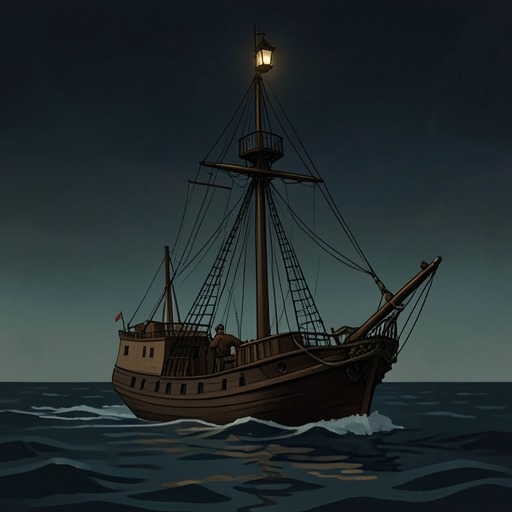
The return begins with a reversal of the usual terms of sailing. The helmsman steers and the ship moves on, but no breeze blows. Later, the ship flies swiftly and still sails softly, while a breeze is heard to blow sweetly. The juxtaposition makes the vessel’s progress feel at once physically legible and uncanny: steering and wind belong to recognizable navigation, yet the movement is not reducible to them.
That tension reaches back to the voyage’s earlier departure and ordeal. The ship had once been cheered as it cleared the harbour, then driven onward by a tyrannous Storm-Blast; after the ice split, a good south wind sprang up behind it. On the homeward course, however, the movement without a breeze makes propulsion itself seem uncertain. The poem retains the visible labor of navigation while placing the ship’s passage within a force that ordinary weather cannot fully explain.
The Harbour and the Prayer of Return
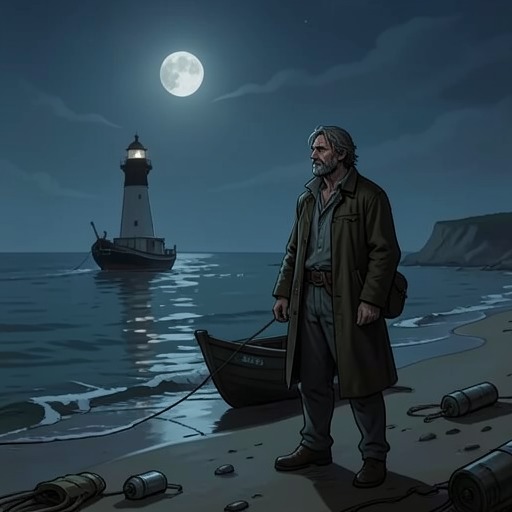
The coast becomes recognizable through the Mariner’s questions about whether the hill and kirk are the ones he knows and whether the land is his own country. The ship drifts over the harbour-bar, a concrete threshold between open water and home waters. The harbour-bay lies clear as glass, its surface smoothly strewn with moonlight. The stillness of this arrival contrasts with the earlier storm-driven departure, but its calm does not erase the Mariner’s fear.
As the vessel crosses the bar, he prays with sobs and asks God either to let him be awake or to let him sleep always. The plea holds two incompatible wishes together: to awaken into the reality of home and to escape that reality through unending sleep. The harbour is therefore both the destination of the voyage and the setting of an unresolved crisis. Recognition of country does not restore the Mariner to uncomplicated safety; it makes the distance between homecoming and peace newly apparent.
The Dead Crew and the Seraphic Vision
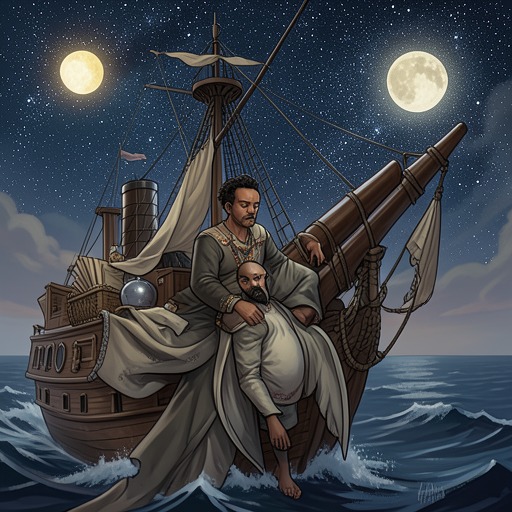
When the Mariner turns his eyes to the deck, he sees every corpse lying flat and lifeless. Over each one stands a figure described as a man all light, a seraph-man. The band waves its hands, and the figures stand as signals to the land. Their gesture is at once a visible sign from the ship and a supernatural spectacle: the dead remain dead, yet the scene above them is transformed by heavenly light.
The vision does not become a conversation or explanation. There is no voice, but the silence sinks into the Mariner’s heart like music. That inward effect distinguishes this moment from the outward signals and sounds surrounding it. The seraphic figures can be seen from the ship and stand as signs toward land, while their wordless presence brings a quiet response within the Mariner rather than a spoken account of what has happened to the crew.
Rescue, Recognition, and the Limits of Return
The vision is followed by an unmistakably practical sound: the dash of oars and the Pilot’s cheer. Rescue approaches by boat, connecting the supernatural voyage to the ordinary work of reaching a harbour. The Mariner’s head is turned away by force, however, so that the arrival of human help does not yield a free or sustained view of the scene. The movement from seraphic silence to the sound of the oars does not settle the meaning of the return; it places rescue beside an experience the Mariner cannot simply choose to face.
The wider account frames the homeward passage with the Mariner’s dependence on religious mercy and his continuing obligation to speak. At an earlier moment, a voice addresses him as the ancient Mariner and asks why he looks as he does, while he is still holding the crossbow; elsewhere, his effort to pray is interrupted before a prayer can emerge. During the return, he gives praise to Mary for the gentle sleep sent from Heaven. At the end of his tale, he tells the Wedding-Guest that the one who loves well prays well, extending the lesson to man, bird, and beast. The homecoming thus belongs to a longer change in the Mariner’s relation to prayer: its relief is real, but it culminates not in silent restoration to ordinary life, but in a continuing charge to recount what he has endured.