The Ship Is Becalmed
The Rime of the Ancient MarinerThe Ship Is Becalmed is the ship’s abrupt loss of movement after it has emerged from the polar ice into a silent sea. The wind that had carried it forward dies, leaving the vessel stranded beneath a hot, copper-colored sky. With water all around but none to drink, the crew’s physical distress becomes an emblem of the voyage’s reversal: the sea that had been a route through danger becomes an enclosing, life-denying expanse.
From departure to entrapment
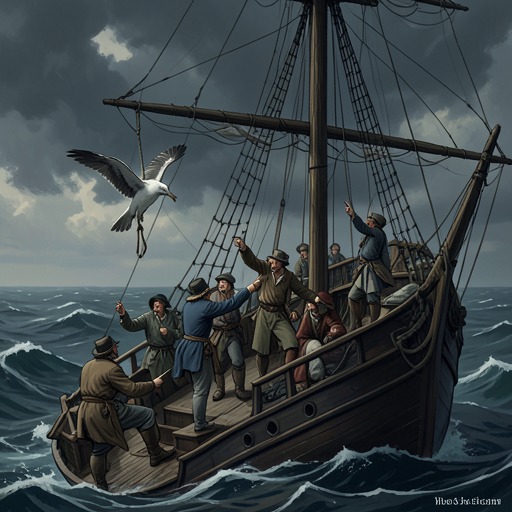
The becalming interrupts a voyage that began with apparent freedom. The ship is cheered from the harbor and passes below the kirk and hill; later, the tyrannical Storm-Blast drives it southward, into mist, snow, and mast-high ice. When the ice splits, the helmsman steers the vessel through, and a good south wind rises behind it. The Albatross follows the ship during this renewed movement, linking the passage out of the ice with the bird’s presence aboard.
The ship then enters what the poem calls the silent sea. A fair breeze drives it forward, white foam flies, and the vessel is described as the first ever to burst into that region. But the favorable motion does not last: the breeze drops, the sails fall, and the crew speaks only to break the stillness. The reversal is stark. A ship that has been driven hard by storm and propelled by wind becomes motionless through the wind’s disappearance.
The becalmed ship and its crew
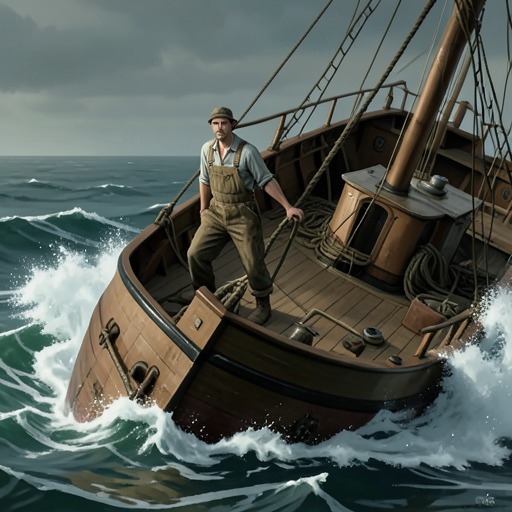
The stillness is not peaceful. The Sun stands at noon above the mast in a hot, copper sky, appearing no bigger than the Moon. Day after day, the ship remains without breath or motion, compared to a painted ship on a painted ocean. That simile makes the vessel seem less like a working craft than an image fixed in place: its sails cannot carry it, and the surrounding sea offers no passage onward.
The crew’s suffering intensifies inside this unnatural pause. Water lies everywhere, yet it cannot relieve their thirst; the boards shrink, and, through utter drought, every tongue withers at the root. The deprivation reaches beyond discomfort to speech itself: the sailors cannot speak. The sea’s abundance and the crew’s need are held together in a cruel contradiction, as the visible water offers no usable drink.
Narrative setting and significance
The becalming follows the passage through the ice and the ship’s entry into the silent sea, but its stillness differs from the earlier polar danger. There, ice surrounded and obstructed the vessel while the Storm-Blast drove it onward; here, wind and motion vanish, and heat and thirst govern the scene. The ship is trapped not by an opposing force that visibly strikes it, but by the absence of the force it needs to move.
This physical stoppage gives the poem’s supernatural voyage a concrete maritime predicament: wind, sails, steering, and the condition of the ship determine whether the crew can travel, while the sailors’ bodily needs set the cost of being unable to do so. The dead stillness also sharpens the contrast between the ship’s earlier movement and its present helplessness. The ship is surrounded by water but cannot drink, and the vessel that crossed the ice under a following wind is reduced to the image of a painted ship, stationary on a painted sea.