The becalmed ship
The Rime of the Ancient MarinerThe becalmed ship names the Ancient Mariner’s vessel in its most punishing condition of immobility: after the ship enters the silent sea, the breeze falls away, the sails droop, and water becomes an all-enclosing but unusable presence. The scene makes the familiar promise of a sea voyage cruelly contradictory. There is water everywhere, yet none to drink; the ship is surrounded by motionless ocean, yet cannot move. Heat, silence, thirst, and the rot of the deep turn a stretch of open water into a place of confinement.
From Passage to Stasis
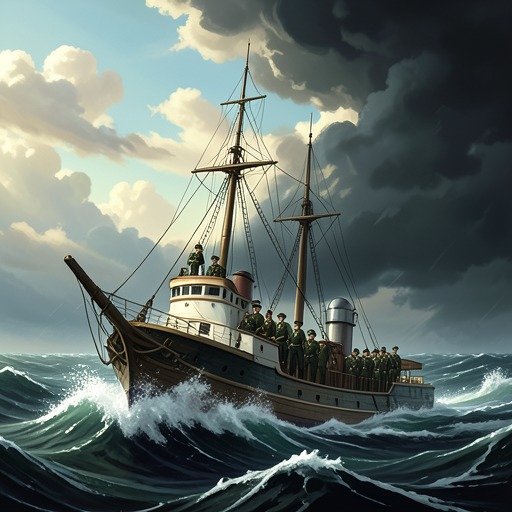
The ship’s arrest follows a brief sense of forward passage. A fair breeze had filled the sails, white foam flew, and the ship’s furrow followed freely as the crew entered a sea described as silent. Then the breeze dropped and the sails fell. The change is both practical and abrupt: the wind that had carried the vessel no longer serves it, and the sailors speak only to break the silence around them. The poem’s repeated account of the breeze and sails dropping makes the loss of propulsion the hinge between travel and ordeal.
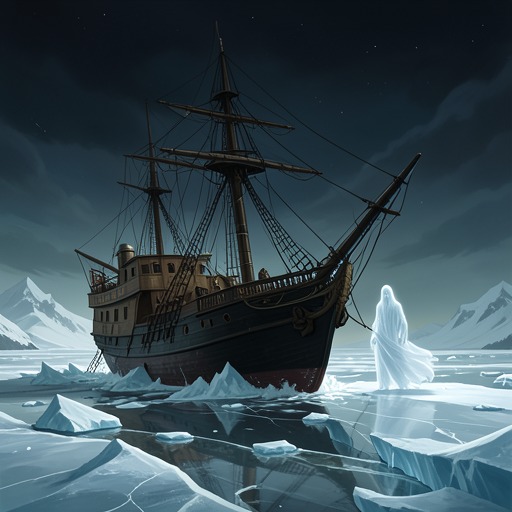
The stillness is not simply a pause in the voyage. The vessel remains at sea, far from any stated refuge, while its means of progress fail. The comparison to a painted ship upon a painted ocean gives the dead calm the unnatural fixity of an image: ship and sea seem present, but movement has vanished from both. The simile sharpens the contrast between the ship’s earlier passage through the water and its present inability to alter its position.
Heat, Water, and Bodily Deprivation
The calm is set beneath a hot, copper-colored sky. At noon the bloody Sun stands directly above the mast, appearing no bigger than the Moon. The detail gives the sailors no relief from the heat and places the motionless ship beneath an unchanging overhead presence. Against that sky, the repeated declaration that water lies everywhere only to offer no drink makes the sea’s abundance an instrument of deprivation. The boards shrink as the crew endures the drought, registering the ordeal in the material surroundings of the vessel as well as in the bodies aboard it.
Thirst progressively strips the crew of speech. Every tongue is withered at the root through utter drought; the sailors cannot speak, as though speech itself has been taken from them. Earlier, their words had served only to interrupt the sea’s silence. Now bodily deprivation closes even that small outlet. The movement from speaking to break the quiet to being unable to speak gives the stillness a human cost: the ship’s inactivity is matched by the crew’s diminishing capacity to act or communicate.
A Sea That Turns Hostile
The water is not represented as a neutral surface around the stranded ship. The very deep appears to rot, and slimy things crawl with legs. This uncanny life makes the surrounding sea seem altered, not merely inaccessible. The sailors are trapped between an abundance they cannot drink and a deep whose visible condition inspires revulsion. Their predicament is thus environmental as well as mechanical: the ship cannot go forward, and the ocean offers neither sustenance nor reassurance.
The crisis follows the ship’s entry into a silent sea and its subsequent loss of wind. In the wider voyage, the vessel had been driven southward by the powerful Storm-Blast, then passed into mist, snow, and towering ice before a good south wind sprang up behind it. The fair passage into the silent sea therefore gives way to a different danger: not violent weather or obstructing ice, but the absence of wind itself. The becalming converts exposure into enforced waiting, with heat and thirst replacing the cold and motion of the earlier passage.
Duration and Isolation
The poem stresses duration through the refrain of day after day: the crew remains stuck, without breath or motion. The repeated phrase refuses the quick resolution associated with a passing lull. Time accumulates while the ship stays fixed, and the painted-ship comparison makes each day seem to reproduce the same motionless scene. The result is not only delayed travel but a deepening sense that ordinary measures of passage no longer help the crew escape their condition.
The Ancient Mariner later describes himself as alone on a wide sea, and he sees the moving Moon rise and continue across the sky without abiding. These details set his isolation against a heavenly body that keeps moving while the ship and its people remain caught in the calm. The moon’s motion does not offer rescue; it makes the contrast between celestial passage and human immobility more pronounced. The becalmed ship’s ordeal thus supplies the physical setting for an experience of isolation that is as temporal as it is spatial.
Consequences and Significance
The windless state persists into the episode in which the dead sailors rise and work the ropes. The helmsman steers and the ship moves on, yet no breeze blows. This later motion marks a sharp contrast with the becalming: the vessel can again travel, but its movement is no longer explained by ordinary wind or by the living crew’s labor alone. The dead crew’s work follows the prolonged stasis as an uncanny reversal of the ship’s earlier helplessness.
The episode’s force rests on a precise inversion: the sea, which should carry a ship, becomes the setting of immobility; water, which should sustain life, becomes undrinkable; and the crew’s voices, which briefly break the silence, are withered by thirst. By making these contradictions recur through windless sails, shriveling boards, a moving Moon, and a decaying deep, the poem turns the becalming into more than a navigation hazard. It is the material form of the voyage’s confinement, with each passing day making the distance between apparent abundance and actual survival harder to ignore.