The curse of the dead men’s eyes
The Rime of the Ancient MarinerThe curse of the dead men’s eyes makes the deaths of the crew an unending presence for the Ancient Mariner. Their bodies fall, but the look fixed on him does not pass away; he must watch it for seven days and seven nights, unable to die or pray. The curse turns a moment of collective death into lasting isolation, making sight itself the means by which guilt and suffering endure.
The deaths that give the curse its force
The curse follows the sudden deaths of the crew. Beneath the Moon, each man turns his face with a ghastly pang and curses the Ancient Mariner with his eye. Four times fifty living men fall one by one, without a sigh or groan; their souls leave their bodies for bliss or woe. The silent collapse gives the curse its terrible form: the men cannot speak, yet their faces communicate the accusation that survives them.
The scale of the loss is sharpened by the contrast between the crew’s former presence and the Ancient Mariner’s survival. He assures the Wedding-Guest that he did not fall with the others, but the reassurance only marks his exceptional sentence: he is left alone on a wide sea, with no saint taking pity on him. The curse is therefore not simply the memory of dead companions. Their eyes remain present to the one living witness, isolating him amid the very people whose deaths have left him alone.
A gaze that death cannot erase
The dead bodies do not decay. The cold sweat melts from their limbs, but there is neither rot nor stench; instead, the look with which they regarded the Ancient Mariner remains unchanged. This arrest of ordinary bodily change makes the eyes the enduring element of the scene. The corpses are at his feet, and their gaze continues to act upon him after their deaths, as though the final moment of accusation has been held in place.
The poem names the force of that gaze as worse than an orphan’s curse, which could drag even a spirit from on high to Hell: a curse in a dead man’s eye is more horrible still. The comparison gives the image a supernatural reach, while keeping its source concrete and intimate. The threat is not an unseen power at a distance but the dead men’s unaltered look, fixed on the person who remains beside them.
Seven days and nights of enforced witness
For seven days and seven nights, the Ancient Mariner sees the curse and still cannot die. The duration makes the punishment more than a moment of shock: it is an imposed vigil in which neither death nor release intervenes. The Moon moves up the sky and does not abide, passing through the scene while the gaze persists. Against that measured movement overhead, the curse remains fixed below, binding the Ancient Mariner to the dead.
The imagery of the earlier voyage intensifies this isolation without displacing the eyes as the curse’s center. Mist and snow have surrounded the ship; ice has enclosed the sea, and later the Sun stands in a hot, copper sky. When the crew has fallen, the Ancient Mariner is alone on the wide sea. These sharply different conditions—polar cold, a bloody noon Sun, and open-water solitude—frame a punishment that does not depend on any single landscape: wherever the survivor is left, the dead men’s gaze remains with him.
The spell breaks, but prayer remains out of reach
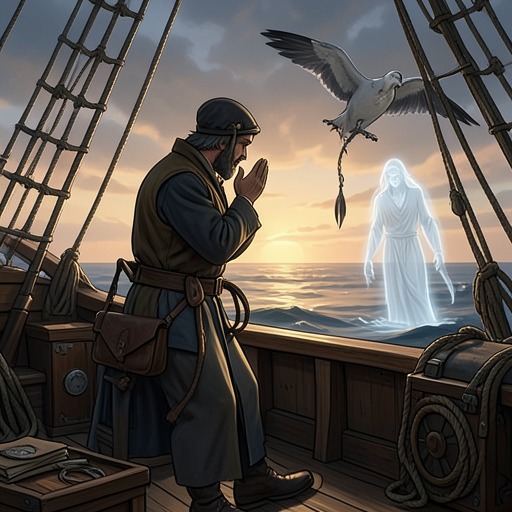
When the Ancient Mariner later sees the dead crew again, their stony eyes glitter in the Moon, and the pang and curse with which they died have not passed away. He cannot draw his eyes from theirs, nor turn them up to pray. The curse thus works through both fixation and deprivation: he is compelled to look at the men, while the act of looking prevents the upward turn that prayer would require.
At last the spell snaps, and he sees the green ocean once more. The breaking of the spell changes what he can see, but the preceding scene defines the curse by its persistence: the faces held their expression beyond death, and the Ancient Mariner remained alive through seven days and nights of their witness. The episode makes the dead crew’s eyes more than a sign of past loss. They are the continuing bond between the deaths and the survivor’s suffering, an image of guilt that cannot be escaped simply by outliving its victims.