The spirit-driven ship
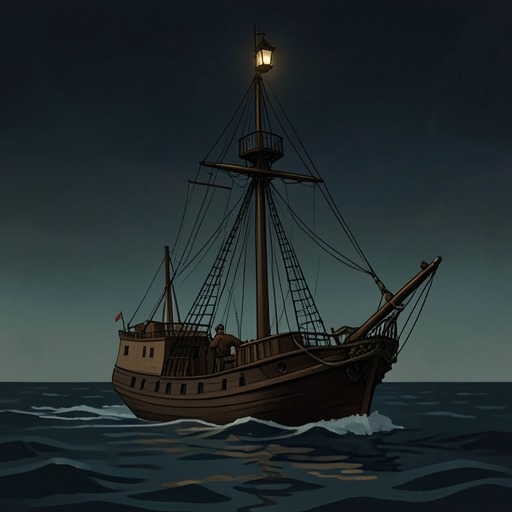
The Rime of the Ancient MarinerThe spirit-driven ship is the Ancient Mariner’s vessel moving across a windless sea by supernatural agency. Its motion reverses the ordinary logic of sailing: the ship travels smoothly and swiftly although no breeze fills its sails, while the ocean lies still. The ship is neither simply stranded nor freely underway; an unseen power carries it onward, making its return a continuation of the Mariner’s supernatural ordeal.
From Departure to Windless Motion
The voyage begins in recognizable maritime activity. The ship is cheered as it leaves the harbour and passes below the kirk and hill; later, after the ice splits, the helmsman steers through and a good south wind rises behind the vessel. The Albatross follows, accompanying the ship in its daily passage. These details establish a contrast between the ship’s earlier movement under wind and seamanship and the later motion that no ordinary sailing conditions can explain.
That contrast becomes decisive when the wind no longer reaches the ship, yet the vessel moves on. The helmsman continues steering, and the mariners work the ropes, so the familiar labor of navigation remains visible even as its normal cause has disappeared. The scene presents motion without breeze not as a sailor’s mistake or a sudden change of weather, but as an uncanny fact that the crew can witness without controlling or accounting for it.
A Voyage Without Wind
The ship continues quietly until noon, sailing slowly and smoothly despite the absence of any breathing breeze. The poem makes this movement especially strange through the difference between the ship’s steady progress and the still air around it. The sails’ tune ceases at noon, yet the vessel’s passage is not thereby explained as a result of wind. The calm is not ordinary rest: the ship continues to travel through it.
The supernatural cause is then made explicit. A spirit slides beneath the keel, nine fathoms deep, and that spirit makes the ship go. The explanation fixes the source of the ship’s motion below the visible surface and outside the ordinary means of navigation. The ship’s progress is real, but its agency is not human: seamanship remains present in the helmsman and the rope-working mariners, while the force that actually propels the vessel belongs to the spirit.
The Ocean and the Unseen Force
In a later exchange, two voices ask what makes the ship drive so fast and what the ocean is doing. The answer emphasizes that the ocean has no blast and stands still before a greater power; the ship is moving without either wave or wind. The voices further describe the air as cut away before the vessel and closing behind it. This image gives the windless passage a strange order: the ship’s way is made open in front of it, while the air closes in its wake.
The exchange does not offer a practical account of navigation. Instead, it makes the ship’s unnatural speed legible through a dialogue that observes the still sea and the apparently manipulated air. The question is repeated because the vessel’s movement remains startling even to those describing it. The spirit’s intervention thus appears not as a visible sail or a strong wind, but as a hidden power that alters the conditions through which the ship passes.
Meaning and Consequences
The spirit-driven motion binds supernatural agency to the material details of a working ship. A keel, a depth of nine fathoms, the helmsman’s steering, and the mariners’ work on the ropes preserve the texture of maritime labor; yet none of these ordinary actions explains why the vessel advances. The ship’s body is carried through a world where the expected relation between wind, ocean, and travel has broken down.
This motion also distinguishes the vessel’s passage from simple becalming. A ship without wind might be expected to lie idle, but this one proceeds smoothly and, as the voices recognize, swiftly. The paradox makes its progress feel both purposeful and imposed: it is going somewhere, but the power deciding and driving that movement is not the crew’s. The spirit-driven ship therefore gives physical form to the supernatural character of the Mariner’s return, turning the voyage home into another stage of the force that governs his experience.
The passage eventually approaches human rescue: the Mariner hears the dash of oars and the Pilot’s cheer. That sound marks a change in the scene from isolated, unexplained motion toward the approach of other people, without making the ship’s prior propulsion any less mysterious. Its windless journey remains a crossing between ordinary seamanship and supernatural compulsion, sustained by a force that moves unseen beneath the keel.