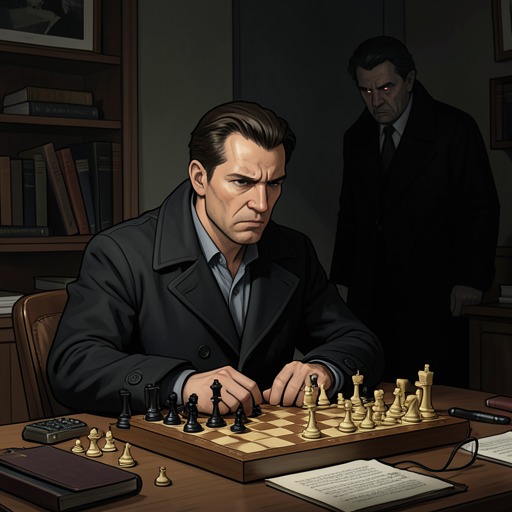
Chess almanac of 150 grandmaster matches
The Royal GameThe Chess almanac of 150 grandmaster matches begins as a small book in a Gestapo overcoat pocket and becomes Dr B’s principal defense against the enforced emptiness of his cell. Its printed games supply both an external structure to memorize and, eventually, a complete mental world; yet when repetition drains that world of novelty, the almanac’s limits drive Dr B toward the dangerous attempt to play chess against himself.
Discovery and Theft
During an interrogation visit, Dr B waits for two hours in an anteroom, where the unfamiliar room and its contents offer relief from the sameness of his cell. His attention fixes on a slight bulge in one of the military overcoats. After recognizing the outline as a book, he edges closer and confirms its shape through the cloth. He slips it from the pocket while keeping his hands behind his back and his eyes on the guard.
The theft must be concealed through the interrogation and the walk back to his room. Dr B hides the slim volume at his waist, holding it in place against his belt as he moves. When it slips in the corridor, he bends to recover it under cover of a simulated coughing fit. The book thus enters the cell not as a planned resource but as a risky, nearly accidental answer to the deprivation around him.
An Unexpected Chess Text
Dr B initially expects the book to offer demanding reading, perhaps poetry or a major literary work. Instead, its pages contain only a collection of 150 grandmaster matches: diagrams and chess notation that at first appear unintelligible. He knows chess only as a game he occasionally tried as a schoolboy, and the text seems unusable without a partner, pieces, or board. The discovery disappoints him because the book is not the kind of reading he had imagined and cannot immediately provide an ordinary game.
He gradually deciphers the notation, understanding that letters mark the board’s columns and numbers its rows. To make the recorded positions playable, he folds his checked bedcover into a sixty-four-square board and shapes chessmen from saved bread crumbs, darkening some with dust to distinguish the two sides. The crude pieces repeatedly confuse him; he has to restart the first match many times. After six days, however, he can play it through correctly. Eight days later he can visualize the positions without the crumbs, and after another eight days he no longer needs the bedcover. The almanac’s abstract symbols have become a three-dimensional board in his mind.
Memory as Occupation
Once the games can be played blind, the book changes from a difficult text into a means of organizing time. Dr B divides each day into two matches in the morning, two in the afternoon, and a brief evening review. The schedule gives shape to days previously marked by waiting and supplies an activity that can occupy his attention without exhausting it. The 150 recorded games are finite, but their complexity makes them an effective counter to the cell’s monotonous conditions.
Repeated play also changes what he can see in the almanac. The games first serve as sequences to reproduce; gradually, Dr B recognizes their attacks, defenses, calculations, and counter-moves, as well as the distinctive styles of individual grandmasters. He comes to regard the players whose games he studies as companions in his isolation. By practicing responses to threats and concealed maneuvers on the chessboard, he also becomes more composed in interrogations and stops yielding ground as he had before. The same remembered positions that occupy his private hours help him resist questioning.
Repetition and Its Limit
The almanac’s relief lasts roughly two and a half to three months. Dr B plays each match twenty or thirty times, and the stored sequences become so familiar that an opening brings the rest of the game automatically to mind. Surprise, suspense, and the effort of solving the positions disappear. What had given the days structure now repeats without providing the fresh problem he needs.
Because another book of games is unavailable, Dr B sees only one way to sustain the activity: invent new games by competing against himself. The almanac therefore has a double consequence. Its limited set of matches makes mental discipline and resistance possible, but their exhaustive memorization leaves him without further material. The move beyond the book is not a continuation of its security; it is a new and unstable form of play.
Return to the Real Board
After his release, Dr B’s memory of the cell is difficult to access. He says that attempts to recall it seemed to make the lights go out in his brain, and that he found the courage to remember only weeks later, aboard the ship. The almanac’s role in the story is consequently conveyed through a recollection that itself describes a period of mental isolation and subsequent difficulty remembering it.
When Dr B later sees other passengers playing at a real chessboard, he has to remind himself that their game is the same game he attempted alone. The remembered notation and imagined pieces must be translated back into movable objects and two bodily present opponents. A move he considers false prompts him to intervene, an impulsive response that he subsequently recognizes as improper. He agrees to play one match as a test of whether his solitary chess was genuinely chess or a fevered form of it, while making clear that he fears returning to the obsessive state. The almanac has enabled his survival of the cell’s empty routine, but its memorized games also lead toward a practice he now regards with apprehension.