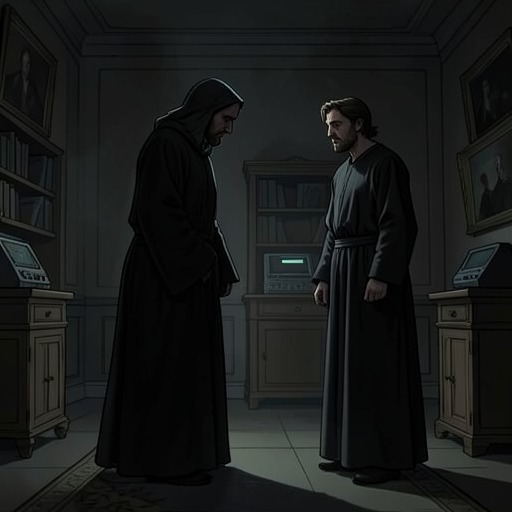
Divine Love and Infernal Competition
The Screwtape LettersDivine Love and Infernal Competition names the opposing accounts of existence that structure Screwtape’s advice: Hell regards every self as a rival to be diminished or absorbed, while the Enemy seeks communion that preserves the freedom and distinctness of those who enter it. The letters present this contrast through the tempter’s own arguments, whose confident denial of love repeatedly exposes the limits of his competitive worldview.
Two Incompatible Accounts of the Self
For Screwtape, the foundational rule is that one thing cannot be another and one self cannot be another self. Good is therefore exclusive: what one gains, another loses. Even physical existence appears to him as a contest for space, and the same rule governs personal relations. Hell’s ideal is not mutual flourishing but the transfer of a weaker will into a stronger one. Screwtape compresses this account into the claim that “To be” means “to be in competition”.
The Enemy’s supposed alternative looks incoherent from that perspective. He seeks many beings who are also one: the good of one self can become the good of another without either being erased. Screwtape dismisses this as contradiction, yet his own description identifies the distinction on which the opposing vision depends. The Enemy does not simply absorb creatures into himself; their wills are to conform freely to his while they remain distinct. Unity, in this account, is not possession by a stronger self but a relation among selves that continue to exist.
That difference is stated through two contrasting images of what each side wants to make of humanity. Hell wants cattle that become food; the Enemy wants servants who become sons. Hell sucks in, seeking to enlarge itself at another’s expense, whereas the Enemy gives out from fullness. The contrast reverses the apparent measure of power: the infernal side treats dependence and absorption as victory, while the Enemy’s power is expressed in the ability to give without consuming the recipient.
Freedom, Love, and the Troughs
The argument becomes practical in Screwtape’s account of spiritual dryness. Human beings, he says, are both spiritual and animal, directed toward eternity yet subject to bodily and emotional change in time. Their lives move through peaks and troughs, and a period of diminished religious feeling is not in itself proof that temptation has succeeded. Screwtape warns that the Enemy may use such low periods more decisively than moments of emotional warmth.
The reason is that the Enemy seeks willing relationship rather than mere compliance produced by overwhelming evidence or irresistible presence. If divine presence were made unmistakable in a way that overrode the human will, it would defeat the purpose of a union in which creatures remain themselves. Screwtape describes the Enemy as one who can woo but cannot ravish: the creature is to become one with him without being cancelled or assimilated. After an initial period of felt support and emotional sweetness, that support may recede from conscious experience, leaving a person to perform duties that no longer feel rewarding. Continued obedience under those conditions is, in Screwtape’s account, precisely the kind of freely sustained action the Enemy wants.
This logic makes the trough a test not of emotional intensity but of intention. A person who no longer desires religious action yet still intends to do the Enemy’s will may appear to have been abandoned; Screwtape admits that this is a moment of exceptional danger for Hell. The tempter can exploit dryness only if he persuades the person to treat a changing feeling as the measure of faith. The Enemy’s aim, as the letter presents it, is instead a will capable of acting without the inducement of immediate consolation.
Love in Creation and Human Relations
Screwtape applies the same conflict to sexuality, marriage, and family. Hell attempts to separate sexual desire from affection and responsibility, while the Enemy has joined desire with affection and made offspring dependent on parents, drawing them into continuing support. Screwtape’s complaint is that sex and family life thereby become further occasions for love: relationships bind individuals together without reducing them to a single undifferentiated self. The family is presented as a particularly difficult case for Hell because its members remain distinct while being joined through conscious responsibilities.
The letters also set out a deliberate distortion of marriage. Hell encourages people to treat the short-lived experience called being in love as the only respectable basis for marriage, and to expect marriage to preserve that excitement indefinitely. When the excitement fades, the same assumption can make the bond appear no longer binding. Screwtape’s account distinguishes that transient feeling from the Enemy’s design for fidelity, fertility, and goodwill: emotional intensity may precede a marriage formed around those commitments, but it is not the foundation that makes them possible.
Screwtape’s discussion of sexual union further unsettles his competitive premise. He invokes the description of husband and wife as “one flesh”, then notes that the significance attributed to intercourse is not confined to the feelings or intentions with which a couple approaches it. In his account, a lasting relation is established between the participants whether or not they welcome that implication. The passage thus presents embodied connection as a challenge to the idea that selves are sealed units whose contact can only be rivalry or appropriation.
Screwtape’s Denial and the Narrative’s Counterevidence
In a later letter, Screwtape notices that his own reasoning has created a problem. He has repeatedly warned that the Enemy really loves human beings and desires both their freedom and continued existence, although his doctrine says that one self cannot will the good of another without seeking advantage. He calls his concession accidental and attempts to restore his position: because human beings are distinct from the Enemy, he argues, the Enemy’s love must conceal an undiscovered motive.
The effort to explain that motive becomes an account of infernal ignorance. Screwtape recounts that, when human creation was proposed and the Enemy disclosed that it would involve a cross, Our Father Below demanded an explanation. The Enemy did not give the kind of account Hell expected. Screwtape says that Hell has since treated the unanswered question as an intelligence problem, multiplying theories and research in the hope of discovering what the Enemy gains. He even claims that understanding love would end the war and permit Hell’s return to Heaven. His certainty that love must be a disguise sits uneasily beside his admission that Hell cannot identify the supposed hidden interest.
The preface instructs readers not to accept everything Screwtape says as true and warns that devils are liars. That caution matters here: the account of divine love comes through an opponent who repeatedly translates generosity into appetite because his own system cannot make sense of self-giving. The letters do not ask readers to treat his assertions about the Enemy as neutral exposition. Their contradictions make his interpretive failure part of the subject.
The Patient’s Ending as a Test of the Theory
The patient’s final arrival in the Enemy’s presence supplies a narrative counterpoint to Screwtape’s abstractions. Screwtape reports that the patient recognizes the spiritual figures around him as beings who had been present in moments he had once thought solitary; what had been an obscure awareness of companionship is clarified. He then sees the Enemy. The patient’s response includes self-knowledge and recognition of his sins, but Screwtape stresses that this encounter is not equivalent to the terror the same presence causes a devil. The patient can meet what is unbearable to Screwtape without being annihilated by it.
That ending gives concrete form to the distinction between union and absorption. The patient is received into a greater reality without ceasing to be himself; the relation does not resemble the stronger self consuming the weaker. Screwtape can only describe the outcome as an inexplicable defeat and return to his unanswered question about the Enemy’s purpose. His failure to understand is not separate from the book’s argument: the infernal model of competition cannot account for a love in which the beloved remains free, distinct, and fully alive.