Gluttony of Delicacy
The Screwtape LettersGluttony of Delicacy is appetite disguised as moderation: instead of demanding a large quantity, a person insists on a narrowly defined pleasure and treats the trouble it causes others as negligible. In Screwtape’s account, its small portions and temperate appearance make it harder to recognize than excess, while its consequences reach well beyond the meal. The patient’s mother exemplifies the pattern; Screwtape urges Wormwood to watch for a related opening in the patient himself.
Delicacy Disguised as Restraint
Screwtape presents the strategy as a deliberate redirection of attention. He claims that the demonic campaign against gluttony has concentrated on delicacy rather than excess, helping to deaden human consciences until the subject scarcely troubles sermons or individuals. Because the portions are small, the eater can mistake the appetite for temperance. The relevant measure, Screwtape insists, is not quantity but whether the palate is being used to produce querulousness, impatience, uncharitableness, and self-concern.
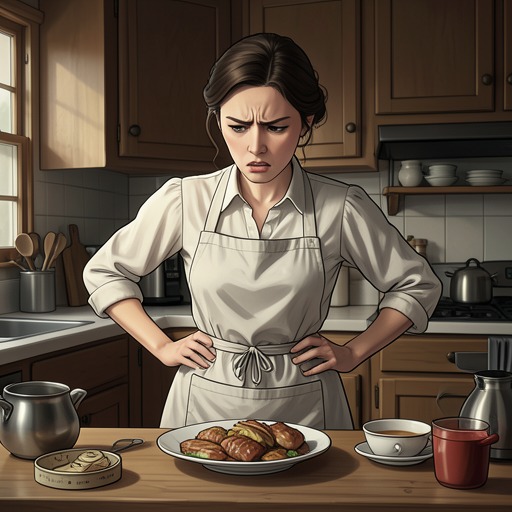
The patient's mother makes that concealment concrete. When food is offered, she turns from it with an air of modesty and specifies tea that is weak but not too weak, together with a very small piece of crisp toast. In a crowded restaurant, she protests that the serving is far too large and asks for about a quarter of it. She could explain the request as an effort to prevent waste, but Screwtape identifies a different cause: the sight of more food than she wants offends her particular standard of delicacy. Her restraint in amount therefore does not mean she is willing to accept what is given; it allows insistence to pass for moderation.
The All-I-Want State
Screwtape describes the mother's condition as the “All–I–want” state of mind. Her requests appear modest and ordinary—a properly made cup of tea, a properly boiled egg, a properly toasted slice of bread—but “properly” conceals a demand for exact, nearly unobtainable palate pleasures. She imagines these as remembered standards from the past, which she recalls as the days when one could get good servants. Screwtape recasts that nostalgia: the past felt more satisfying not because service met an exacting standard, but because her senses were easier to please and other pleasures made her less dependent on food.
The standard is self-sealing. No servant or friend can reliably satisfy a demand whose apparent simplicity hides an almost impossible degree of exactness. Each failure produces another disappointment, and the repeated disappointments turn the meal into a recurring source of ill temper. The quiet work Screwtape attributes to Glubose is measured not by dramatic excess but by the way the mother's appetite comes to dominate daily life: cooks give notice, and friendships cool. A preference that seems private thus acquires consequences for the people expected to accommodate it.
Self-Justification and Domestic Effects
The mother's self-explanation protects the appetite from scrutiny. If she begins to suspect that she is too interested in food, Glubose redirects her attention toward the claim that she does not care what she eats herself and merely wants things nice for her boy. Screwtape calls this a countermeasure to the Enemy's challenge, not evidence that her appetite is harmless. He says her greed has been a chief source of the boy's domestic discomfort for years. Her stated concern for another person therefore masks a pattern that burdens him.
The contrast between her small requests and their large relational effects is central to Screwtape's account. She may ask for less food, but obtaining the precise version she wants remains paramount; the moral cost lies in the irritation, inconvenience, and cooled relationships generated by that insistence. The disguise also makes the pattern hard to name: she can regard herself as temperate even while other people repeatedly bear the consequences. Delicacy operates not simply as a taste but as a claim on other people's labor and patience.
Wormwood's Opportunity and the Patient
Screwtape warns Wormwood not to neglect gluttony while working on other fronts. The patient is his mother's son, but Screwtape thinks men are less likely to be caught through the mother's “All I want” camouflage. He recommends approaching the patient through vanity: make him think himself knowledgeable about food and proud of having found the town's one restaurant where steaks are properly cooked. What begins as a display of discernment can, Screwtape argues, become habit.
The intended test is not whether the patient eats a great deal. Screwtape wants him to reach a state in which being denied any chosen indulgence—whether champagne, tea, sole colbert, or cigarettes—puts him out. Once deprivation of a particular pleasure governs his response, Screwtape says, the patient's charity, justice, and obedience become vulnerable. The mother's fussiness and the proposed strategy for her son are distinct versions of the same larger method: make appetite seem like a reasonable preference, then let attachment to that preference shape conduct toward other people.
A Wider Method of Managing Desire
Across these examples, Screwtape treats gluttony as a matter of cultivated preference rather than sheer consumption. The middle-aged married couple who visit the patient's office are described as rich, smart, superficially intellectual, and sceptical; Screwtape also notes their fashionable, literary communism. In the same letter he celebrates the use of the patient's social, sexual, and intellectual vanity. This surrounding emphasis on fashionable identity echoes the later advice about food: an appetite can be made to feel like evidence of discernment or belonging, not a weakness. Screwtape's interest is in the posture and habits that follow.
The letters also place delicacy within a broader account of appetite and pleasure. In discussing beauty and sexual taste, Screwtape describes social fashions as capable of directing desire toward difficult or unreal standards. In his discussion of novelty, he likewise argues that a natural pleasure in change can be distorted into an insistent demand for absolute novelty, a demand that diminishes satisfaction while increasing desire and may bring expense and unhappiness. These arguments illuminate the logic of delicacy without making it identical to either topic: an ordinary pleasure is turned into a stricter demand, and the resulting dissatisfaction can be used to move a person away from settled, generous conduct.
Gluttony of Delicacy is therefore important to the book's account of temptation because its appearance contradicts its effect. Small portions look like self-denial; requests for food to be made “properly” sound modest; concern for a son appears generous. Yet Screwtape measures the pattern by its fruits: irritation, demands on others, estrangement, and weakened charity. The episode makes a quiet appetite legible as a moral and domestic force, while showing how the demonic strategy depends on keeping the person who indulges it convinced that nothing improper is happening.