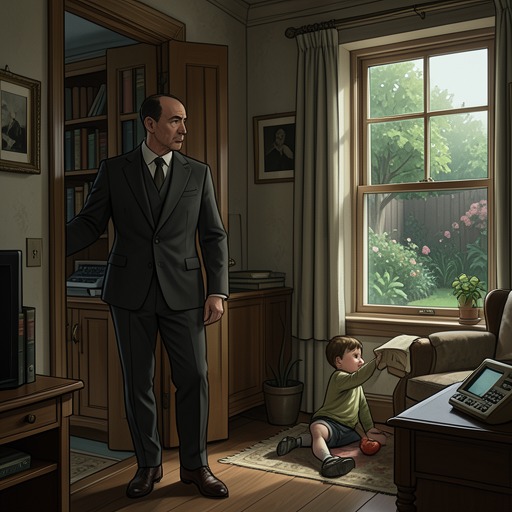
The patient falls in love with a Christian woman
The Screwtape LettersThe patient falls in love with a Christian woman, and the relationship becomes a decisive turn in his spiritual course: it brings him into contact with her family and Christian friends, while frustrating the devils’ attempts to reclaim him. Screwtape’s alarm reveals the courtship’s importance less through any account of its private development than through the consequences he observes: the patient’s social world changes, his spiritual life becomes harder to dislodge, and his attention shifts toward love, duty, and other people.
The Relationship and Screwtape’s Alarm
Screwtape first learns that the patient is in love from Wormwood’s report, and immediately complains that the woman had not appeared in that report. He retrieves her dossier and reacts with open hostility to her Christianity. His description is a hostile tempter’s caricature, not a neutral portrait: the preface cautions readers that Screwtape lies and that the human portraits may not be wholly just. What can be established from the letter is that she is a Christian, that the patient loves her, and that Screwtape regards her influence as a serious threat.
Screwtape’s anger is sharpened by his recognition that Christian pleasure is not, in itself, something the devils can claim. He objects that the world contains ordinary activities—sleeping, washing, eating, drinking, making love, playing, praying, and working—that God permits, and that these must be twisted before they can be used for infernal purposes. The patient’s relationship therefore cannot simply be treated as proof of corruption. Screwtape sees instead that the woman and her Christian surroundings expose the patient to forms of pleasure and companionship that do not naturally serve Hell.
Her Family and Christian Circle
The courtship brings the patient into the woman’s home and into the company of her family and wider circle. Screwtape insists that he should never have entered that house. In his account, its influence extends beyond its residents: the gardener, who has been there for only five years, is beginning to acquire it, and even guests carry something of it away after a weekend visit. The dog and cat, too, are described as affected. The hyperbole belongs to Screwtape’s perspective, but it conveys the reach he attributes to the household’s Christian life.
Most troubling to him is that he cannot explain its relationships through the infernal assumption that each person is exploiting the others. He is certain that the family must be making capital out of one another, yet admits that he cannot discover how. The household thus challenges his governing account of human relations as competition and self-interest. Its mysterious mutuality is not a detail he can resolve; it is precisely what makes the family’s influence so unsettling to him.
By the next letter, the woman and her family have introduced the patient to more Christians every day, including people Screwtape calls intelligent. He predicts that spirituality will remain in the patient’s life for a long time and advises Wormwood to corrupt it rather than expect to remove it. The relationship’s consequence is therefore social as well as intimate: it enlarges the patient’s circle of Christian contact and makes faith more difficult to isolate or dismiss.
A Threat to Infernal Methods
Screwtape’s response also reflects the larger contest over how love and desire are understood. Hell’s philosophy treats selves as separate and competitive: one person’s gain must come at another’s expense. By contrast, the Christian household appears to join distinct people in a shared life without making their closeness reducible to exploitation. Screwtape’s inability to account for the family on his own terms makes the relationship an implicit challenge to his theory, even as he tries to redescribe its goodness as a threat.
The letters elsewhere show how the devils attempt to redirect spiritual practice from God toward manufactured feelings and self-inspection. Screwtape advises Wormwood to distract the patient from prayer’s object and to make him judge prayer by whether he can produce the desired emotion. That general strategy helps explain why the woman’s influence matters: the patient is not merely exposed to religious ideas, but is drawn into an expanding Christian community. Screwtape accordingly proposes a more sophisticated attack, aimed at the border between theology and politics among the patient’s new friends. He considers corrupted spirituality more valuable to Hell than simple worldliness, because a spoiled saint can serve infernal purposes while appearing religious.
War, Duty, and Consequences
As the war draws closer, Screwtape reports that the patient has fallen in love with a very Christian woman and is temporarily immune to attacks on his chastity. The letters do not describe the courtship’s stages or provide a private scene between the couple; they establish its significance through this strategic assessment and through the changes surrounding it. The patient is also occupied with defence work, increasingly attentive to his neighbours, and growing in conscious dependence on God. He finds that attending to his neighbours takes him out of himself and that he likes doing so more than he expected.
These circumstances make the prospect of the patient’s death alarming to Screwtape. Although Wormwood celebrates the expectation of heavy air raids on the town, Screwtape rebukes him: if the patient dies now, the devils lose a soul whose worldly hopes have receded and whose spiritual commitments have strengthened. Screwtape therefore wants the patient kept bodily safe. His preference is not compassion but time: survival would give Hell further opportunities to wear the patient down through the routine of later life, whether through adversity or through prosperity’s attachment to the world.
The woman’s love, her Christian family, the patient’s growing circle of believers, and his wartime service converge as mutually reinforcing pressures against isolation and self-absorption. The episode does not establish the couple’s eventual marriage or describe the woman’s later fate. It does establish why Screwtape treats the relationship as a major reversal in Wormwood’s campaign: through it, the patient enters a community whose unexplained pattern of love resists the competitive logic of Hell, while his own attention turns increasingly toward God and his neighbours.