The patient's parish church
The Screwtape LettersThe patient's parish church is presented as both an unprepossessing local building and a demanding spiritual setting: its ordinary worshippers and imperfect services can disappoint a new convert, yet remaining among them may teach him to receive faith without making the Church conform to his preferences. Screwtape’s account treats the parish’s shared life as a threat to infernal division, even as he tries to turn its visible shortcomings into reasons for contempt.
Appearance and First Impressions
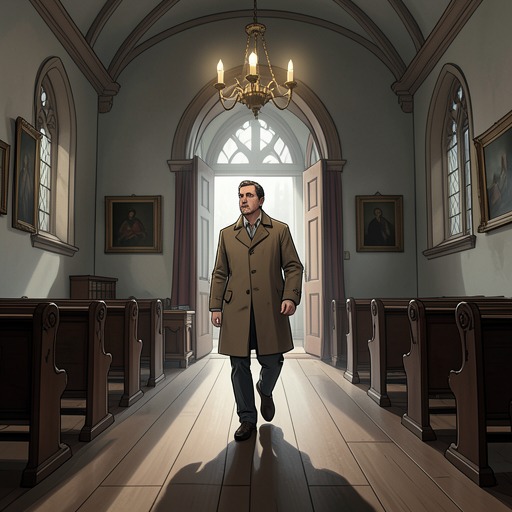
When the patient first enters the church, he sees a half-finished, sham Gothic building on a new estate, not the Church as Screwtape describes it from the perspective of eternity. Inside, a local grocer offers a shiny service book whose liturgy neither he nor the patient understands, alongside a shabby book of small-print, corrupt religious lyrics. The physical books and unfinished building make worship look awkward and ordinary rather than immediately elevated.
The congregation sharpens that impression. The patient sees neighbours he has previously avoided, and Screwtape instructs Wormwood to make him compare the abstract phrase “the body of Christ” with the faces in the next pew. A squeaky pair of boots, an untuneful voice, a double chin, or odd clothes can become, in the patient’s imagination, evidence against the religion itself. His mental picture of Christians is still largely pictorial, filled with togas, sandals, armour, and bare legs; modern clothing therefore jars with the image he expected, even though he does not consciously identify that mismatch.
Screwtape’s strategy depends less on proving that the neighbours are bad than on directing the patient’s attention toward their appearance and away from his own assumptions. The congregation might include a great warrior on the Enemy’s side, but that reality does not help if the patient is busy finding its members ridiculous. Even genuine failings among churchgoers can be exploited: Wormwood is to suppress the obvious question of why the patient’s own claim to Christianity should survive his own faults while theirs supposedly invalidates their faith.
Disappointment and the Work of Worship
Screwtape expects an anticlimax in the patient’s first weeks as a churchgoer and urges Wormwood to make use of it. He presents this disappointment as a familiar threshold in human commitments: the transition from an imagined ideal to the effort of doing the thing itself. Learning Greek after being enchanted by stories of the Odyssey and learning to live together after marriage are his examples. For the patient, the gap between a new religious aspiration and the realities of a local congregation offers a similar temptation to retreat into dissatisfaction.
The crucial issue, in Screwtape’s account, is what the patient does when religious feeling fails to carry him. The Enemy, as Screwtape calls God, does not make people reach their goals by affection and habit alone; the convert must act without being carried by enthusiasm. If he passes through this first dryness, he becomes less dependent on emotion and harder to tempt. The shabby books, imperfect building, and irritating neighbours thus matter not merely as comic details: they are the ordinary conditions under which the patient’s initial ideal must become practice.
Screwtape also identifies the patient’s undeveloped humility as a vulnerability. The patient may talk about his sinfulness while still believing that conversion has earned him a favourable balance in the Enemy’s ledger. He can regard attendance among commonplace neighbours as a condescension on his part, mentally labelling them smug while imagining himself spiritually superior. In that state, the church offers him a stage on which to display his supposed generosity rather than a community in which to recognize his dependence and limitations.
Parish, Preference, and Religious Faction
Later, the patient continues attending one church, and only one, despite not being wholly pleased with it. Screwtape regards this fidelity as dangerous unless it results from indifference. His preferred remedy is to send the patient from church to church in search of one that “suits” him, turning attendance into connoisseurship. The shift is significant: instead of joining a local body and learning within it, the patient would assess congregations according to personal taste.
Screwtape contrasts parish organization, grounded in a shared place, with congregational life organized around likings. A parish brings together people of different classes and psychologies, an inconvenient mixture from the demonic perspective; a church shaped as a club can become a coterie or faction. The patient’s continued attendance at one parish therefore has a communal consequence: it keeps him in contact with people he might not have chosen for himself, rather than letting preference sort worshippers into a more congenial circle.
The parish is not idealized as immune to corruption. Screwtape discusses two nearby churches whose leaders and practices provide different opportunities for distortion: one vicar has watered down the faith and abandoned the lectionary and appointed psalms for a small, repetitive selection; at the other, Fr. Spike’s shifting opinions are linked by hatred, although he genuinely believes. These examples complicate any simple contrast between a good parish and bad alternatives. The danger lies not only in a particular building or minister but in the habits of criticism, evasion, and faction that can take hold within religious life.
Screwtape accordingly urges Wormwood to attach the patient violently to a party within the Church if he cannot keep him away from church altogether. He wants hostility built around differences of usage—such as saying “mass” rather than “holy communion”—and around indifferent matters such as candles and clothing, rather than around substantive doctrine. Such quarrels can turn a community into opposing camps even when neither side can explain the theological distinctions supposedly at stake. The parish’s variety could instead foster charity and humility, but Screwtape says infernal efforts have worked to prevent that outcome.
Narrative Function and Limits of the Account
The church’s significance emerges through Screwtape’s effort to misread it. His letters advise Wormwood to make ordinary imperfections appear conclusive, while his own analysis discloses how much depends on the patient’s attention, expectations, and willingness to remain among unlike neighbours. The shabby books and squeaky boots are small, concrete irritants; the larger contest concerns whether the patient will treat them as grounds for superiority and withdrawal or as part of the unglamorous setting in which religious commitment is lived.
Screwtape is not a neutral guide to the parish. The book’s prefatory warning says that the devil is a liar and that not everything he says should be assumed true, even from his own point of view; it also cautions that his portraits of human beings may be unfair. His description of the church’s defects and his account of its spiritual dangers therefore belong to a deliberately compromised perspective. Yet his attempts to exploit disappointment and faction repeatedly reveal what his side fears: a worshipper who does not require emotional excitement, social polish, or personal preference to remain engaged in shared religious life.